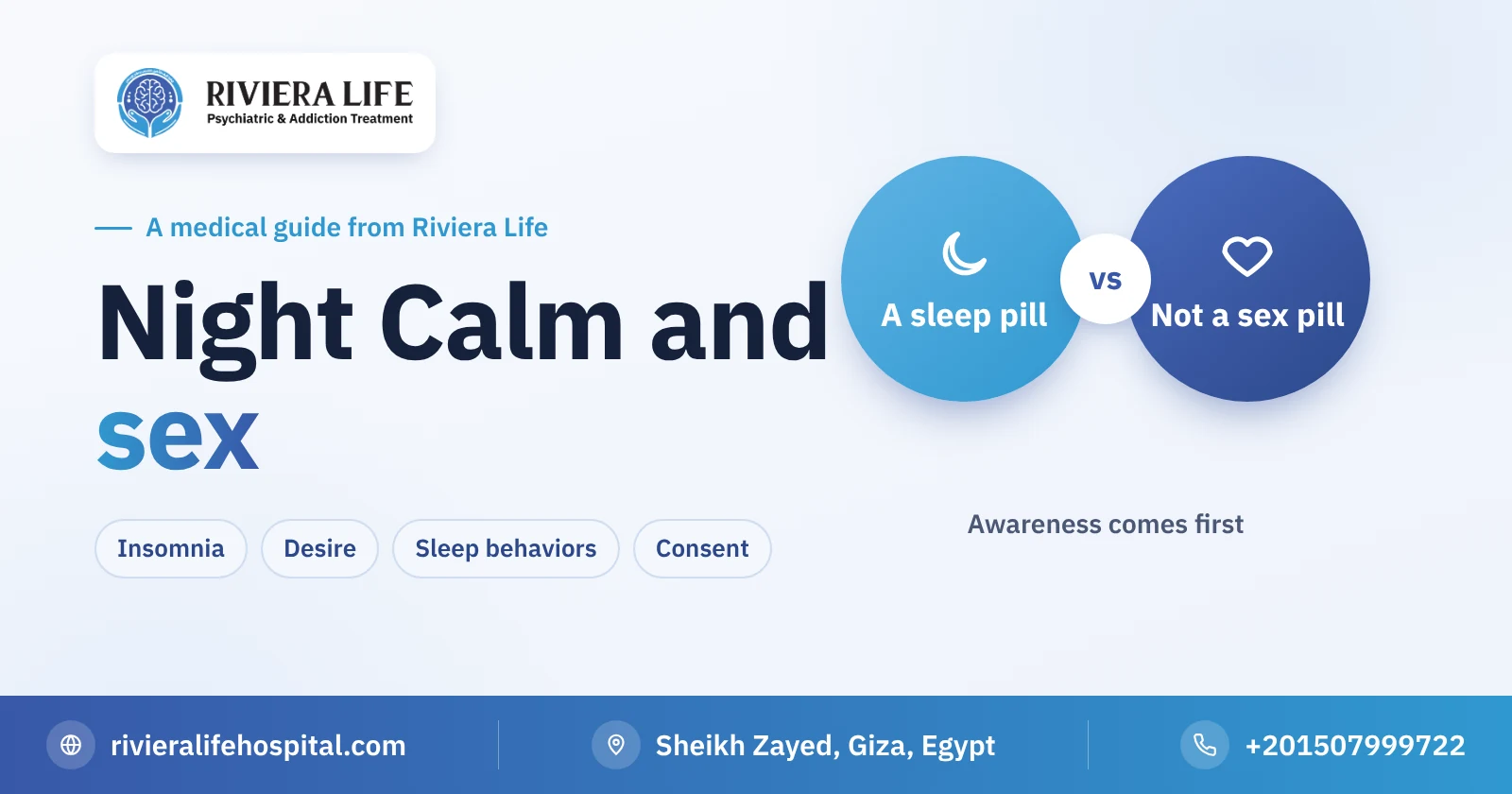
Night Calm and sex is a question that recurs in clinics, and the answer is that Night Calm (zolpidem) is a sleeping pill, not an intimacy pill. The patient takes it to fall asleep, so if he takes it moments before approaching his partner, he has put a hypnotic into his body that pulls him into sleep and weakens his attention and memory. Medical leaflets note that some people carry out complex behaviors under its effect that they don’t remember in the morning,
which is what makes the subject bigger than a matter of desire or performance, because it touches awareness, consent and safety. The article covers the relationship between this medicine and married life from the angle of sleep, explains why insomnia itself harms desire, and how a couple acts if one of them depends on the pill every night.
What is Night Calm?
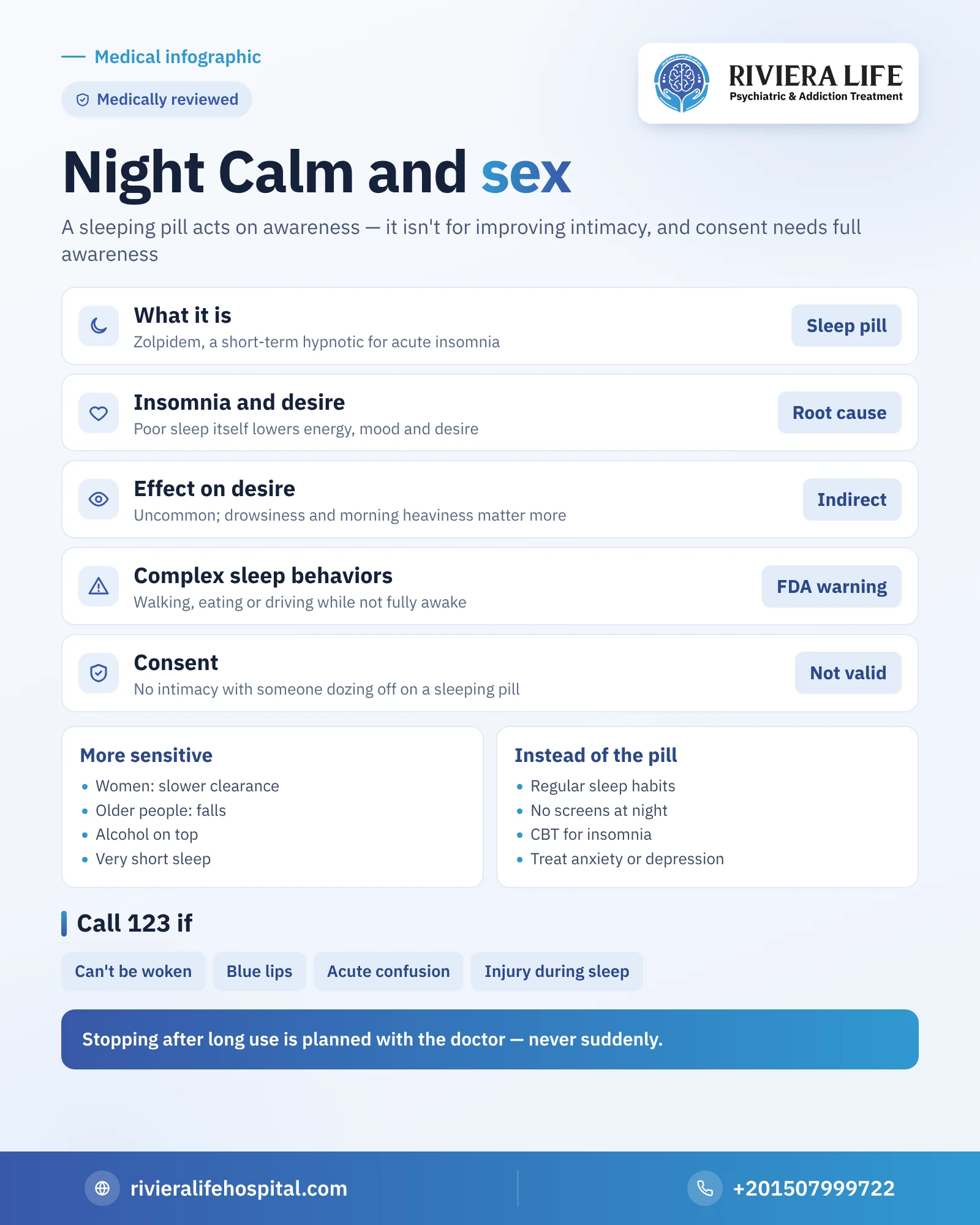
A brand name in circulation in Egypt for a medicine whose active substance is zolpidem, a hypnotic from a class that acts on GABA receptors in the brain as benzodiazepines do, but with a different structure. Doctors prescribe it for short periods to treat acute insomnia, and it isn’t supposed to continue for months. Our zolpidem guide details these basics. What matters here is that the medicine is taken at bedtime, not before an activity that needs full awareness.
Why do people search for “Night Calm and sex”?
The questions that reach clinics revolve around three things: a person who wants to relax before intimacy because he is tense, a person whose wife thinks the pill is the cause of the coolness, and a person asking why he sometimes wakes and doesn’t remember what happened at night. Each has a different answer, but they share one idea: a sleep medicine acts on awareness, and shouldn’t be used to improve a moment in which the person needs to be fully present.
Insomnia alone dims desire
Before blaming the pill, remember that the person turned to it because he doesn’t sleep. Disturbed sleep is linked to exhaustion, tension, mood swings, and lower energy and desire, and affects hormones in the long run. That is why the improvement some think they see after the pill may actually be the result of better sleep, not a direct sexual effect. Chronic insomnia has behavioral and medical treatments more useful than depending on a pill every night, and you will find an introduction in sleep disorders: types and signs.
Does the medicine itself affect desire and erection?
Some drug references list weakened desire among the uncommon effects of hypnotics of this type, but the evidence is limited, and it isn’t the most prominent thing recorded about them. Clearer are drowsiness, dizziness, weak concentration, numbness and heaviness of the body the next morning, all of which reduce interest in intimacy indirectly. So if you notice a change after starting the medicine, note when it happened and tell your doctor, and remember that the insomnia or anxiety that called for the medicine may be the cause.
Complex sleep behaviors: what have health authorities warned about?
The US Food and Drug Administration added a prominent warning about serious injuries resulting from behaviors during sleep with zolpidem and similar hypnotics, such as walking, eating or driving a car, and possibly other activities, while the person isn’t fully awake and remembers nothing later. This sometimes includes actions in bed. It doesn’t mean everyone who takes the pill will go through this, as it is rare, but it is the most dangerous part of the subject, and it is more likely with alcohol, with other sedating substances, or with very little sleep.
Consent and memory: why does it matter to the partner?
A healthy relationship rests on the awareness of both partners and their clear consent. A person under the influence of a hypnotic may not be fully aware, and doesn’t keep a reliable memory of what happened. So no intimacy should take place with someone who has taken a sleeping pill and started to doze off or speak with difficulty, and no consent in this state is considered reliable. If one spouse wakes and doesn’t remember what happened, or feels upset, step out of the circle of blame and see the doctor together. Our article on sedatives and sex covers this aspect in more detail.
Call an ambulance on 123 immediately if you see
After zolpidem alone, or with alcohol, sedatives or opioids.
- Severe drowsiness the person doesn’t wake from, or slow or irregular breathing
- Blue lips or fingertips
- Acute confusion or strange behavior with loss of consciousness
- An injury from a fall or driving during sleep
Women and older people: greater sensitivity to the medicine
Drug information shows that a woman’s body clears zolpidem more slowly, so its effect may remain in the morning, and concentration and attention decrease in waking hours. For older people, the greatest risk is falls and night-time confusion, especially when they wake half-asleep to go to the bathroom. These groups need periodic review of the medicine with the doctor, and it isn’t a matter of embarrassment. A woman who notices weaker desire with persistent morning tiredness may find that the medicinal heaviness is one of its causes, not emotional coldness as she thinks.
Alcohol and the sleeping pill: a mix that isn’t advised
Some people drink a glass or smoke other substances “to ease tension” and then add the pill. Combining alcohol or sedatives with the hypnotic increases slowed breathing, drowsiness, confusion, the chance of complex sleep behaviors and falls. This mix has no sexual benefit, as alcohol alone weakens erection, as in alcohol and sex.
When the pill becomes a condition for sleep
Someone who takes the pill for many weeks may find that his body no longer sleeps without it, so he turns to increasing it or to a combination of other pills. Then rebound insomnia worse than the first appears if he tries to stop. At this stage the person doesn’t feel he wants a high, he just wants sleep, and his social and family life recedes. We have explained this in our article on sleeping pill addiction, and the stopping symptoms in Night Calm withdrawal symptoms.
How does a couple talk about the pill without a quarrel?
Many partners hear the same sentence every night: “I’ll just sleep”, and interpret it as escape. And many husbands feel a guilt they don’t know how to express. Try a conversation at a calm hour in the daytime, not in bed: what is preventing sleep? Is it work worries, pain or thoughts? And what do you both expect from the doctor? If insomnia becomes a shared problem solved together, each of you feels less accused, and agreeing on a visit and follow-up becomes easier.
What to do instead of the pill?
The foundation of treating insomnia is regular sleep habits, keeping screens and stimulants away at night, treating anxiety and depression if present, and cognitive behavioral therapy for insomnia sessions with a specialist. The doctor may consider other medicines for a short period under his supervision. It helps a couple to make the time for closeness another hour of the day than bedtime, so the bed doesn’t become a place of tension. Changing or stopping the medicine is the doctor’s decision alone, because stopping suddenly may cause severe insomnia and anxiety.
When do you need specialist help?
If you no longer sleep without the pill, have increased its amount yourself, wake without remembering what you did, or mix it with alcohol, you need a considered stopping plan. Riviera Life’s psychiatry and addiction consultants assess your condition in complete confidentiality, and treat the cause of the insomnia alongside gradual stopping. You will find the stages in zolpidem addiction treatment. The first consultation is free on +201507999722.
More from our zolpidem guide
- Zolpidem: the complete guide
- Sleeping pill addiction
- Night Calm withdrawal symptoms
- Zolpidem addiction treatment
Questions many people ask
No, it is a sleeping pill that weakens attention and memory, and isn't suitable before an activity that needs full awareness.
Some references mention weakened desire as an uncommon effect, but insomnia itself and morning drowsiness are more likely causes of a cooling relationship.
They are actions such as walking, eating or driving during sleep without full awareness and without remembering them, and the US Food and Drug Administration has warned about them with zolpidem.
No, someone who has taken a sleeping pill and started to doze off or speak with difficulty isn't fully aware and doesn't have reliable memory, so their consent doesn't count.
No, stopping suddenly after continuous use may cause severe rebound insomnia and anxiety; a gradual plan with the doctor is better.