How long benzodiazepines stay in the body varies a great deal. In a urine test they usually show for about two to ten days after the last dose, depending on the type of medicine: short-acting types disappear faster, and long-acting types such as diazepam stay longer, and detection may extend to weeks in someone who has used them daily for a long time.
Blood and saliva tests detect recent use within hours to about two days, and a hair test reflects roughly the last three months. But these figures are approximate, and reading a result requires understanding what the test is actually looking for. This article explains the time windows for each sample, the factors that change them, and when a result can be misleading.
What happens to benzodiazepines inside the body?
After swallowing, the body absorbs the medicine, then the liver breaks it down into metabolites, most of which leave in the urine. What matters here is that the test usually doesn’t look for the original medicine, but for these metabolites. Diazepam, for example, is converted into a substance called nordiazepam, which is itself active and stays in the body longer than diazepam itself, before being converted in turn into other substances.
That is why the effect of a tablet may have worn off days ago while its metabolites still show in the sample. On the other hand, some types are converted into metabolites that some rapid strips don’t easily pick up, which explains some unexpected negative results, as we will see.
Why does the time differ from one type to another?
The main reason is the medicine’s lifetime in the body — the time the body needs to get rid of half the amount. Specialist laboratories give approximate windows for benzodiazepines appearing in urine according to their group:
| Group | Examples | Approximate detection in urine |
|---|---|---|
| Short-acting | Triazolam | Up to about two days |
| Intermediate-acting | Alprazolam, clonazepam and lorazepam | Up to about five days |
| Long-acting | Diazepam | Up to about ten days, and longer with long-term daily use |
These figures refer to ordinary use, and change a lot with the dose, the frequency of use and the person’s condition.
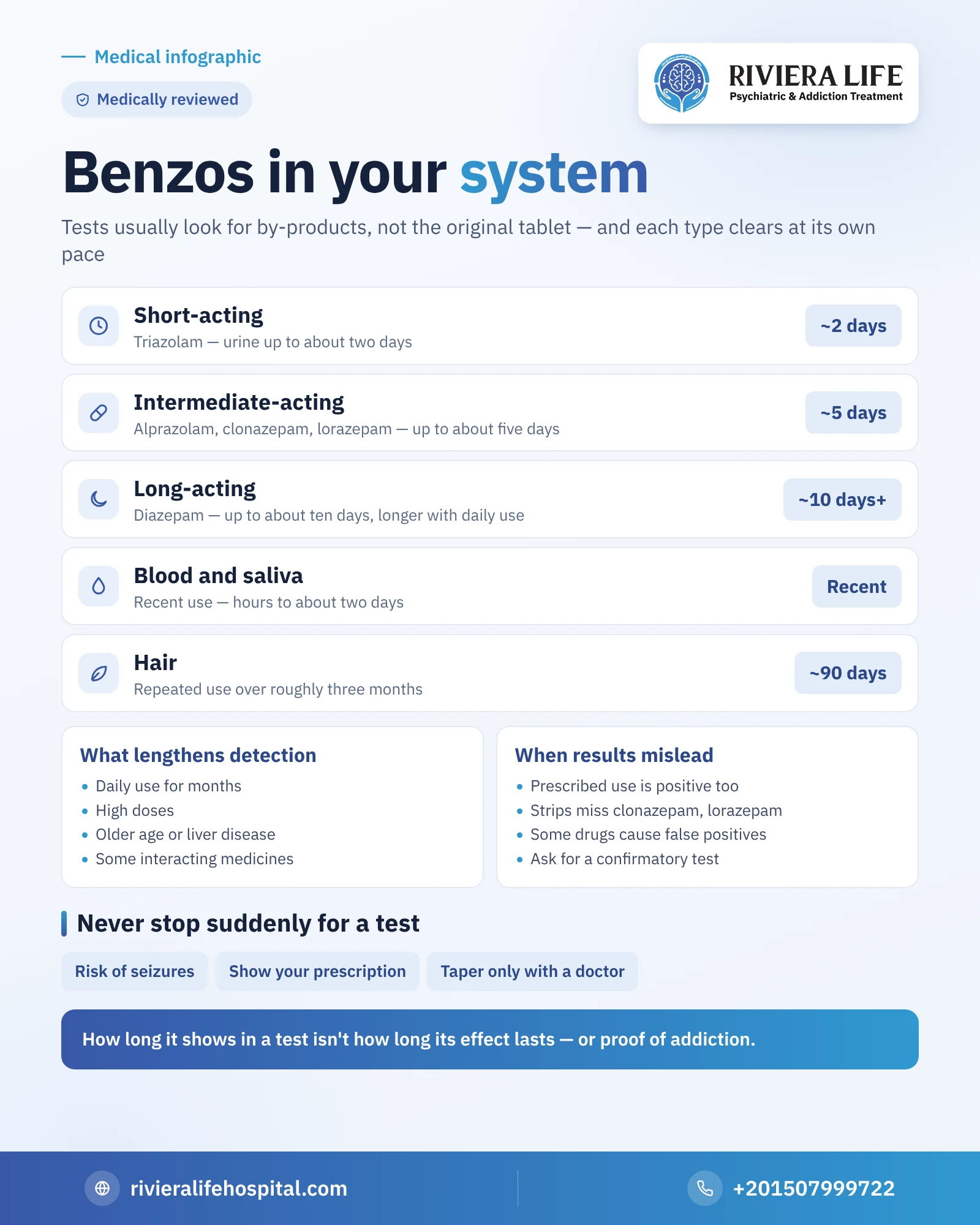
Detection time in each type of test
The urine test
The most widely used, in laboratories and in workplace and driving tests. Its window is shown in the table above, and it is longer in someone who takes long-acting types daily for months, because the metabolites build up in the body, so detection may continue for weeks after stopping.
The blood test
Detects the medicine while it is actually present in the circulation, that is, within hours, and it may reach a day or two depending on the type. It is used mainly in emergencies to assess someone unconscious or suspected of poisoning, more than to detect earlier use.
The saliva test
Its window is short, around hours to about two days. Its advantage is that the sample is taken in front of the person responsible for the test, but the concentration of some benzodiazepines in saliva is low, so only a highly sensitive device may detect them.
The hair test
Reflects repeated use over roughly the last three months, but it is less accurate at detecting a single dose, and doesn’t detect use that happened in the last few days, because hair needs time to grow.
Factors that lengthen or shorten the time
- The type of medicine: the difference between short-acting and long-acting types can amount to days.
- The length and frequency of use: daily use for months makes metabolites build up.
- The dose: large amounts take longer to clear.
- Age: the body clears these medicines more slowly with advancing age.
- The liver: any weakness in its function delays breakdown.
- Body fat: some types dissolve in fat, are stored there and then leak out slowly.
- Other medicines: some medicines slow the liver enzymes responsible for breaking them down.
Older people and liver patients: a longer window
A woman of seventy who has taken a sleeping tablet every night for years may keep the medicine in her body twice as long as a young man of thirty, because the liver breaks these medicines down more slowly with age, and because the proportion of body fat rises and stores part of them. The same happens with chronic liver disease. The result isn’t only a test that stays positive longer, but a build-up of the medicine itself that increases drowsiness, dizziness and the risk of falls — which is why reviewing sedative doses in older people is a medical necessity, not a luxury.
How long clonazepam stays in the body
Clonazepam (best known by the brand name Rivotril) is an intermediate- to long-acting type, and the body usually needs a day or two to clear half the amount. So after occasional use it shows in urine for several days, and this may extend further in someone who has taken it daily for months.
And there is a point that matters to anyone reading their result: the body converts clonazepam into a compound that some screening tests pick up with difficulty, so a negative result may come out despite use. That is why the laboratory turns to a precise confirmatory test if the decision is medically or legally important.
The time it shows in a test doesn’t mean the effect lasts that long, and doesn’t by itself indicate dependence: someone taking it on prescription will also test positive. Anyone who wants to understand the medicine itself and its withdrawal will find the details in Rivotril (clonazepam) addiction and in Rivotril withdrawal symptoms.
How long Valium stays in the body
Valium (diazepam) is the longest-lasting of the common benzodiazepines. The half-life of it and its by-product can extend to several days, especially in older people and liver patients, so it usually shows in urine for about a week to ten days after a single dose or short use, and for weeks in someone who takes it daily for a long time.
This long stay is why the medicine builds up in the body with repetition, and why its effect may still be visible the next day. It is also why its withdrawal is slower to start and longer-lasting than with the short types.
And Valium shouldn’t be stopped suddenly in order to take a test: stopping suddenly after regular use can cause seizures. The medical profile of the medicine is in the medicine diazepam (Valium), and the safe reduction plan in Valium addiction treatment.
The screening test and the confirmatory test
Home strips and the first laboratory screen rely on an immune reaction that looks for a group of similar substances, which is why their result is preliminary. And here is a point specific to benzodiazepines: some strips are quite sensitive to diazepam’s metabolites, but weaker at picking up those of clonazepam and lorazepam, especially at small doses. So someone may take Rivotril regularly and get a negative strip result. That is why, if the question is important medically or legally, the confirmatory test using chromatography linked to mass spectrometry is what identifies the substance by name and settles the result.
When is a result misleading?
A positive result isn’t in itself proof of misuse. Someone taking a sedative on a valid prescription will test positive, which is why any prescribed medicine must be reported to the laboratory before the test, and the prescription kept. Some other medicines may also interfere with some strips in known cases, such as the painkiller oxaprozin and some psychiatric medicines, giving a false positive result that the confirmatory test uncovers. In the opposite direction, a result may be negative despite use, because of a strip’s weak sensitivity to a particular type, or because the sample was taken after the window ended.
What can’t the test tell you?
The test answers a limited question: are the substance or its metabolites present above a certain threshold? But it doesn’t tell you exactly when the person took their last dose, whether they take it on prescription or not, whether they are addicted or used it once, or whether they were under its influence when the sample was taken. Diagnosis needs a full medical and psychological assessment, and you will find the signs that complete the picture in our article on benzodiazepine addiction symptoms.
Time in a test isn’t the length of the effect
Many people confuse the two. The sedative effect of a single tablet lasts hours, but some long-acting types leave a slight effect on attention and reaction speed until the next morning, without the person feeling it. This is what makes driving in the morning after a night-time sedative more dangerous than people think. On the other hand, withdrawal symptoms may begin in someone used to the medicine while its metabolites still show in urine, so the substance appearing in a test doesn’t mean the body is still “satisfied” with it.
Don’t stop your sedative suddenly for a test
Some people cut the medicine suddenly before a work test or a pre-marriage test, thinking a few days of discomfort is an acceptable price. With benzodiazepines, that price can be a seizure. Anyone who uses these medicines regularly, with a prescription or without, shouldn’t stop them except with a gradual reduction plan set by the doctor. And if the medicine is prescribed, the right solution is to give the prescription to the requesting authority, not to risk withdrawal. You will find what happens when stopping suddenly in our article on benzodiazepine withdrawal symptoms.
How are tests used during treatment?
In treatment programs, urine tests are used regularly, but they are read differently here: a patient in the gradual reduction stage is taking the sedative in calculated doses, so their result will naturally be positive. What matters to the medical team is confirming there are no other unprescribed substances, such as tramadol, pregabalin or hashish, then following the sedative’s gradual disappearance after the reduction ends. In this way the test becomes a tool for building trust between the patient and their family, not a means of punishment. Learn more about these stages in our article on benzodiazepine addiction treatment, and about Xanax specifically in our guide to Xanax addiction.
More from our benzodiazepine guide
- Benzodiazepines: the complete guide
- Benzodiazepine addiction symptoms
- Benzodiazepine withdrawal symptoms
- The harmful effects of benzodiazepines
- How long zolpidem stays in your system: blood, urine and the next-day effect
- The difference between Valium and Rivotril: use, duration, dependence and withdrawal
Questions many people ask
Alprazolam is an intermediate-acting type, and usually shows in urine for up to about five days after the last dose; the time may be longer with daily use and high doses.
Because diazepam is converted into a long-lasting active by-product called nordiazepam, so it shows in urine for up to about ten days, and sometimes weeks with long use.
Not always. Some strips are weakly sensitive to clonazepam's by-products, especially with small doses. A confirmatory laboratory test is more accurate.
Yes, the result will be positive. Tell the laboratory about the medicine before the test, and keep the prescription to show the requesting authority.
No. Stopping suddenly after regular use can cause dangerous withdrawal, up to seizures. Any stopping must be gradual, with a plan from the doctor.