The short answer
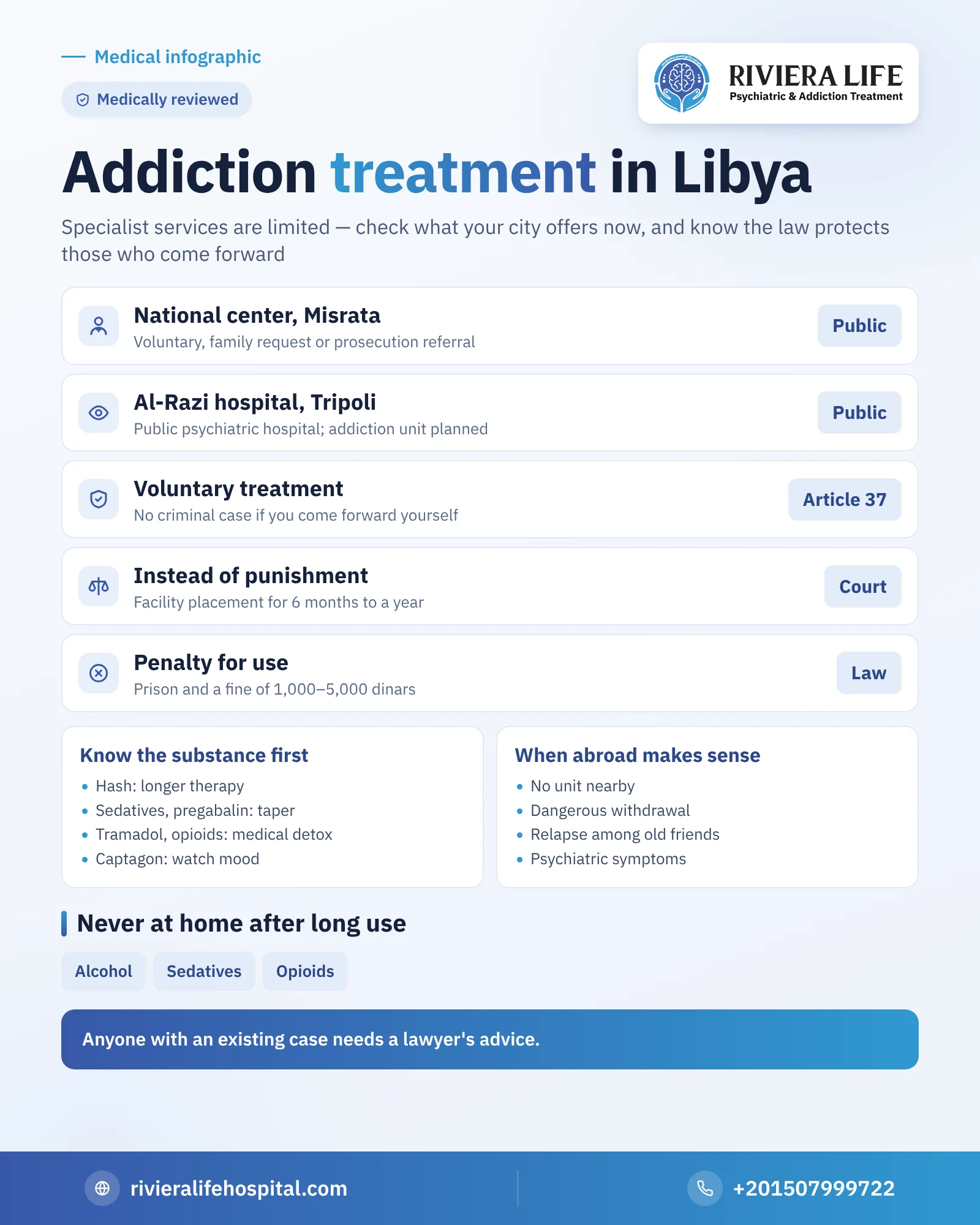
Specialist addiction treatment services in Libya are limited, and one of the oldest experiences is the government “Al-Irada” treatment facility in Benghazi, which expanded from a small unit inside a psychiatric hospital, so it is advisable to check the services currently available in your city through public psychiatric hospitals. Law No. 7 of 1990 punishes use or possession for personal use with prison and a fine of one to five thousand dinars, but it explicitly provides that no criminal case is brought against someone who comes forward for treatment at a facility of their own accord, and allows the court to place an addict in a treatment facility instead of punishment.
- Local servicesLimited; need checking by city
- Voluntary treatmentNo case against those who come forward themselves
- Instead of punishmentFacility placement from 6 months to a year
A Libyan family that discovers its son’s drug use faces a practical question before anything else: where is there a specialist place nearby? Years of instability have affected health services, and addiction services in particular. This guide tries to be practical: what the law says, how the family checks local services, and when treatment in a nearby country such as Egypt becomes a sensible option.
What is available for addiction treatment in Libya?
One of the known experiences is the government “Al-Irada” treatment facility in Benghazi, which started as a small unit inside a psychiatric hospital and then expanded to about a hundred beds. Because circumstances have changed a lot since then, the right first step is to contact the nearest public psychiatric hospital in your city to find out what it offers now: is there a detox unit? Is regular psychotherapy available? And how long is the wait?
In all cases, withdrawal from alcohol, sedatives or opioids shouldn’t be done at home after long use, because withdrawal may be dangerous. The danger signs that call for emergency care are explained in drug overdose.
The public bodies known today
- The National Center for the Treatment and Rehabilitation of Addicts: established by Council of Ministers Resolution No. 593 of 2022 by converting the addicts’ care center in Misrata into a national center based in Misrata. According to the Libyan News Agency, from January to September 2025 it received about 968 cases from 38 municipalities, of whom 421 were admitted for a stay. Admission is voluntary, at the family’s request or by referral from the Public Prosecution, and it offers medical consultation, tests, and individual, group and family therapy.
- Al-Razi Hospital for Psychiatric and Neurological Diseases in Tripoli (Gargaresh): a public psychiatric hospital whose management announced in 2022 steps towards setting up an addiction treatment department, and we found nothing confirming its opening so far. Its phone numbers, according to the Tripoli Doctors’ Syndicate: 0214773299 and 0214771900.
There is no recent information on whether the “Al-Irada” facility in Benghazi is still operating, and there is no national phone line dedicated to addiction.
What does Libyan law say?
The matter is regulated by Law No. 7 of 1990 on narcotics and psychotropic substances, and its Article 37 provides for:
- Punishing anyone who possesses, holds or buys narcotic substances for the purpose of use or personal consumption, or uses them, with prison and a fine of no less than one thousand dinars and no more than five thousand dinars.
- No criminal case being brought against a user of narcotics or psychotropic substances if they come forward for treatment at a treatment facility of their own accord.
- Allowing the court, instead of punishment, to order placing someone proven to be addicted in a treatment facility for no less than six months and no more than a year, after addiction is established by a medical committee, unless they have been placed twice before or less than five years have passed since their discharge.
The conclusion is that coming forward voluntarily for treatment is the route that protects the patient from prosecution. Anyone with an existing case needs to consult a lawyer.
Why does knowing the substance matter before any step?
The treatment plan differs by substance: hash needs longer psychotherapy, sedative pills and pregabalin are withdrawn gradually, tramadol and other opioids need carefully planned medical withdrawal, and stimulants such as captagon may cause depression or psychosis after stopping. The type of substance and the duration of use determine the form and length of withdrawal. Read captagon addiction treatment and the tramadol guide.
When is treatment outside Libya a sensible option?
- When there is no specialist unit nearby or the wait is long.
- When the patient needs medical withdrawal from substances with dangerous withdrawal.
- When the patient returns to use after every attempt because using companions are around them.
- When psychological symptoms such as suspicion or depression appear that need a psychiatrist following them daily.
If you decide on treatment in Egypt
Libya’s closeness to Egypt makes it one of the nearest practical options. At first a confidential call is enough, in which the family presents the case, and the doctor determines whether the patient needs a stay and its approximate length. Then the family arranges travel themselves, and one of them accompanies the patient until they settle into the program. On return, follow-up continues through remote sessions. The guide to the steps is in addiction treatment in Egypt for Arab patients.
How can Riviera Life help you?
Riviera Life offers Libyan families a confidential remote assessment, programs for safe withdrawal from substances with dangerous withdrawal such as sedatives and opioids, and treatment of depression following stimulants, with follow-up after returning to Libya. The first consultation is free and confidential on +201507999722.
Read also
- Addiction treatment in Tunisia
- Addiction treatment in Sudan
- Addiction treatment in Egypt for Arab patients
- Online addiction treatment
Questions many people ask
Article 37 of Law No. 7 of 1990 provides that no criminal case is brought against a drug user if they come forward for treatment at a treatment facility of their own accord.
The court may place someone proven to be addicted in a treatment facility for between six months and a year instead of punishment, with conditions related to previous placements.