A drug overdose is the moment when a substance exceeds the body’s capacity to cope, so breathing slows until it stops, or the heart and temperature spin out of control. It doesn’t happen only to beginners; many cases happen to someone who has been using for years and took “their usual amount”. The signs differ according to the type of substance, but the rule is the same: calling an ambulance on 123 immediately matters more than anything else. In this article we explain how to recognize an overdose by substance, what to do in the first minutes, the myths that waste rescue time, and what comes after survival.
What exactly is a drug overdose?
Doctors use the term “acute poisoning” to describe what people call an overdose: an amount of one or more substances exceeding what the liver, kidneys and brain can handle at that moment. The important word here is “at that moment”; the same amount may pass safely one day and kill on another, because the body isn’t constant.
An overdose doesn’t always mean death. Some cases pass with harsh symptoms and then improve, some leave permanent damage in the brain or kidneys, and some turn into respiratory or cardiac arrest within minutes. That is why you should never bet that the person “will wake up on their own”.
Why does an overdose happen even with the usual amount?
The cause is rarely a deliberately huge amount. More commonly something changes without the user noticing:
- Mixing: combining two substances that slow breathing, such as tramadol with sedatives or alcohol, multiplies the risk beyond the sum of the two. We devoted our article on the dangers of mixing drugs to this.
- A substance of unknown strength: adulterated pills and synthetic drugs such as strox vary in strength from bag to bag, and may contain substances much stronger than the user thinks.
- A change in method of use: moving from swallowing or snorting to injecting delivers the substance to the brain all at once.
- The body’s condition: liver, kidney and lung disease, exhaustion, little food and old age all reduce the body’s ability to get rid of the substance.
- Using alone: it doesn’t change the amount, but it means no one will notice and call an ambulance.
Signs of an overdose of depressants
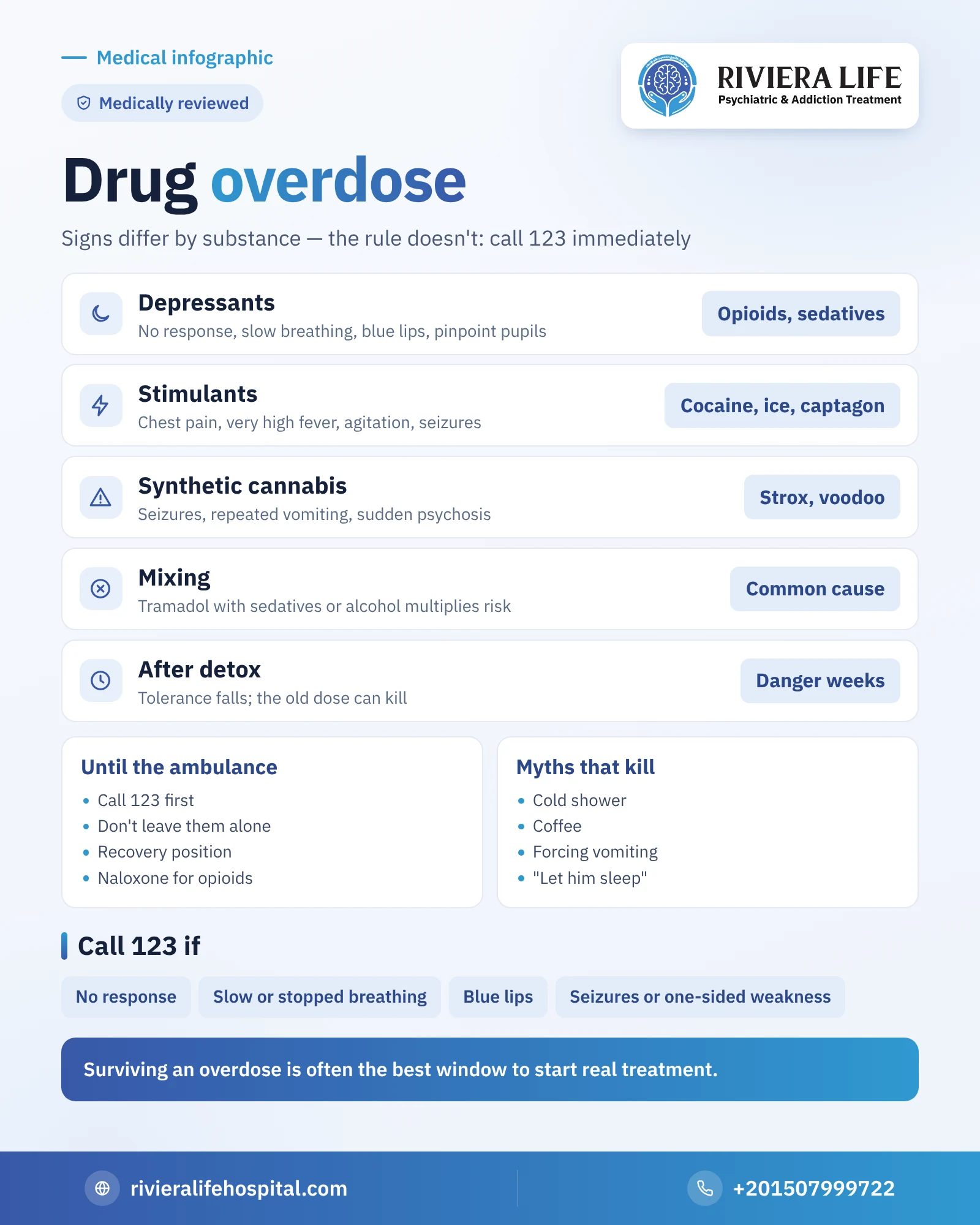
Depressants include opioids (heroin, tramadol, codeine and nalbuphine), sedatives such as Rivotril and Xanax, pregabalin, alcohol and sleeping pills. Their biggest danger is that they silence the breathing center in the brain, and the person looks as though they are deeply asleep. Watch for:
- No response to being called loudly or to firm pressure on the breastbone.
- Very slow or irregular breathing, or an unusual snoring and gurgling sound.
- Blue or grey lips and fingertips, and cold, clammy skin.
- A completely limp body, and very small pupils, especially with opioids.
The harms of opioids beyond the moment of overdose are explained in the harms of opioids on the body and mind, and we won’t repeat them here.
Signs of an overdose of stimulants
With cocaine, ice, captagon and amphetamine the picture is almost the opposite: a body in a state of acceleration that won’t stop. The problem here usually isn’t breathing, but the heart, temperature and brain:
- Pain or pressure in the chest, and a very fast or irregular heartbeat.
- A very high temperature with hot skin, and heavy sweating or a sudden stop in sweating.
- Severe agitation, paranoia and hallucinations, or violent behavior unusual for the person.
- Seizures, a sudden violent headache, or weakness on one side of the body and difficulty speaking.
These signs may mean a heart attack, a stroke, or a dangerous rise in temperature that destroys muscles and kidneys, even in a young person without any illness.
Other substances and different signs
Some substances don’t clearly belong to either group, and each has its own picture of poisoning:
| Substance | What you may see | The main danger |
|---|---|---|
| Synthetic cannabis (strox, voodoo and shadow) | Seizures, repeated vomiting, agitation or coma, sudden psychosis | Repeated seizures and damage to the heart and kidneys |
| Tramadol | Drowsiness with seizures, tremor, fever and muscle rigidity | Seizures and breathing depression together |
| Anticholinergic substances such as Mydrapid eye drops | Hot, dry skin, wide pupils, confusion and delirium | Heart rhythm disturbance and high temperature |
| Hallucinogens | Severe panic, loss of sense of reality | Injuries, accidents and dangerous behavior |
If you don’t know what the person took, don’t try to guess; describe what you see to the paramedic as it is.
Call an ambulance on 123 immediately if you see
Don't wait to be sure of the type of substance; every minute of delay with these signs may cost a life.
- No response to being called or to firm touch
- Very slow, irregular or stopped breathing
- Blue lips and fingertips
- Chest pain or severe irregular palpitations
- A very high temperature with agitation or confusion
- Seizures or sudden weakness on one side of the body
What do you do until the ambulance arrives?
- Call 123 first: say you suspect an overdose, describe the breathing and level of consciousness, and follow the dispatcher’s instructions on the phone.
- Don’t leave them alone: even if they seem to have improved, they may slip away again after minutes, especially with long-acting substances.
- The recovery position: if they are breathing but not responding, put them on their side, bend the upper knee to steady them, and tilt their head slightly back so the airway stays open and they don’t choke if they vomit.
- Naloxone with opioids: if you have it on prescription and know its instructions, it may save them temporarily until paramedics arrive. Details of how it works and its limits are in our article on naloxone.
- With stimulants: move them away from dangerous and hot places, loosen their clothes, speak calmly, and don’t try to restrain them by force.
- During a seizure: move hard objects away from them, don’t put anything in their mouth, and after the seizure stops put them in the recovery position.
- Gather the evidence: medicine boxes, strips and any remains, and hand them to the paramedics with what you know, honestly.
Myths that kill: cold water, coffee and vomiting
In Egyptian homes inherited “first aid” spreads that seems logical but wastes the critical minutes, and some of it adds a new danger:
- A cold shower or bath: it doesn’t restore breathing, and may cause a dangerous drop in body temperature, drowning, or a fall and head injury.
- Coffee or stimulant drinks: they don’t counter the effect of depressants, and trying to make a semi-conscious person drink may choke them. With stimulants they add to the burden on an already exhausted heart.
- Forcing them to vomit: vomit may enter the lungs and cause serious pneumonia or choking, and it usually doesn’t help after the substance has been absorbed.
- “Let him sleep”: the most dangerous phrase of all; breathing stops silently during this sleep.
- Giving them another substance to wake them: a stimulant on top of a depressant doesn’t cancel one with the other, but puts the body under two opposing pressures.
And don’t hesitate to call an ambulance for fear of accountability; the medical team’s job is to save life first.
What happens in hospital?
The team starts by securing the airway, breathing and oxygen and monitoring the heart, then gives the treatment suited to the substance: an antidote with opioids, medicines to calm agitation and lower temperature with stimulants, and treatment for seizures if present. Tests of blood, kidney function and muscles are done.
The patient is usually asked to stay under observation for hours even after waking, because the effect of some substances lasts longer than the antidote. Leaving early against medical advice may end with symptoms returning at home.
Lost tolerance after detox: the most dangerous weeks
One of the most painful facts is that a large number of fatal overdoses happen after a period of stopping, not during regular use. After days or weeks of abstinence, in a detox program, in hospital or in custody, the body’s tolerance falls quickly, while memory stays linked to the old amount.
If the person returns to what they used to take, their body may receive the equivalent of a dose it has never been used to. That is why the patient and their family must know this before leaving any period of treatment, and the follow-up plan must be ready from day one.
After survival: why isn’t waking up enough?
Surviving an overdose doesn’t mean everything is over. Lack of oxygen may leave problems with memory and concentration, muscle breakdown may strain the kidneys, and inhaling vomit may cause pneumonia that appears a day or two later. That is why medical follow-up needs to extend beyond leaving the emergency department.
Most importantly, someone who survived once is more likely to have it happen again. Many families consider the incident “lesson enough”, but addiction doesn’t stop through fear alone. Those days after survival are often the best window to start real treatment, and talking with the patient works better without blame or threats. Our article on how to help someone addicted to drugs explains how to open this conversation.
And if you have any suspicion that the overdose was deliberate, don’t treat it as a passing accident. Ask for an urgent psychiatric assessment, and you can contact the mental health hotline on 16328.
How can Riviera Life help you?
After the patient stabilizes in the emergency department, it is the turn of treatment that prevents the next time. At Riviera Life, the hospital licensed by the Ministry of Health in Sheikh Zayed, consultants in psychiatry and addiction treatment assess the case in complete confidentiality, and detox starts under round-the-clock medical supervision, followed by psychological rehabilitation and follow-up that pays attention to the risk of lost tolerance after discharge. The first consultation is free on +201507999722.
Read also
- Naloxone: how it saves someone from an opioid overdose
- Mixing drugs: why combinations become deadly
- The harms of opioids and overdose risks
- Drug addiction: definition, signs and treatment
- Driving under the influence of drugs: the dangers, the law and what the family does
Questions many people ask
Yes; a beginner has no tolerance at all, and adulterated substances or those of unknown strength may be stronger than expected. That is why there is no safe first try.
Breathing may stop within minutes with injection or mixing, and it may develop over hours with long-acting pills. That is why you must call an ambulance as soon as signs appear, not after watching them.
The emergency department's priority is saving life, and the medical team treats it as a medical case. This fear shouldn't stop you calling 123, because delay may cost a life.
Naloxone reverses only the effect of opioids, and doesn't help with stimulants or sedatives alone. But it does no harm if given as a precaution when opioids weren't the cause.
Lack of oxygen may cause weak memory and concentration, and the kidneys and heart may be affected depending on the substance. That is why the survivor needs medical follow-up after the emergency department and to start addiction treatment.