The short answer
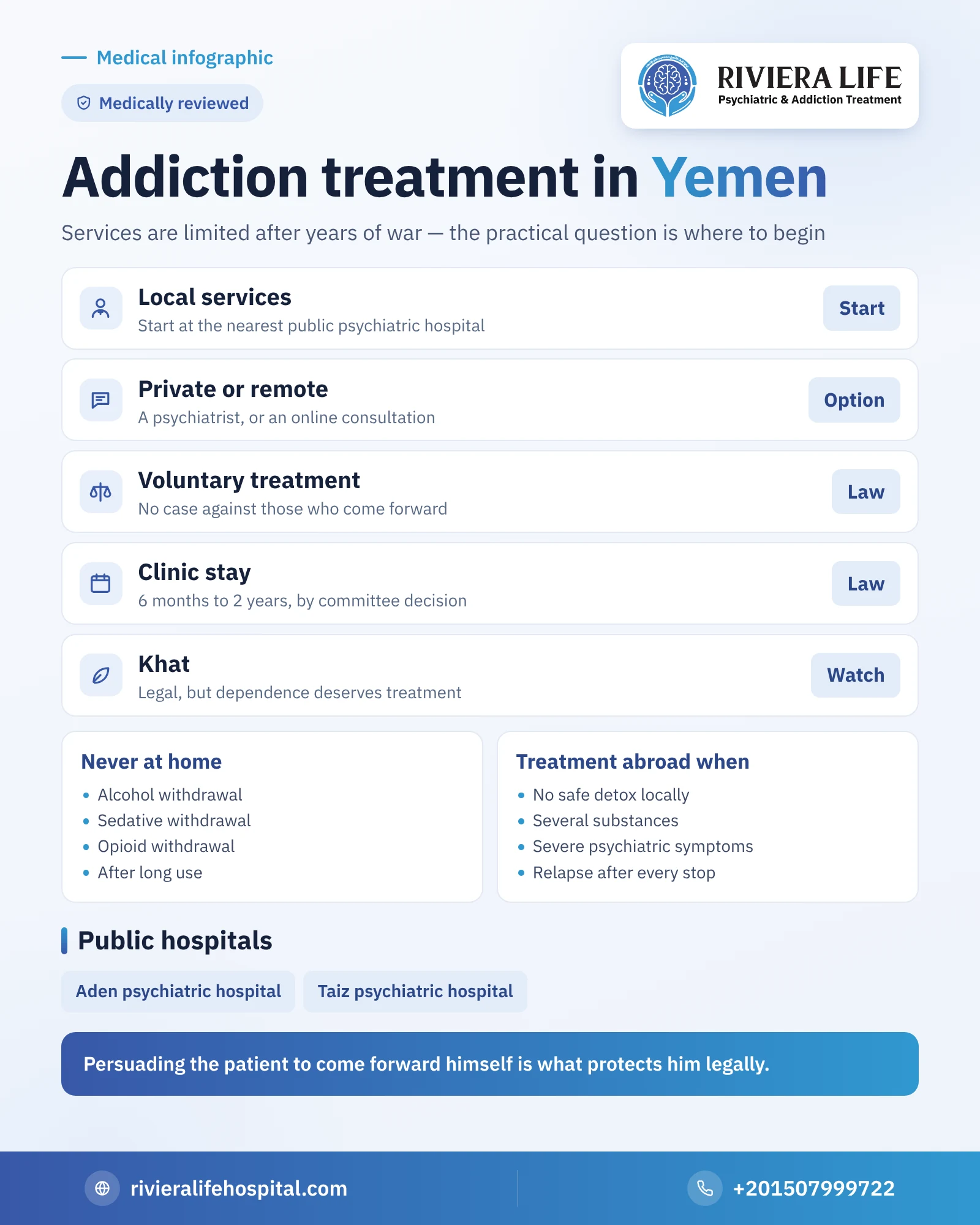
Specialized addiction treatment services in Yemen are very limited after years of war, so families usually start with the nearest public psychiatric hospital or a psychiatrist, or with a remote consultation. Law No. 3 of 1993 punishes possessing or using drugs for personal use with five years in prison, but it provides that no criminal case is brought against a user who comes forward to the clinic for treatment of their own accord, and they stay there until the competent committee decides to release them, for a period of not less than six months and not more than two years. Khat remains legal in Yemen, but dependence on it is a health problem that deserves treatment.
- Local servicesLimited, starting with public psychiatric hospitals
- Voluntary treatmentNo case against those who come to the clinic themselves
- Clinic stay6 months to 2 years by committee decision
In Yemen, talk about addiction gets mixed up with talk about khat, so some families find it hard to see the difference between a widespread social habit and using pills, stimulants or hash that threaten a son’s life. With health services exhausted by war, the practical question becomes: where do we start? This guide answers with what the law says, how the family should act, and when treatment abroad is a sensible option.
Where does the family start inside Yemen?
- The nearest public psychiatric hospital or psychiatric department in a government hospital, for assessment and to find out what detox or follow-up is available.
- A psychiatrist in a private clinic if reaching a public hospital is impossible.
- A remote consultation with a specialized provider, which is useful for understanding the case and deciding the next step. Read online addiction treatment.
The fixed rule is that withdrawal from alcohol, sedatives or opioids after long use shouldn’t be done at home without medical supervision.
What is actually available inside Yemen?
A scientific study published in 2024 describes Yemen as having no specialized addiction treatment service and no national strategy for it, and says the only rehabilitation center in Sanaa doesn’t operate regularly. Among the working public psychiatric hospitals are the psychiatric hospital in Aden, renovated with World Health Organization support in 2024, and the psychiatric hospital in Taiz, where the women’s ward was reopened. These are general psychiatric hospitals, not specialized addiction centers, but they can assess the case, treat psychiatric complications and the first withdrawal symptoms, then direct the family to the next step.
What does Yemeni law say?
The matter is governed by Law No. 3 of 1993 on combating illicit trafficking and use of narcotic drugs and psychotropic substances, and its Article 38 provides for:
- Punishing anyone who possesses, buys or produces narcotic substances for the purpose of use or personal consumption with five years in prison.
- Allowing the court, instead of the penalty, to order that a person proven to be addicted be placed in a treatment clinic for a period of not less than six months, after which a competent committee decides on their release.
- Not bringing a criminal case against a user of narcotic substances who comes forward to the clinic for treatment of their own accord; they stay there until the committee decides to release them, for not less than six months and not more than two years.
The text doesn’t mention a right for the family to request treatment on the patient’s behalf, so persuading him to come forward himself is what protects him legally.
Khat: a social habit or a health problem?
Khat is legal in Yemen and widespread in daily life, but that doesn’t mean it is harmless. Long daily chewing may cause insomnia, anxiety, appetite disturbance and raised blood pressure, consumes a large part of the family’s income, and may be accompanied by using other substances to stay up or to sleep after it. If the person becomes unable to get through their day without khat or suffers depression and irritability when they stop, these are signs of dependence that deserve treatment. Read khat addiction treatment.
When is treatment outside Yemen a sensible option?
- When there is no clinic or department able to carry out detox safely.
- When more than one substance is mixed, or there are severe psychiatric symptoms.
- When the patient relapses after every short stop and needs a period away from using circles.
If you decide on treatment in Egypt
If treatment inside Yemen isn’t possible, the start is a confidential call in which the doctor asks about the substance, about khat if it accompanies it, and about psychiatric symptoms, then suggests the program and its duration. The family arranges travel and procedures itself, and one of its members accompanies the patient at the start. The patient leaves with a written plan and remote follow-up appointments. The details are in the addiction treatment guide for Arab patients.
How can Riviera Life help you?
Riviera Life receives patients from Yemen, and starts with their families with a confidential remote assessment, then a program that treats the main substance and what accompanies it, such as khat dependence, insomnia or depression, with follow-up after returning home. The first consultation is free and confidential on +201507999722.
Read also
- Khat: the complete guide
- Addiction treatment in Sudan
- Addiction treatment in Saudi Arabia
- Addiction treatment in Egypt for Arab patients
Questions many people ask
No criminal case is brought against a user who comes forward to the clinic for treatment of their own accord, and they stay there between six months and two years until the committee decides to release them, under Article 38 of Law No. 3 of 1993.
Khat is legal in Yemen, but long daily chewing may cause insomnia, anxiety and raised blood pressure, and if the person becomes unable to get through their day without it or suffers depression and irritability when they stop, these are signs of dependence that deserve treatment.