The short answer
Addiction treatment hospitals and centers in Saudi Arabia are divided between a free public path led by the Eradah and mental health complexes and hospitals in Riyadh, Jeddah, Dammam, Madinah, Tabuk, Qassim and elsewhere, addiction clinics in general hospitals, and licensed private hospitals and centers. You can start without revealing your identity via 937, the Sehhaty app or the National Addiction Consultation Center on 1955. The Narcotics Control Law provides that no case is brought against someone who requests treatment themselves or through a relative, provided they hand over any substances they have. Treatment in Egypt is a suitable option in specific cases, not as a rule.
- The public pathEradah complexes and hospitals, with free detox
- Voluntary treatmentNo case is brought when treatment is requested and substances are handed over
- To start anonymously937, Sehhaty or 1955
“Will my son be jailed if we take him for treatment?” is a question repeated in many Saudi homes before any step. The legal answer is reassuring at its core, but fear, stigma and long waits in some places delay treatment for months. This guide gathers addiction treatment hospitals and centers in Saudi Arabia by region and sector, based on the guide to addiction treatment and rehabilitation services issued by the Ministry of Health, and explains how to reach them, what the law says about voluntary treatment, and when treatment in Egypt is an option worth considering. Whatever the provider, the basic stages of addiction treatment are the same: assessment, then safe detox, then rehabilitation, then follow-up.
Addiction treatment hospitals and centers in Saudi Arabia
The Ministry of Health guide divides addiction treatment services into levels: detox and treatment of withdrawal symptoms, inpatient admission, outpatient clinics, then rehabilitation and aftercare. Each provider offers one or more of these levels.
Eradah and mental health complexes and hospitals (public)
These are the main public path, formerly known as Al-Amal hospitals. They offer free detox and withdrawal treatment, inpatient admission, outpatient clinics and rehabilitation, and are spread across the Kingdom’s regions:
| Region | Provider |
|---|---|
| Riyadh | Eradah Complex for Mental Health in Riyadh, and Eradah Hospital for Mental Health in Al-Kharj |
| Makkah | Eradah Complex for Mental Health in Jeddah, and the Mental Health Hospital in Taif |
| Eastern Province | Eradah Complex for Mental Health in Dammam, and the Mental Health Hospitals in Al-Ahsa and Hafr Al-Batin |
| Madinah | Eradah Complex for Mental Health in Madinah |
| Tabuk | Eradah Complex for Mental Health in Tabuk |
| Qassim | Eradah Hospital for Mental Health in Qassim |
| Hail | Eradah Hospital for Mental Health in Hail |
| Jazan | Eradah Hospital for Mental Health in Jazan |
| Al-Jouf and the Northern Borders | Eradah Hospital for Mental Health in Al-Jouf, and Eradah Complex for Mental Health in the Northern Borders |
| Najran | Eradah Hospital for Mental Health in Najran |
| Asir and Al-Baha | The Mental Health Hospitals in Abha, Bisha and Al-Baha |
Some patients mention that admission may need a wait at busy times, which pushes some families toward the private path.
Addiction clinics in general hospitals
Some general hospitals offer outpatient addiction clinics that treat withdrawal symptoms and psychological symptoms and encourage involving the family and support groups. Examples in the Ministry’s guide include Al-Muzahmiyah General Hospital, King Khalid Hospital in Al-Kharj, Dammam Medical Complex and King Fahd Specialist Hospital in Buraydah. These clinics suit those who accept treatment and whose condition is stable.
Licensed private hospitals and centers
The Ministry’s guide mentions private hospitals that offer inpatient admission and detox along with treatment of accompanying psychiatric disorders, such as Dallah Namar Hospital, Makkah Medical Center Hospital and Dr. Soliman Fakeeh Hospital, as well as private centers for counseling, outpatient treatment and rehabilitation such as Qaweem Addiction Treatment Center and Rushd Specialist Center. The advantage of the private path is often a faster start and more privacy, with a big difference in cost. A Ministry of Health license is an essential condition before anything else.
Rehabilitation and aftercare
After the detox and inpatient stage come public and private halfway houses, rehabilitation centers, then associations supporting people in recovery such as the Ishraqa Association in Riyadh, the Taafi Charitable Association in the Eastern Province and the Sawab Association in Jazan. This stage is the one that protects against relapse, so you shouldn’t stop at detox alone.
How do you start?
- Calling 937, a route that allows consultation without revealing your identity.
- An instant consultation through the Sehhaty app, in which the doctor determines the right level for the case.
- The National Addiction Consultation Center on 1955.
- Booking directly at the addiction clinic in the nearest general hospital or Eradah complex.
Voluntary treatment in the Saudi system
According to what Okaz newspaper reported from the Public Prosecution in June 2025, the Narcotic Drugs and Psychotropic Substances Control Law provides that no case is brought against someone who uses or is addicted if they request treatment on their own initiative, or a relative submits the request, provided they hand over any narcotic substances they have or reveal where they are. The idea is clear: the system encourages treatment before arrest. The details in special cases, such as someone with a previous case or someone working in a sensitive job, remain a matter for a lawyer or the relevant authority. This is a general explanation, not legal advice. We explain the texts of the articles, the penalties and the cases in which investigations are closed in detail in our article on drug penalties in Saudi Arabia and treatment without prosecution.
The most common substances and their effect on the treatment plan
In Saudi Arabia and the Gulf, shabu or crystal, captagon, hashish and some misused medicines such as pregabalin and sedatives come up repeatedly. Each substance has a different plan: shabu and captagon may cause psychosis and aggression that need close psychiatric follow-up, while sedatives and pregabalin are withdrawn gradually because stopping suddenly may cause seizures. The street names in circulation and their meaning are in drug street names in Saudi Arabia.
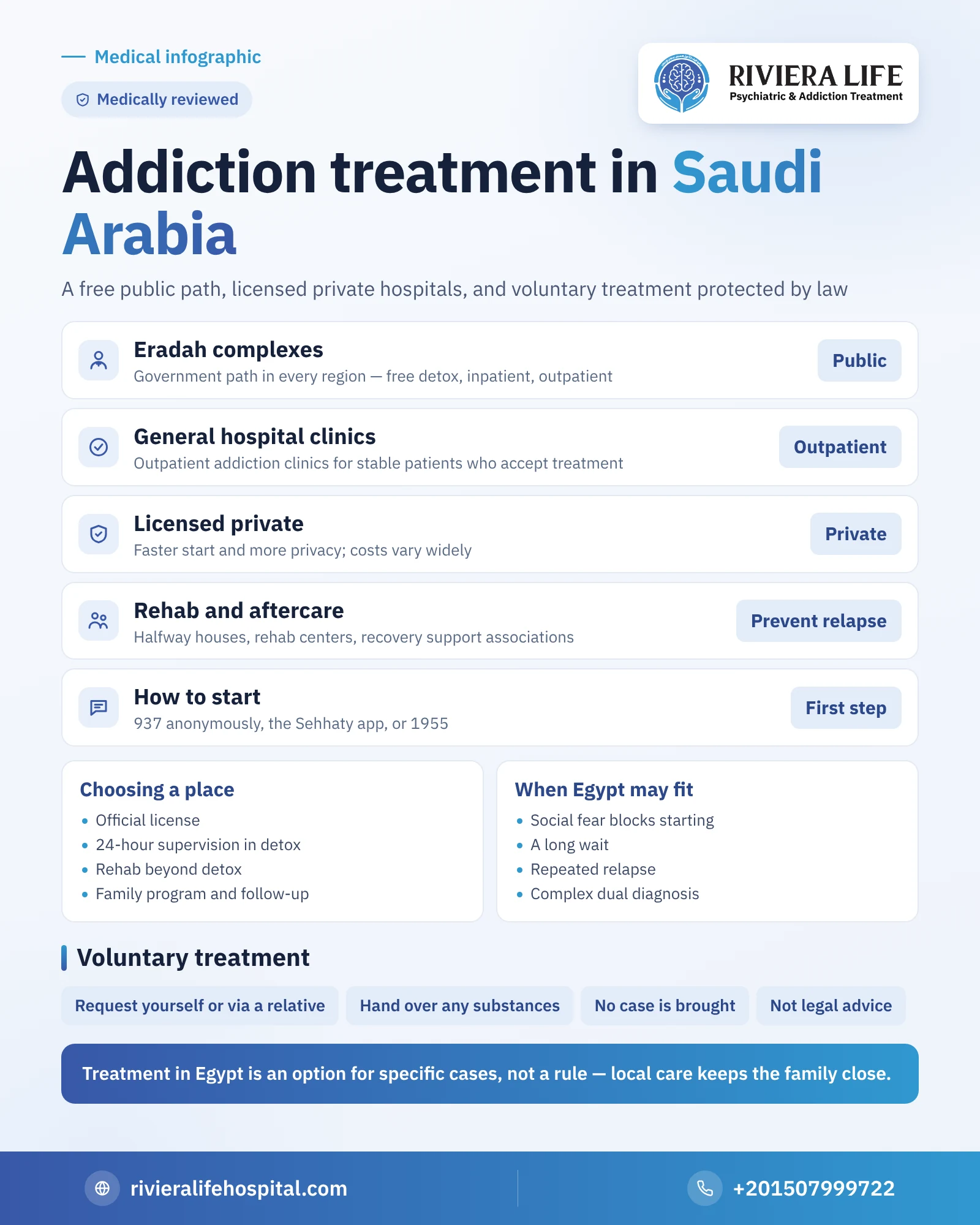
How do you choose a place of treatment inside the Kingdom?
- An official license and a psychiatrist responsible for the case.
- Round-the-clock medical supervision during detox.
- A clear psychological rehabilitation program after detox, not detox only.
- The ability to treat accompanying psychiatric disorders.
- A family program, and a written plan for follow-up after discharge.
- Transparency about cost and duration, without promises of a guaranteed cure in days.
The full checklist is in how to choose an addiction treatment hospital.
When is treatment in Egypt a suitable option?
Treatment outside the Kingdom isn’t a substitute for local services, but an option that suits specific cases:
- When fear of social exposure stops the patient from starting at all.
- When the wait is long and the condition can’t tolerate delay.
- With repeated relapse after local treatment, and the need for a different environment for a while.
- With a complex psychiatric disorder that needs an integrated dual diagnosis program.
- When the patient needs to move away temporarily from using friends and places, with a longer stay and a family program.
Outside these cases, treatment inside the Kingdom remains an excellent option for many, because the family is close and follow-up afterwards is easier. And if you choose to travel to Egypt, the details of the steps and follow-up after returning are in addiction treatment in Egypt for Gulf patients.
How can Riviera Life help you?
Riviera Life starts with Saudi families through a confidential remote consultation that helps assess the case and choose the most suitable path, inside the Kingdom or in Egypt, and offers dual diagnosis programs and remote follow-up after returning. The first consultation is free and confidential on +201507999722.
Read also
- Addiction treatment in Oman
- Addiction treatment hospitals and centers in Kuwait
- Drug penalties in Saudi Arabia and treatment without prosecution
- Ice and shabu addiction treatment
- How long addiction treatment takes
- Kuwait’s drug law and voluntary treatment
- Addiction treatment in Egypt for Arab patients: a guide by country
Questions many people ask
According to what the Public Prosecution has stated, no case is brought against someone who requests treatment on their own initiative or at the request of a relative, provided they hand over any substances they have or reveal where they are.
Yes. The text covers a treatment request submitted by a relative, and it is better for the family to ask the treatment provider about the procedures before applying.
They are government facilities for psychiatry and addiction treatment, formerly known as Al-Amal hospitals, offering detox, rehabilitation and follow-up.
The National Committee for Narcotics Control announced the National Addiction Consultation Center on 1955 for referral to treatment.
Not necessarily. It is considered when more privacy is needed, the wait is long, relapse repeats or there is a complex psychiatric disorder; otherwise treatment close to the family is easier to follow up.