How long amphetamine stays in the body varies by sample: in a urine test it usually remains detectable for one to three days after the last use, and the time may extend to four days or slightly more with heavy, repeated use. It shows in the blood for hours up to about a day, in saliva for a day or two, and in hair for up to about three months.
But these figures are approximate, and are affected by the amount, the pattern of use, kidney function and the type of test itself. This article explains what happens to amphetamine inside the body, how long it shows in each sample, why a positive result may appear in someone who hasn’t used, and what the test can’t tell you.
What happens to amphetamine inside the body?
After swallowing, amphetamine is absorbed from the gut within about one to three hours to reach its highest level in the blood. The liver processes part of it, but a significant proportion leaves in the urine unchanged. Amphetamine’s half-life, the time it takes for its blood level to fall by half, averages about ten hours in adults, and may be several hours shorter or longer depending on several factors, including the chemistry of the urine itself. Because the body usually needs several half-lives to clear a substance almost completely, the detection window in urine extends to days.
An important note: part of methamphetamine is converted inside the body into amphetamine. So amphetamine may show in the test of someone who used methamphetamine, while the reverse doesn’t happen. This is one of the points the laboratory uses to interpret the result.
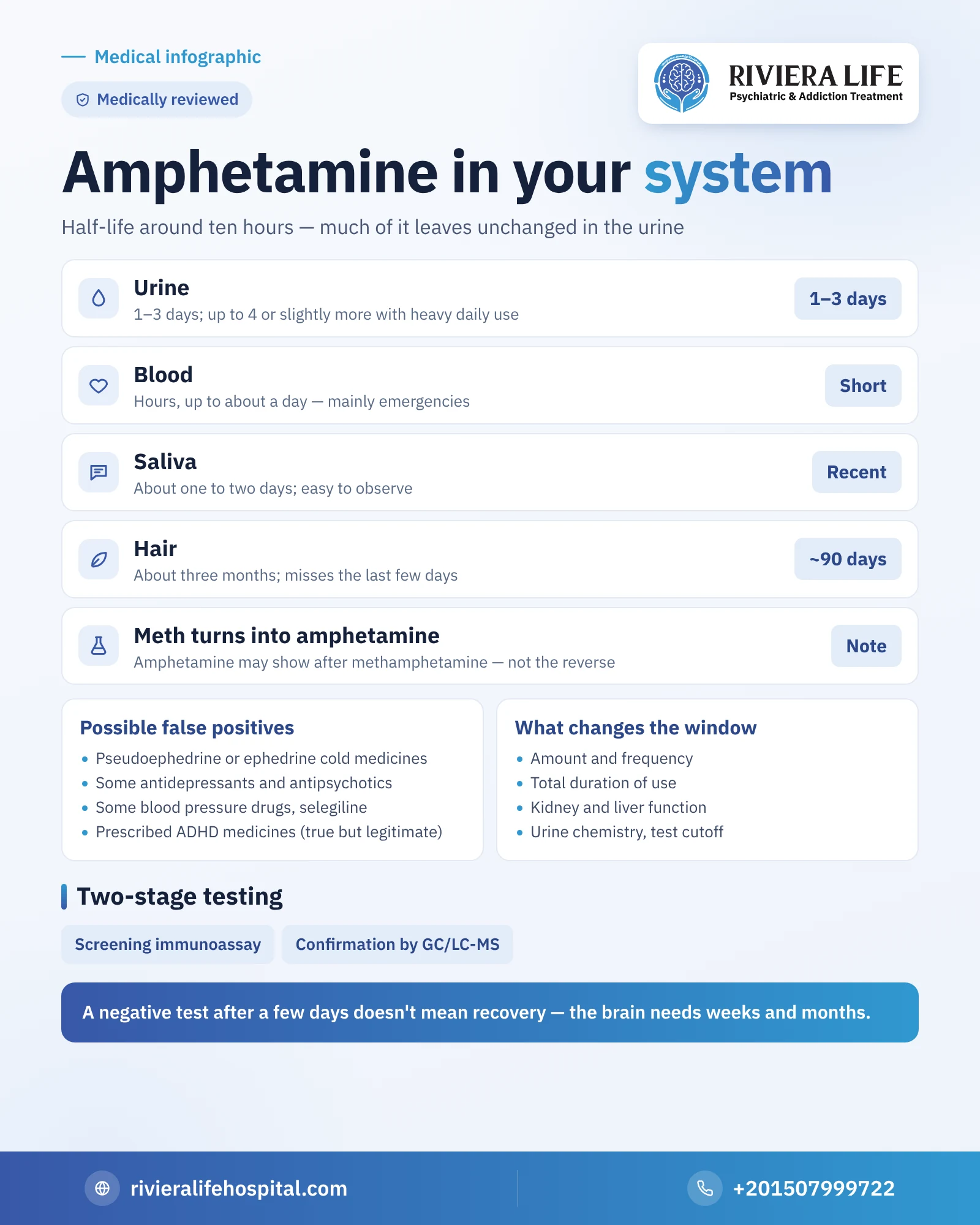
How long amphetamine shows in each type of test
The urine test
The most widely used in Egypt, whether in laboratories, workplaces or home strips. Amphetamine usually shows in it for one to three days after the last use, and the time may extend in someone who uses large amounts daily for a long period. It starts to appear in urine a few hours after use.
The blood test
Its window is relatively short, from hours to about a day. It is mostly used in emergencies to assess acute poisoning or explain the symptoms of a confused or unconscious patient, more than to detect past use.
The saliva test
Detects recent use, within roughly a day or two. Its advantage is that the sample can easily be taken under direct observation, which is why it is used in some countries for testing drivers.
The hair test
A hair test covers the longest period; the part closest to the scalp detects use over roughly the past three months. But it can’t detect the last few days, because hair needs time to grow and appear above the skin, and it is also more expensive and less widely available.
Why does the time differ from person to person?
- The amount and number of uses: continuous daily use lengthens the window compared with a single use.
- The method of use and the total duration of use.
- Kidney and liver function: any weakness slows the substance’s exit.
- Urine chemistry and concentration when the sample is taken.
- Age, weight and general health.
- The sensitivity of the device or strip used and its minimum detection threshold.
The screening test and the confirmatory test
Home strips and rapid tests in laboratories rely on an immune technique that looks for substances structurally similar to amphetamine. This method is fast and cheap, but it can be wrong. That is why its result is considered preliminary, and any positive result with important consequences, such as work, marriage or a legal case, must be confirmed by a more precise laboratory method such as chromatography combined with mass spectrometry. This method identifies the substance by name and concentration, and can also distinguish the different forms of amphetamine when needed.
When is a positive result inaccurate?
A screening test may give a positive amphetamine result in someone who hasn’t used any drug, because of medicines or substances that are chemically similar, for example:
- Cold and decongestant medicines containing pseudoephedrine or ephedrine.
- Some antidepressants and antipsychotics.
- Some blood pressure medicines, and selegiline, used to treat Parkinson’s disease.
- Prescribed ADHD medicines from the amphetamine family; here the result is correct, but its cause is legitimate.
That is why it is always advised to tell the laboratory about every medicine the person takes before the test, and to ask for confirmation with any unexpected positive result.
Does Captagon show in an amphetamine test?
In most cases, yes. The Captagon in circulation today is counterfeit pills, most of which contain amphetamine, which is why it shows under amphetamine in an ordinary test. But because the content of these pills isn’t consistent, other substances may show with it, or no amphetamine may show at all. You’ll find details of these pills on our page about Captagon, and methamphetamine detection times in our article on how long methamphetamine stays in your system.
What can’t the test tell you?
A positive test says the substance entered the body within a certain period, but it doesn’t say whether the person is addicted or tried it once, doesn’t determine the amount precisely, and doesn’t reveal their psychological state. A negative test doesn’t necessarily mean they don’t use; they may have used days ago, outside the detection window, or use a substance the strip doesn’t cover. Addiction is diagnosed by medical assessment, behavior and symptoms, as we explained in our article on amphetamine addiction symptoms.
Work tests and premarital tests
Many people go through a drug test when applying for a job, getting a license or before marriage. If you take a prescribed medicine from the amphetamine family, or any medicine that may give a false positive result, carry the prescription and mention it to the laboratory before the sample is taken. If the result comes back positive unexpectedly, you have the right to ask for a confirmatory test before any decision is based on it. But if the worry is due to actual use, the test isn’t the real problem; the problem is the use itself, and dealing with it early is far easier than waiting for a result that reveals it at a difficult time.
Advice for families before using a home test
A home strip may seem a quick solution to suspicion, but it often turns into a tool of confrontation. Forcing a son to test after an argument, or testing him without his knowledge, destroys trust and pushes him to hide more. It is better for testing to be part of a plan everyone agrees on with the doctor, and for its result to be interpreted calmly. And remember that a strip’s result is preliminary in any case.
Amphetamine leaving the body doesn’t mean the end of addiction
After a few days the test becomes negative, but the brain needs weeks and months to regain its balance. During this period the person goes through the crash, depression and intense craving, symptoms we explained in our article on amphetamine withdrawal symptoms. That is why waiting for the body to be “clean” isn’t a substitute for treatment.
How are tests used during treatment?
In stimulant treatment programs, regular tests are a therapeutic tool, not a tool of accusation. They give the patient tangible evidence of their progress, rewards that encourage continuing are sometimes built on them, and they help the team detect relapse early and intervene before it worsens. At Riviera Life these tests are carried out confidentially, and their results are discussed with the patient within their treatment plan. In the first months after discharge, the team agrees with the patient and family on a clear testing schedule, whose frequency gradually decreases as stability is established, until mutual trust becomes the basis instead of surveillance.
More from our amphetamines guide
- Amphetamines: the complete guide
- Amphetamine addiction symptoms
- Amphetamine withdrawal symptoms
- The difference between methamphetamine and amphetamine
Questions many people ask
Usually one to three days after the last use, and the time may be slightly longer with heavy daily use.
Yes. A hair test reflects roughly the last three months, but it doesn't detect use in the last few days.
Medicines containing pseudoephedrine or ephedrine, and some other medicines, may give a positive preliminary result, which is why any positive result needs a confirmatory test.
In most cases yes, because most Captagon pills in circulation contain amphetamine, but their content isn't consistent and other substances may show with it.
Not necessarily: use may be outside the detection window, or with a substance the strip doesn't cover. Diagnosis relies on medical assessment, not the test alone.