Music and art therapy is a treatment path that uses drawing, shaping, singing and rhythm to express what is hard to say in words. It doesn’t require talent or previous experience, and the beauty of the work isn’t evaluated, as what matters is what happens to the person while making it. It is usually offered as a complementary treatment alongside medical and psychological treatment, not a substitute for them. This article explains how both art therapy and music therapy work, what the evidence says, what a structured program looks like, when it helps in addiction and mental disorders, and what to beware of.
What is art and music therapy?
It is a psychological therapy led by a therapist trained in this specialty, not merely a recreational activity. It combines psychological and artistic expertise: the therapist sets a goal for the session, chooses the medium, accompanies the patient during the work, then opens a conversation about what emerged. It differs from “amateur workshops” in that the session has a written therapeutic goal and an assessment of progress. It may be offered individually or in small groups, for children, teenagers, adults and the elderly.
Visual art therapy
It uses colors, clay, collage and free or guided drawing. The patient may be asked, for example, to draw “a safe place”, express their state this week with colors, or make two masks: what they show people and what they hide. Some therapists believe that the image goes beyond verbal defenses, so the patient reaches a feeling for which they found no word. Specialists stress that the therapist’s role includes listening to the maker’s own interpretation of the work, and that they don’t extract a diagnosis from the shape of lines or colors. This is among the most common myths about the subject.
Music therapy
It uses listening, singing, playing, improvisation and songwriting. Its forms vary: guided listening after agreeing on what is heard, group drumming to regulate rhythm, writing lyrics that express the stage of recovery, or analyzing the lyrics of a song close to the patient’s life. Music touches areas of the brain linked to emotion, memory and movement, so it may open a door with those for whom dialogue is difficult, such as children and some trauma or dementia patients.
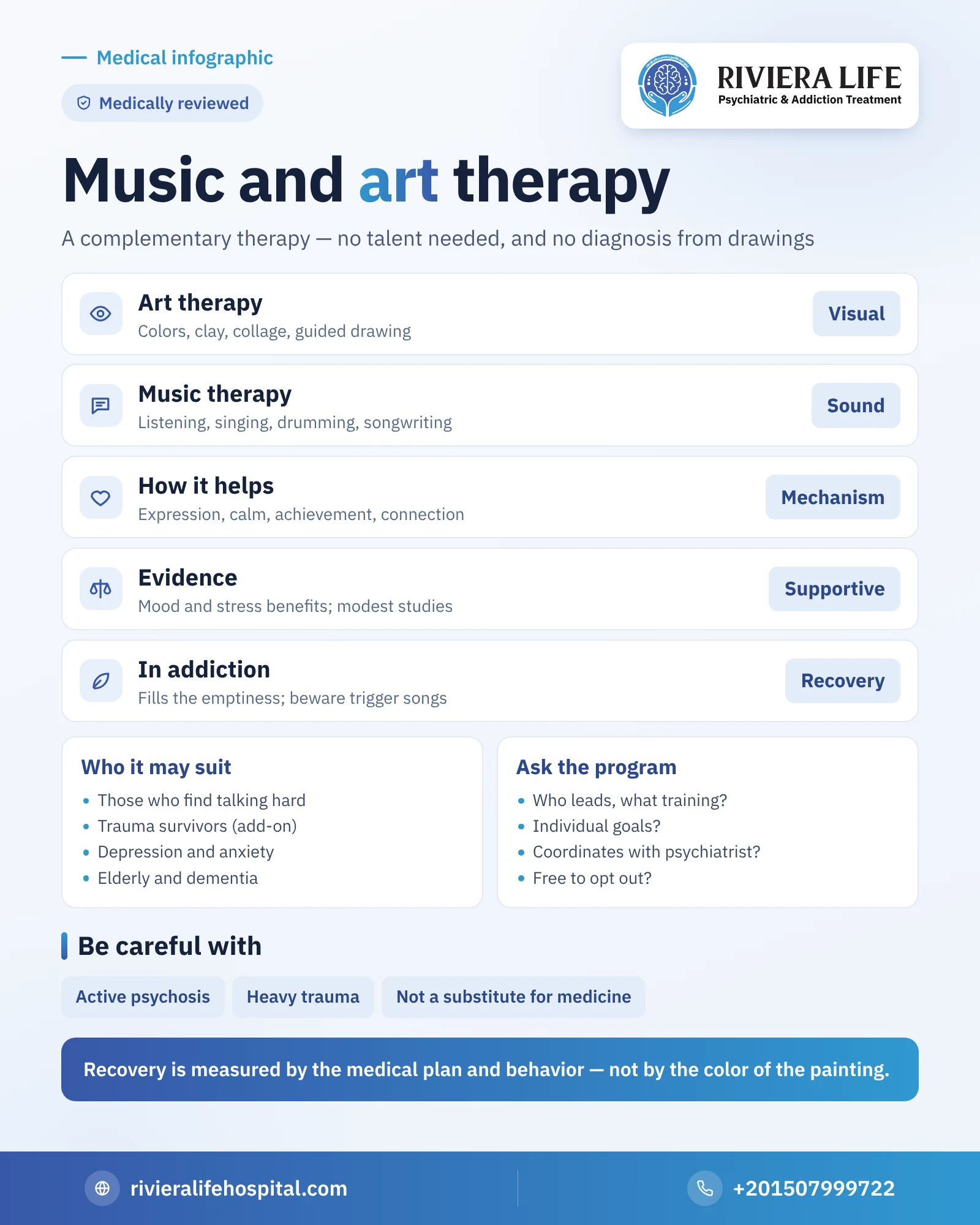
How does it help? Behind the idea
- Expression without words: useful when feelings are heavier than language or when talking itself is frightening.
- Regulating emotion: rhythm, breathing and focus on manual work calm the body and ease tension.
- A sense of achievement: producing something tangible restores confidence to someone who has lost the sense of their ability.
- Connecting with others: in the group members share a common work so isolation decreases.
- A safe space to approach the difficult: the patient can approach a painful subject from a distance, through a symbol, a color or a melody.
What does the scientific evidence say?
The major reviews, including a review by the World Health Organization Regional Office for Europe on the role of the arts in health, found that artistic participation is linked to improvement in mood, coping with stress and social interaction, appearing especially clearly in dementia, depression and some pain conditions. On the other hand, the quality of many studies is modest, the groups are small, and it is hard to conduct comparative trials between art and a placebo treatment. That is why art and music therapy is considered a useful support accepted by patients, not evidence that it treats addiction or psychosis on its own. Claiming otherwise is an exaggeration.
Music and art therapy in addiction
In recovery from addiction the patient is exposed to a great emptiness: their time, hobbies and feelings all revolved around the substance, and suddenly there is nothing. Artistic activities come to fill this emptiness in a healthy way, and give an outlet for anger, sadness and shame without use. Groups help in breaking silence and withdrawal, and in building new daily habits within the stages of recovery. But there is a trap therapists know: some songs are linked to times of use, so they activate craving. That is why a safe list is agreed on in advance, and the patient remains free to leave any song that disturbs them.
Who may it suit?
- Those who find it hard to talk about their feelings: children, teenagers and some people with social anxiety, as in social anxiety treatment.
- Trauma survivors, as a complement, not a substitute for the specialized treatment explained in PTSD treatment.
- Those with depression or anxiety as support alongside medicine and talking therapy.
- People recovering from addiction, to manage craving and stress and build a new routine.
- The elderly and those with dementia, as old songs help evoke memory and communication.
What does a structured program look like?
- First — assessment: the therapist learns about the condition, interests and what may disturb the patient, and sets goals.
- Second — sessions: weekly meetings or more, each usually lasting forty to sixty minutes, starting with calming, then an activity, then a conversation.
- Third — follow-up: the therapist reviews progress and adjusts the plan with the medical team.
- Fourth — ending: the works are kept if the patient wishes, and they are left with something to continue at home.
Good sessions avoid forced interpretation, let the patient talk about their work if they wish, and respect silence.
When should we be careful?
- With those with active psychosis, getting carried away in images or sounds may increase symptoms, so simple structured activities are chosen.
- Heavy trauma: painful memories may surface during drawing or singing, so a therapist who knows how to calm and set the pace is needed.
- Extreme sensitivity to sound, or to smells and art materials, in some people.
- It shouldn’t replace withdrawal treatment, psychiatric medicine or the doctor’s follow-up.
Questions to ask when choosing a program
- Who leads the sessions, and what is their training in art or music therapy?
- Is there an individual assessment and written goals, or just general activities?
- Does it coordinate with the treating psychiatrist?
- Can the patient withdraw from any activity without pressure?
- How is the privacy of works and recorded sounds kept?
And beware of any party that markets music or drawing as a quick treatment for addiction or mental illness.
What can you do at home?
You don’t need a therapist to benefit cautiously from the general idea. Set aside ten minutes a day for drawing, coloring, writing or arranging a list of songs that calm you, without judging the result. If you are in the recovery stage, choose what doesn’t link you to memories of use. And if you notice the activity stirs severe distress or painful memories, stop and talk to your therapist. This fits with the stress-relief skills explained in psychological stress: its signs and how to deal with it.
The family’s role
Parents can encourage without imposing: provide simple tools, avoid mocking the works, and not ask for an interpretation of every drawing. Most importantly, they shouldn’t consider the artistic activity evidence of improvement or deterioration; recovery is measured by the medical follow-up plan and behavior, not by the color of the painting.
Seek urgent help immediately if there appear
Call an ambulance on 123, or the mental health hotline 16328, or go to the nearest emergency department.
- Thoughts of ending life, or messages and works expressing a farewell
- Frightening voices or visions pushing them to harm themselves or others
- Rapid deterioration in sleep, eating and self-care
How does Riviera Life help you?
Any treatment program begins with a complete medical and psychological assessment, not a single activity. The psychiatry and addiction consultants at Riviera Life set a plan that suits your condition with round-the-clock medical supervision, including the family program and follow-up after discharge. The first consultation is free and confidential on +201507999722.
More from the psychotherapy guide
- Cognitive behavioral therapy
- The stages of recovery from addiction
- Psychological stress
- Depression: the complete guide
Questions many people ask
No. The beauty of the work isn't evaluated; what matters is what happens to the person while making it and what it expresses.
No. No illness is diagnosed from the shape of lines or colors; diagnosis is made through the psychiatrist's assessment.
No. It is considered a complementary supportive treatment, and doesn't replace medical withdrawal, psychotherapy and medicine when needed.
It may if a song is linked to times of use, so a safe list is agreed on and the patient remains free to leave any song.
Those who find talking hard, such as children and some trauma survivors, and those who want to express themselves and face emptiness in the recovery stage.