Tourette syndrome and tic disorders are neurodevelopmental conditions that begin in childhood, appearing as repeated involuntary motor and vocal tics, such as blinking, shrugging the shoulder, clearing the throat or making short sounds. They are part of one spectrum, which starts with simple passing tics that are very common in children, and ends with Tourette’s when multiple motor tics and at least one vocal tic come together for more than a year.
Contrary to the common picture in films, involuntary swearing isn’t the core of Tourette’s, but appears in a minority of those with it. In this article we explain the types of tics, how they begin and develop, their relationship with ADHD and OCD, the role of the school, and treatment methods.
What are tics?
A tic is a sudden, quick, repeated movement or sound that serves no purpose and happens in a semi-involuntary way. Many of those affected, especially older ones, describe a sensation preceding the tic, such as an itch, pressure or tension in a particular place, called the “premonitory urge”, which calms after the tic is performed. The person can sometimes suppress it for a short time, but this exhausts him, and it may come out more strongly afterwards.
And tics change by nature: they intensify with stress, excitement and tiredness, ease while concentrating on an enjoyable activity such as drawing or sport, and one tic may disappear to be replaced by another within weeks.
Motor and vocal tics: clear examples
| Type | Simple | Complex |
|---|---|---|
| Motor | Blinking, grimacing, shaking the head or shoulder | Jumping, touching objects or people, imitating others’ movements, sequences of movements |
| Vocal | Throat clearing, sniffing, light coughing, whistling, grunting | Repeating words or phrases, repeating the last thing heard, and sometimes inappropriate words |
Many families at first think the child has an allergy in the eye or nose because of the repeated blinking and sniffing, and move between eye and nose doctors before anyone notices they are tics.
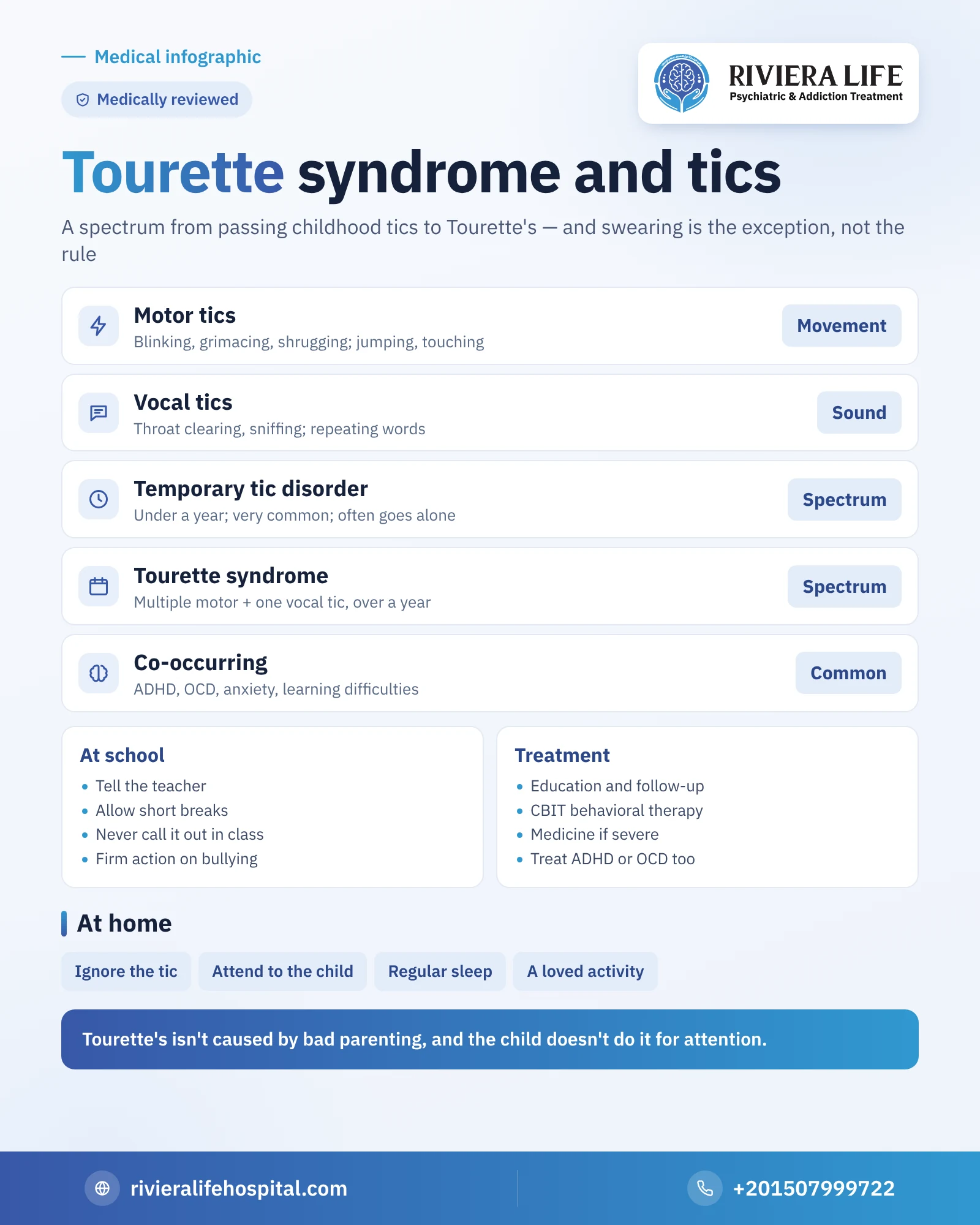
From the passing tic to Tourette’s: the spectrum of tic disorders
- Provisional tic disorder: tics lasting less than a year; very common among schoolchildren, and often disappears on its own.
- Chronic tic disorder: motor tics only or vocal tics only lasting more than a year.
- Tourette syndrome: multiple motor tics and at least one vocal tic, lasting more than a year, beginning before age eighteen.
There is no blood test or scan that diagnoses Tourette’s; diagnosis relies on the description of the tics, their duration and the doctor’s observation. The doctor may request tests to rule out other causes of involuntary movements when needed.
When does it start and how does it develop?
Tics usually begin between the ages of five and seven, typically in the face and head, then may extend to the shoulders and body, and vocal tics appear later. Severity tends to peak before or at the start of puberty, then eases clearly in many teenagers by the end of adolescence and the start of adulthood, and may disappear completely in some. Males are diagnosed several times more often than females.
The cause isn’t fully known, but research points to a strong genetic role, and to differences in brain circuits that regulate movement and habits, with an environmental influence. What is certain is that Tourette’s doesn’t result from bad parenting, and the child doesn’t do it on purpose to attract attention.
The swearing myth: what does reality say?
The picture entrenched by films and videos, a person shouting swear words non-stop, relates to a symptom called “coprolalia”, which affects only a minority of people with Tourette’s. Most of those affected never have it, and their vocal tics are simple sounds such as throat clearing and sniffing. This myth harms children, because it makes the family rule out the diagnosis as long as the child doesn’t swear, and makes schoolmates link the condition with mockery.
Co-occurring conditions: ADHD, OCD and others
Often the tics are the mildest thing the child suffers from. Co-occurring conditions are very common, and specialists consider that a large number of people with Tourette’s have at least one other condition:
- Attention-deficit/hyperactivity disorder: the most common, and sometimes affects study and behavior more than the tics themselves. You will find its details in our ADHD guide.
- Obsessive-compulsive disorder: intrusive thoughts and repeated acts such as touching, arranging and counting, and it can sometimes be hard to distinguish them from complex tics. See our OCD guide.
- Anxiety: increases tics, and tics in turn increase social anxiety.
- Learning difficulties, sleep problems and anger outbursts.
That is why the doctor assesses the whole child, not just the tics, because treating the co-occurring condition may be what most improves his life.
Tourette’s and school
School may be the hardest place for a child with tics. Bullying, a teacher scolding a child for “making sounds on purpose”, and exam pressure all increase tics. Some steps make a big difference:
- Informing the teacher and the social worker of the diagnosis and explaining that tics aren’t deliberate behavior.
- Allowing the child to step out for a few minutes when he needs to release tics away from view.
- Not drawing attention to him in front of the class or asking him to stop.
- A quiet place or extra time in exams if possible.
- Firm action against bullying, and a simple explanation to classmates if the child and his parents agree.
How does the family deal with it at home?
The golden rule: ignore the tic itself, and attend to the child. Don’t tell him “stop”, don’t punish him, and don’t draw his attention every time it appears, as this increases his tension and the tics with it. Focus on his strengths, keep regular sleep and a calm routine, and encourage him in a sport or art he loves. It also helps for the child to understand his condition in simple words suited to his age, so he can explain it to his friends if asked.
Treatment of Tourette syndrome
Not every child with tics needs treatment; if the tics are mild and don’t cause pain, embarrassment or disruption, education and follow-up may be enough. When tics affect his life, the options include:
Comprehensive behavioral intervention for tics
This approach, known by the abbreviation CBIT, is the first line in many guidelines. In it the child or adult learns to notice the premonitory urge, then perform a competing movement incompatible with the tic, such as slow breathing through the nose instead of sniffing, until the urge passes. It also includes adjusting the situations that increase tics, and training the family. Large scientific trials have shown that it clearly reduces tics in a good proportion of participants.
Medicines
When tics are severe or painful, or behavioral therapy isn’t enough, the doctor may turn to medicines that help reduce them, from different classes acting on messengers in the brain, and sometimes local injections for specific tics. These medicines don’t cure Tourette’s, and have side effects that need follow-up, and the doctor alone determines what suits each case. The doctor also treats co-occurring conditions such as ADHD and OCD with their own plan, taking into account their effect on tics.
Tourette’s in adults
Many improve with adulthood, but in some adults tics continue, or appear in periods of stress. Behavioral therapy is also useful in adults. Those affected live successful academic, professional and family lives, especially when they find understanding from those around them.
How can Riviera Life help you?
The psychiatry team at Riviera Life helps families understand tics and assess any accompanying ADHD, OCD or anxiety, and sets a behavioral and medication treatment plan when needed, with guidance for the family on dealing with it at home and school, in complete confidentiality. The first consultation is free.
Read also
- ADHD
- Obsessive-compulsive disorder
- Trichotillomania
- Anxiety
- Misophonia: when the sound of chewing and breathing provokes you and how to deal with it
- Nail biting: its causes, harms and how to stop in children and adults
Questions many people ask
No, tics are semi-involuntary. The child may suppress them for minutes but gets tired from it, and then they come out more strongly, so punishment or scolding doesn't help.
No, involuntary swearing affects only a minority of those with it. Most vocal tics are simple sounds such as throat clearing, sniffing and a light cough.
Tics ease in many teenagers by the end of adolescence, and may disappear in some. But in some adults they continue to some degree and improve with behavioral therapy.
Not necessarily, as temporary tics are very common in children and usually disappear within months. See an eye doctor first, then a child psychiatrist if they persist or multiply.
This may happen in some children, and many tolerate them without a clear increase. The doctor decides the appropriate plan and follows the tics, and the medicine shouldn't be stopped or adjusted without him.