Mental illnesses in children are more common than many parents think, and the World Health Organization estimates that about one in every seven adolescents aged 10 to 19 lives with a mental disorder, many of these disorders beginning years before that. The most common are anxiety, attention deficit hyperactivity disorder, depression, autism spectrum disorder, OCD and tics.
But they don’t appear in a child as they do in adults: they may come as repeated stomach aches on school mornings, tantrums, or falling grades. In this article we present the most common disorders, the worrying signs at each age stage, how to talk to your child, the school’s role, what treatment looks like, and when to ask for help.
Why do symptoms look different in children?
A young child usually doesn’t have the words to say “I’m anxious” or “I’m depressed”. Instead, their body and behavior speak: headache, stomach pain, refusing to sleep alone, irritability, and clinging excessively to their mother. A teenager may have the words but hide them for fear of mockery or punishment.
Children also change quickly, so what is normal at three years old, such as fear of strangers or crying fits, may be worrying at ten. That is why the doctor always asks two questions: is this behavior appropriate for the child’s age? And is it disrupting their life at home, at school or with friends?
The most common psychiatric disorders in children
Anxiety
The most common. It may appear as separation anxiety from the parents, intense fear of exams, a phobia of particular things, or shyness that stops the child speaking at school. We explained its general signs in the article on anxiety symptoms.
Attention deficit hyperactivity disorder
Persistent difficulty concentrating, or excess movement and impulsivity, beyond what is expected of peers and appearing in more than one place. Not every active child has it, and diagnosis needs careful assessment with information from home and school. You will find the details in the guide to attention deficit hyperactivity disorder.
Depression
In children and teenagers it often appears as irritability and quick anger more than visible sadness, with loss of interest in play and friends and changes in sleep and eating.
Autism spectrum disorder
A developmental disorder that appears early, usually before age three, affecting communication and social interaction, with limited interests or repetitive behaviors. Early diagnosis and early intervention make a big difference.
OCD
Disturbing thoughts that repeat and rituals the child feels forced to perform, such as washing their hands a lot, checking repeatedly, or arranging things in a particular way. The child often hides it out of embarrassment. See OCD symptoms to learn its forms.
Tics
Quick, repeated, involuntary movements or sounds, such as blinking, shrugging the shoulder or throat clearing. Most are simple and temporary and ease with time, and increase with stress. But if they continue for more than a year, include movements and sounds together, or affect the child’s life, assessment is necessary.
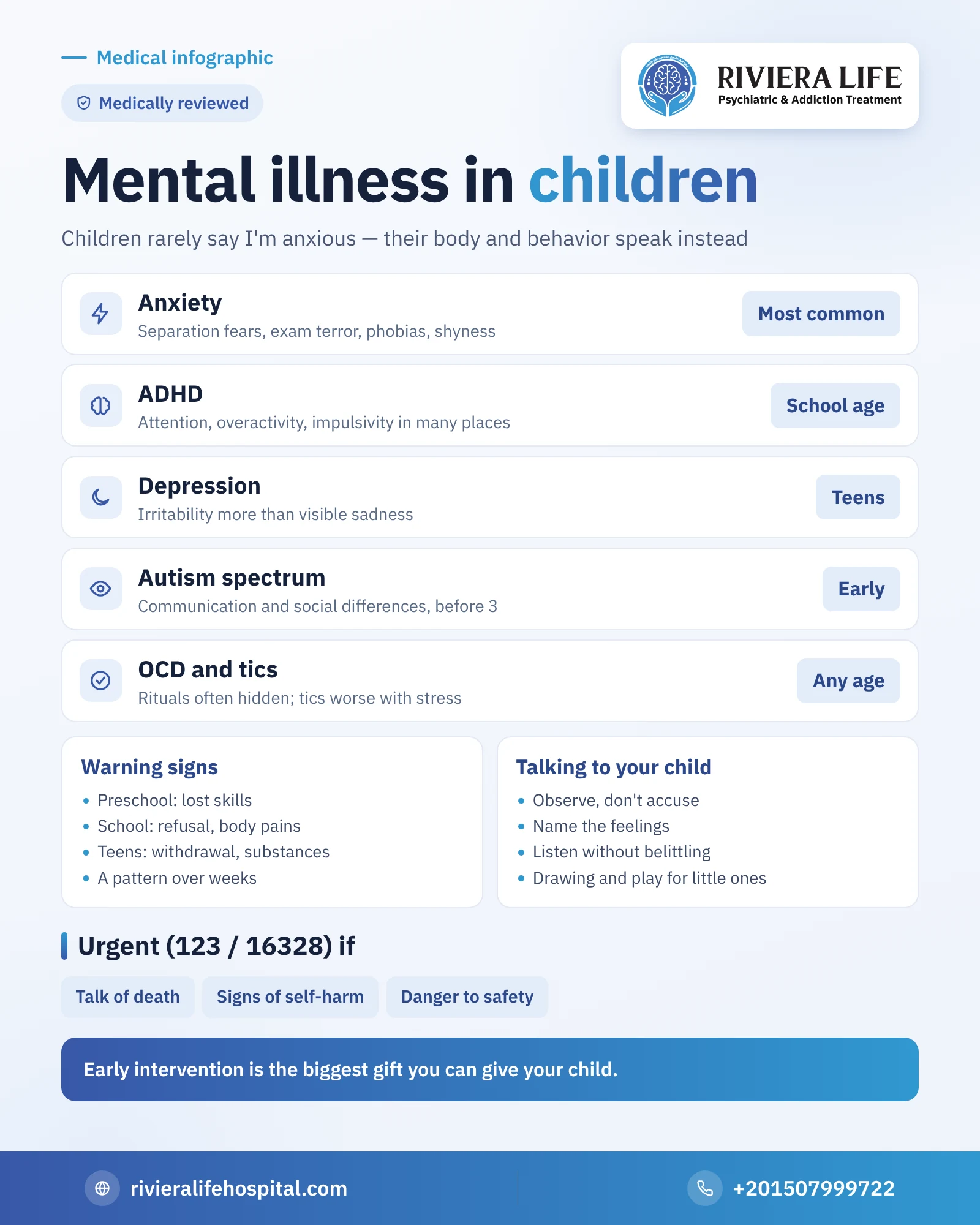
Warning signs by age
| Stage | Signs that deserve attention |
|---|---|
| Preschool (2–5 years) | Very severe and frequent tantrums, delayed speech or losing skills already acquired, weak eye contact and response to their name, and intense fear of separation that disrupts daily life |
| School age (6–12 years) | Refusing to go to school, repeated physical complaints with no medical cause, difficulty concentrating that affects achievement, withdrawal from friends, repetitive rituals, and persistent nightmares |
| Adolescence (13–18 years) | Long withdrawal, a sharp change in sleep or weight, a sudden drop at school, constant irritability, substance use, talk of despair or death, and signs of self-harm |
What matters isn’t one sign on a bad day, but a pattern that continues for weeks, or a clear change from the child’s usual nature. If you notice signs of substance use in your teenager, the article on how to know if my son is addicted to drugs may help you.
How do you talk to your child about their feelings?
Talking doesn’t need a formal session. Sometimes the truest words come in the car, during play or before sleep. These points help:
- Choose a calm time, and start with an observation, not an accusation: “I’ve noticed you don’t like going to training these days”.
- Name the feelings and help them name them: upset, scared, annoyed, embarrassed.
- Listen without rushing to a solution or belittling with phrases like “that’s a trivial matter”.
- With young children use drawing, stories and puppets, as they are their natural language.
- With a teenager respect their privacy, and assure them you are there when they are ready to talk.
- Explain that visiting a psychiatrist is like visiting any doctor, and is neither a punishment nor a shame.
And don’t forget yourself on this journey. Worrying about a child in pain is very exhausting, and an exhausted parent finds it hard to stay calm. Ask for support from your partner or family, share responsibilities, and don’t hesitate to ask for a consultation for yourself if you need it. A child learns to regulate their emotions largely by watching their parents regulate theirs.
The school’s role
The teacher sees the child for long hours in a different situation from home, and often notices concentration difficulties, withdrawal or bullying first. Regular communication with the school helps in three things: gathering information that helps the doctor with diagnosis, setting simple accommodations such as sitting in the front row or extra time in exams, and making sure the child isn’t a victim of bullying that increases their suffering.
School refusal in particular is a sign that shouldn’t be ignored or dealt with by force alone, as behind it there is usually anxiety, bullying, a learning difficulty or depression that needs understanding.
How are mental illnesses in children treated?
The general rule in treating children is that psychological and behavioral therapy comes first, and medicine is added when needed according to the disorder and its severity.
- Cognitive behavioral therapy: very effective in anxiety and OCD and depression, and adapted to the child’s age. Learn about it in the article on cognitive behavioral therapy.
- Parent training: essential in ADHD and tantrums, it teaches parents practical ways to manage behavior and reinforce the positive.
- Play therapy: for young children who express themselves through play more than words.
- Developmental interventions: in autism spectrum disorder, such as speech therapy, behavioral intervention and occupational therapy.
- Medicines: the child psychiatrist may prescribe a medicine in certain cases, such as moderate or severe ADHD, or anxiety, OCD and depression when psychotherapy alone isn’t enough. This is done after careful assessment and with regular follow-up, and it isn’t adjusted or stopped except by the doctor’s decision.
A child rarely needs hospital admission, and this happens when there is a danger to their safety or severe symptoms that can’t be dealt with at home.
When should you ask for help?
Ask for a specialist assessment if the symptoms continue for more than two to four weeks, affect study, relationships or sleep, if you notice a regression in skills the child had acquired, or if the teacher or pediatrician is worried. If your child or teenager talks about death or harming themselves, this is an urgent situation: call the ambulance on 123 or the mental health hotline on 16328, or go to the nearest emergency department, and read the article on self-harm to know how to respond calmly.
Early intervention is the biggest gift you can give your child, as a child’s brain is flexible and responds excellently to treatment, and delay makes the problem become entangled with study, self-confidence and relationships. To understand the role genetics may play, especially if one of the parents has a psychiatric disorder, see the article on hereditary mental illness.
How can Riviera Life help you?
The family can start with a free first consultation with a consultant psychiatrist at Riviera Life, to discuss what you are noticing and set an assessment plan suited to the child’s age, involving the parents at every step and in complete confidentiality. For teenagers who combine a psychological problem with substance use, the students and adolescents program is available.
Read also
- Attention deficit hyperactivity disorder
- Mental illness: symptoms, types and treatment
- Hereditary mental illness
- When you need a psychiatrist
- Oppositional defiant disorder: when is a child’s stubbornness an illness and how is it treated?
- Selective mutism in children: why do they talk at home and fall silent outside?
- Separation anxiety: when is it normal and how do parents deal with it in children and adults
- OCD in children: signs by age and the family’s role
- Bullying: its forms and signs and how parents and school should act
Questions many people ask
Some appear very early, such as autism spectrum disorder before age three, some at school age, such as ADHD and anxiety, while depression increases in adolescence.
Tantrums are normal at a young age, but they deserve assessment if they are very severe, repeated daily, continue past the expected age, or affect the child's life.
Treatment usually starts with cognitive behavioral therapy and family training, and medicine is added in certain cases after the psychiatrist's assessment and with regular follow-up.
If refusal repeats with morning physical complaints, intense fear or crying, anxiety, bullying or depression may lie behind it, and it deserves a calm conversation and a specialist assessment.
No. Early treatment protects the child's future because it treats the problem before it affects achievement and self-confidence, and medical information stays confidential.