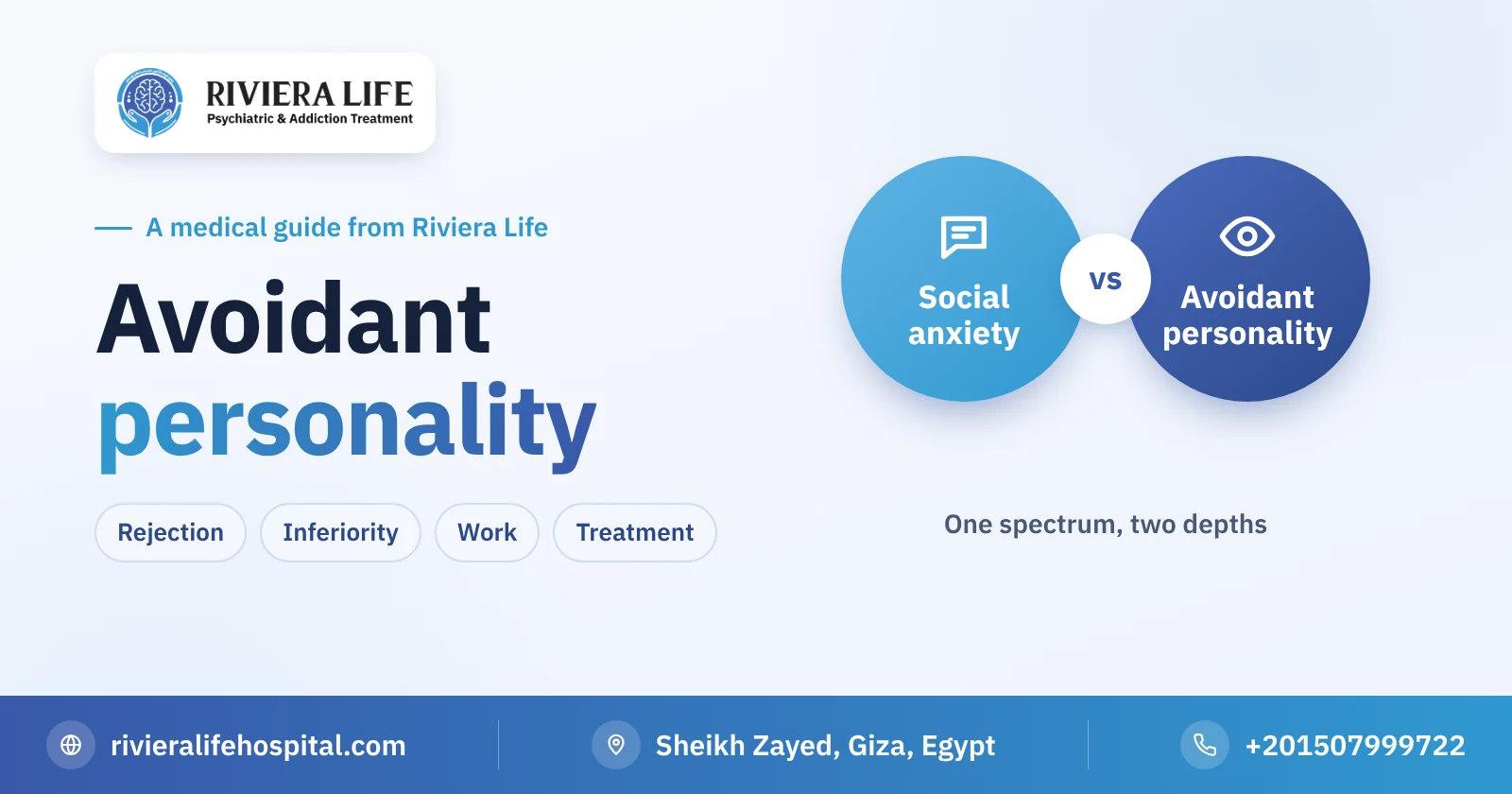
Avoidant personality, medically called avoidant personality disorder, is a lasting pattern of feeling inferior and intense fear of rejection and criticism, which drives its owner to withdraw from relationships and opportunities even though he longs to be close to people. The painful paradox here is that the person wants company, but is convinced he will inevitably be rejected, so he rejects himself first. This article explains the difference between it and social anxiety, its signs, its effect on work and relationships, and how treatment works. Diagnosis is the task of the psychiatrist or clinical psychologist, not a list you read online.
What is avoidant personality?
Avoidant personality disorder is one of the types in the anxious-fearful cluster. It usually begins in childhood with intense shyness, but instead of easing with maturity as happens with most shy children, it becomes more entrenched until it becomes a complete way of seeing oneself: “I’m less than others, and if they knew me well they’d move away”.
Studies estimate its prevalence at about one to two and a half percent of the general population, and men and women are affected about equally. Many of those affected never reach the clinic, because asking for help is itself a frightening social situation. To learn its place among the ten types, see our guide to personality disorders.
Avoidant personality and social anxiety: where is the difference?
This is the most important question, because the similarity is great and the two conditions often come together in the same person. We explained social anxiety in detail in its own guide, and here we just set out what distinguishes them:
| Point of comparison | Social anxiety | Avoidant personality |
|---|---|---|
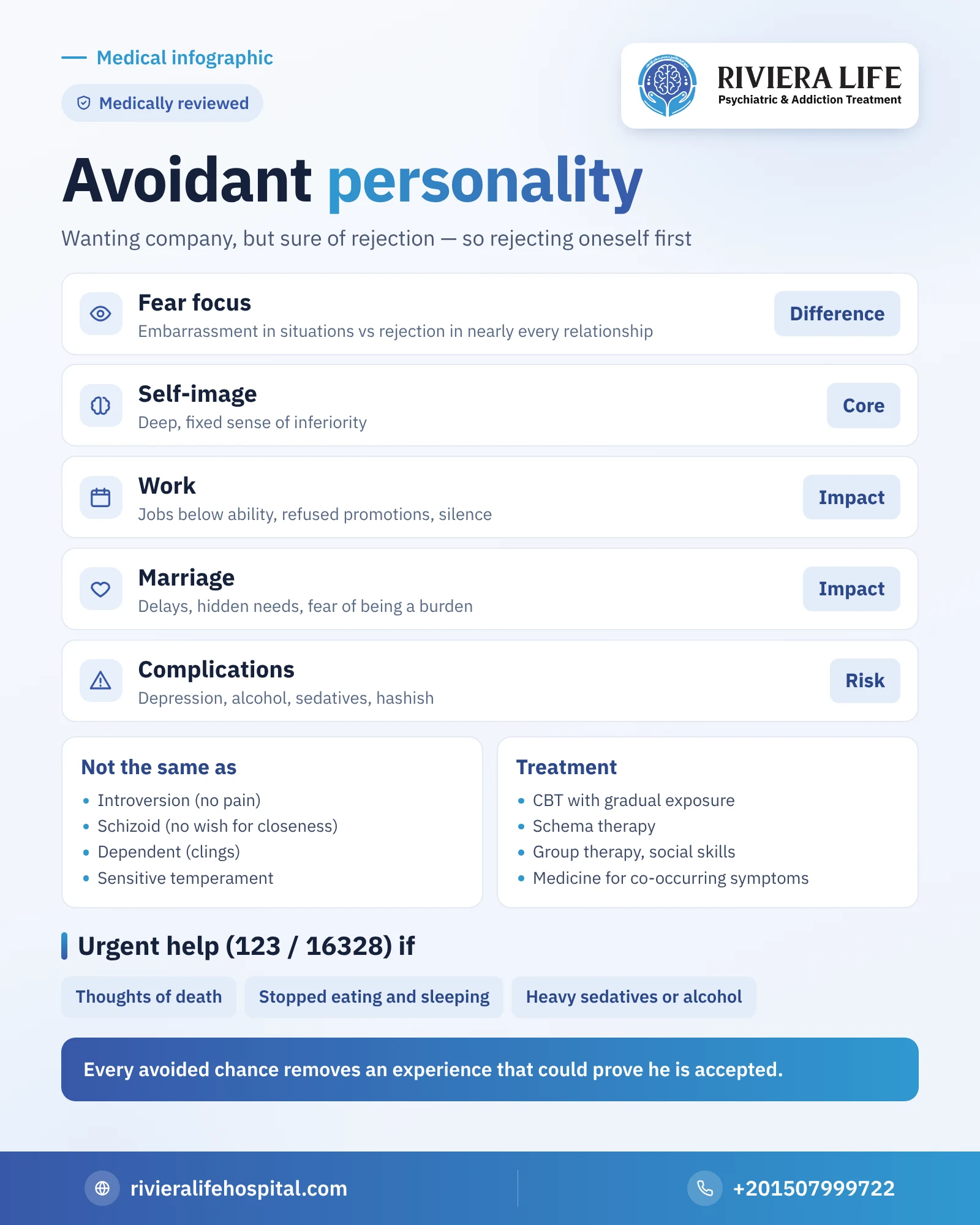
| Focus of the fear | Embarrassment in specific situations such as speaking or eating in front of people | Rejection in almost every relationship, even with those closest |
| Self-image | May be acceptable outside the feared situations | A deep and fixed sense of inferiority and unattractiveness |
| Breadth | May be limited to performance situations | Extends to work, friendship, marriage and everything new |
| Onset | Usually in adolescence | Clear roots in childhood and a fixed pattern from early adulthood |
| Close relationships | Usually possible with those he feels at ease with | Reserve and fear of exposure even within them |
Many researchers see the two conditions as lying on one spectrum, with avoidant personality representing its most severe and widespread end. The practical benefit of distinguishing them is that the treatment plan is longer and deeper when the sense of inferiority is part of the person’s identity.
Signs of avoidant personality
The fifth edition of the American diagnostic manual requires at least four signs:
- Avoiding work that requires a lot of dealing with people for fear of criticism or rejection.
- Not entering a relationship unless sure the other person will accept him.
- Reserve even in close relationships for fear of ridicule or embarrassment.
- Constant preoccupation with the possibility of being criticized or rejected in social situations.
- Inhibition and freezing in new situations because of feeling inadequate.
- Seeing himself as less than others or socially undesirable.
- Intense hesitation about any new experience for fear of embarrassment.
Before diagnosis, the specialist makes sure this pattern is old and stable, not a sudden withdrawal after trauma or during a depressive episode. He also rules out other causes that may resemble it, such as culturally expected shyness in a particular environment, isolation caused by substance use, or the beginnings of illnesses dominated by withdrawal. That is why he asks about childhood, school and the first job, and sometimes listens to a family member with the patient’s consent.
Not introversion and not cold isolation
An introvert enjoys his time alone and chooses a small circle without pain. Someone with schizoid personality doesn’t want closeness in the first place. But the avoidant person suffers from his loneliness, watches others laughing together and wishes he were among them. He also differs from dependent personality: the dependent clings to whoever cares for him, and the avoidant moves away before getting close. And if you are sensitive to criticism but your social life holds together, what you experience may be a temperament, not a disorder, which we explain in our article on the sensitive personality.
Why does avoidant personality form?
Some children are born with a more cautious temperament towards the new, a tendency with a genetic basis. When this temperament meets repeated experiences of rejection, such as parental mockery, constant comparison with siblings, bullying at school or emotional neglect, the child learns that exposure is dangerous. Then avoidance feeds itself: every opportunity he avoids deprives him of an experience that would prove he is accepted, so the belief stays in place and grows stronger.
The effect of avoidant personality on work
Many of those affected are competent and have real abilities, but choose jobs below their potential because they don’t require meetings or presentations. They refuse promotion if it means managing a team, don’t ask for a raise, and stay silent in meetings even though they have good ideas. And they may leave a whole job after a single remark from a manager because they read it as a final verdict on them.
Its effect on friendship and marriage
The social circle stays very narrow, sometimes only one or two people from the family. In engagement and marriage many are delayed, or accept the first person who shows acceptance of them for fear the opportunity won’t come again. And within marriage the partner may find it hard to know what the other feels, because he hides his needs for fear they will seem a burden. What helps the partner here is calm, regular reassurance, encouraging small steps, and avoiding mockery, even as a joke.
Complications: depression and substance use
Long loneliness and the sense of lost opportunities clearly raise the risk of depression. Some turn to alcohol, sedatives or hashish to be able to attend an occasion or to numb the feeling of loneliness, so the temporary solution turns into a second problem. Here treatment needs a plan that treats both together, as in our dual diagnosis program.
Treatment of avoidant personality
The good news is that avoidant personality is one of the personality disorders that respond most to treatment, because the person suffers and wants change. The main options:
- Cognitive behavioral therapy: it tests beliefs such as “they’ll inevitably reject me”, and builds a plan for gradually facing chosen situations in cooperation with the therapist.
- Schema therapy: it deals with the roots of the sense of defect and inferiority formed in childhood.
- Group therapy and social skills training: a safe space in which he tries talking and expressing himself and receives real acceptance from others like him.
- Medicine: it doesn’t treat the disorder itself, but the doctor may prescribe antidepressants to ease accompanying social anxiety or depression, and any adjustment or stopping is done with him only.
One known challenge is that the patient may miss sessions or withdraw from them for fear of disappointing the therapist, and a good therapist expects this and talks about it frankly and kindly.
When do you need urgent help?
Seek urgent help immediately if you see
Call an ambulance on 123 or go to the nearest emergency department, and don't stay alone with these thoughts.
- Thoughts of death or ending life, or talk about them
- A complete stop in eating, sleeping and going out for days
- Heavy use of sedatives or alcohol with disturbed consciousness
You can seek guidance from the General Secretariat of Mental Health and Addiction Treatment hotline on 16328.
How can Riviera Life help you?
We know that just making the call may be a hard step for someone living with this fear. That is why Riviera Life’s psychiatry consultants start with a calm, completely confidential meeting, in which they distinguish between social anxiety and a personality pattern, then suggest a plan of small steps that suits you. The first consultation is free, and you can get in touch at any time on +201507999722.
More from our personality disorders guide
- Types of personality disorders: the complete guide
- Dependent personality: the complete guide
- The sensitive personality: temperament or disorder?
- Social anxiety symptoms
- The introverted personality: a trait or a disorder, and how to tell it from social anxiety?
- The sadistic personality: signs, the difference between trait and disorder, and treatment
Questions many people ask
Shyness is a common trait that usually eases with familiarity and maturity. Avoidant personality is a fixed pattern of feeling inferior and fearing rejection that extends to work and close relationships and deprives its owner of real opportunities.
Yes, and many marry and form families. It may be delayed or need longer to build trust, and psychotherapy helps express needs within the relationship instead of hiding them.
It is one of the personality disorders that respond most to psychotherapy, and many improve clearly in confidence, relationships and work with commitment to sessions and practice in facing situations.
Give him steady acceptance without pressure or mockery, encourage small steps and celebrate them, help him book a first appointment with a specialist, and avoid talking about him in front of others.
No. Avoidance is a way the person learned to protect himself from the pain of rejection, usually rooted in a cautious temperament and painful early experiences, and it can be replaced with better ways through treatment.