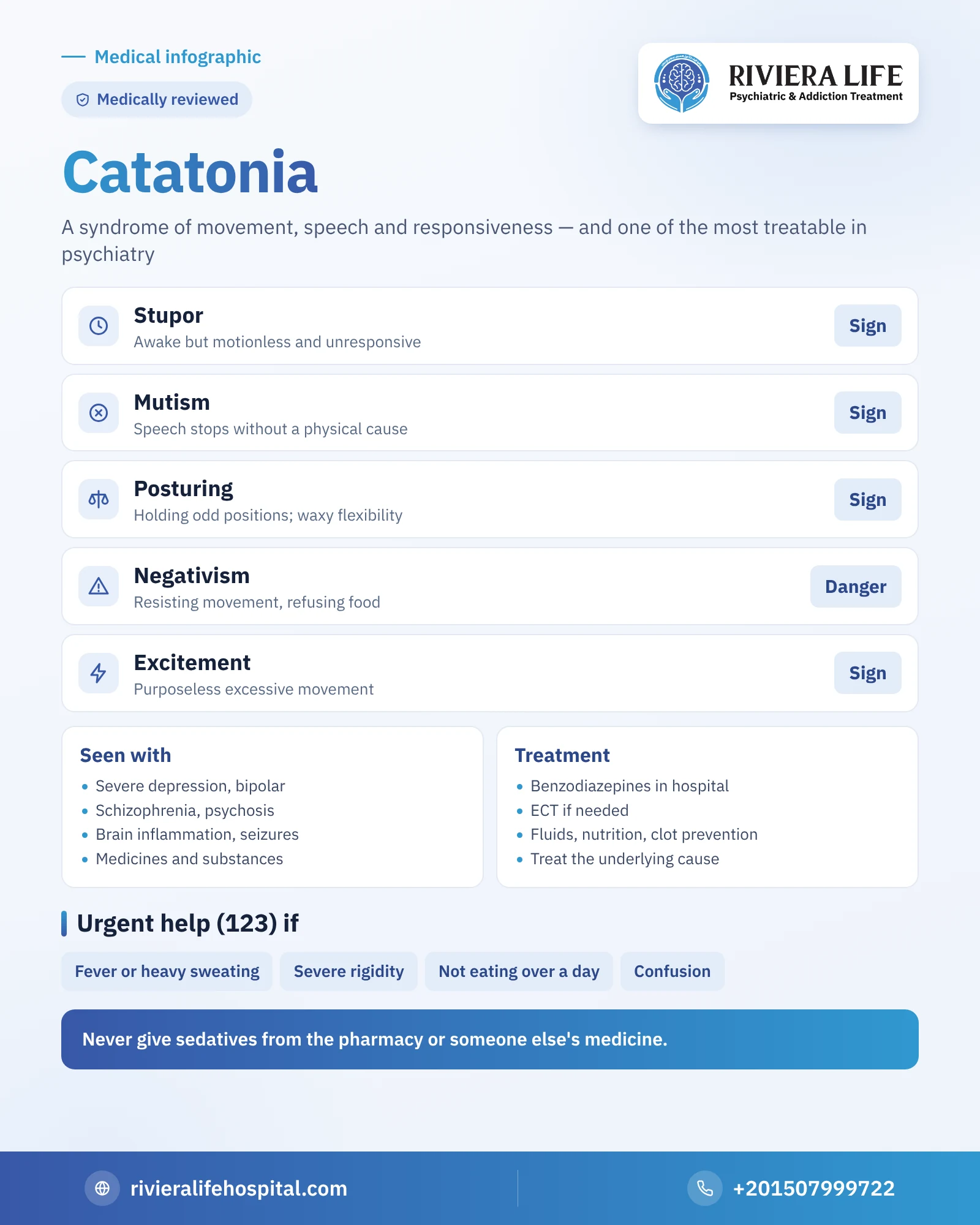
Catatonia is a syndrome affecting movement, speech and responsiveness together: a person may freeze in one position for hours, stop talking and eating, or enter purposeless motor agitation. Its name was once linked to schizophrenia alone, but doctors know today that it also appears with severe depression, bipolar disorder and some physical illnesses. The good news is that most cases respond clearly to treatment, sometimes within days, if diagnosed early. In this article we explain its signs, when it becomes an emergency, and how doctors deal with it, and in all cases diagnosis is for the psychiatrist alone.
What is catatonia?
Catatonia, which some doctors call “rigidity” or “motor immobility”, isn’t so much a standalone illness as a set of motor and behavioral signs that appear together on top of another condition. Modern classifications such as DSM-5 and ICD-11 describe catatonia as a syndrome that may accompany a psychiatric disorder or a medical condition, and usually require three or more signs from a specific list to be present together.
The basic idea that matters to the family: the affected person isn’t “stubborn” or “acting”. Many patients who have recovered later describe feeling intense fear, or being unable to initiate movement despite wanting to, as if the body wouldn’t obey.
Which conditions does catatonia appear with?
This is what distinguishes the modern view from the old one. Catatonia may appear with:
- Mood disorders: severe depression and bipolar episodes are among the most common causes, and some references indicate they are more common than schizophrenia among people with catatonia.
- Schizophrenia and psychotic disorders: “catatonic schizophrenia” was a separate type in the old classifications, and we explained why it was dropped in our article on types of schizophrenia.
- Medical conditions: brain inflammations, including autoimmune encephalitis, non-visible seizures, salt and gland disorders, and brain tumors or injuries.
- Medicines and substances: some antipsychotics in susceptible people, sudden stopping of benzodiazepines, and use of substances such as phencyclidine or high doses of some drugs.
- Developmental disorders: it may appear in some people on the autism spectrum, especially in adolescence.
That is why the doctor doesn’t stop at naming catatonia, but always looks for the cause behind it, because treating it is part of the plan.
Signs of catatonia: what do they look like in reality?
Stupor
A person who is awake with eyes open, but barely moves or responds to speech or touch. They may have been sitting on the edge of the bed since morning without changing position.
Mutism
Speech stops completely or almost completely, without a physical cause in the larynx or tongue. Sometimes they whisper a single word and then fall silent.
Posturing and holding positions
The person holds an odd position for a long time, such as raising an arm in the air or keeping their head lifted off the pillow as if on an “imaginary pillow”. In a sign called “waxy flexibility”, the doctor moves their arm and it stays in the new position.
Negativism and refusing food
Resisting any attempt to move or feed them, or doing the opposite of what is asked. This is the most dangerous part of the condition physically, because refusing food and drink leads to dehydration and malnutrition.
Echoing and repetition
Repeating the words of the person speaking to them literally, imitating their movements, or repeating a single movement without purpose.
Catatonic excitement
The other face of the condition: purposeless excessive motor activity, unrelated to what is happening around them, which may be accompanied by shouting or rushing that exposes the patient and those around them to injury.
Malignant catatonia: an emergency
In a proportion of cases catatonia develops into a dangerous form called malignant or lethal catatonia. Here it isn’t limited to immobility; the autonomic nervous system is disturbed: temperature rises, blood pressure and pulse fluctuate, the body stiffens, and consciousness may be affected. This form may deteriorate within days and threaten life, and needs admission to hospital immediately, sometimes to intensive care.
One reason for caution is that some forms of malignant catatonia resemble neuroleptic malignant syndrome, a rare complication of these medicines. That is why doctors are very cautious with antipsychotics during the episode, and the family must not give or stop any medicine without the doctor.
Seek urgent help immediately if you see
Call an ambulance on 123 or go to the nearest emergency department if the person is frozen or silent and also shows:
- A rise in temperature or heavy sweating
- Severe muscle stiffness or tremor
- A racing pulse, fluctuating blood pressure or difficulty breathing
- Refusing food and drink for more than a day
- Clouded consciousness or difficulty waking them
- Severe agitation that exposes them or others to harm
Complications of prolonged immobility
Even non-malignant catatonia may cause physical problems if it lasts: dehydration and kidney failure, weight loss, clots in the leg veins from lack of movement, bedsores, pneumonia if food or saliva enters the airway, and permanent muscle contractures. These complications are the reason for insisting that catatonia isn’t left “until it passes”.
How is catatonia diagnosed?
Diagnosis depends first on observation and clinical examination, and the doctor may use a structured scale going through the signs one by one. Then comes the search for the cause:
- Comprehensive blood tests including salts, kidney, liver and thyroid function, and the muscle enzyme if the malignant form is suspected.
- An electroencephalogram to rule out non-visible seizures.
- Brain imaging in certain cases, and sometimes examination of the spinal fluid.
- A careful review of the medicines and substances the patient has taken in recent weeks.
The doctor often carries out a treatment test with a benzodiazepine under observation; improvement of the signs afterwards supports the diagnosis and is at the same time the beginning of treatment.
Treatment of catatonia
Benzodiazepines
These are the first line of treatment in most guidelines, and a large proportion of patients respond to them clearly. They are given in hospital at doses set by the doctor and adjusted according to response, breathing and level of consciousness. This is a fully controlled medical use, different from using these medicines without supervision, which we discussed in our guide to benzodiazepines.
Electroconvulsive therapy
If the condition doesn’t improve with benzodiazepines within days, if the catatonia is malignant, or if the patient refuses food to a life-threatening degree, doctors turn to electroconvulsive therapy. It is given under full anesthesia with muscle relaxation, and is among the most effective treatments for catatonia, with high response rates reported in the medical literature. The frightening image of these sessions in films has nothing to do with their modern practice.
Supportive care and treating the cause
This includes fluids and nutrition, preventing clots, moving the patient to avoid sores, and monitoring vital signs. In parallel the underlying cause is treated: depression, a bipolar episode, psychosis or the physical condition. If catatonia is part of schizophrenia, for example, treatment continues after the episode is controlled, as in our article on schizophrenia treatment.
Does a person with catatonia recover?
Yes, and this is one of the messages families most need to hear. Catatonia is one of the few psychiatric conditions in which the family may see great improvement within days of starting the right treatment. A person who was frozen and silent may sit, eat and talk after a short time. But the possibility of the episode returning remains, especially if the cause isn’t treated or treatment is stopped early, so follow-up remains necessary.
The family’s role: what do you do if you notice these signs?
- Don’t interpret silence or immobility as stubbornness or “being spoiled”, and don’t try to force them to move.
- Record when the signs began, whether they are eating and drinking, and which medicines they take or have recently stopped.
- Seek an urgent psychiatric assessment the same day; don’t wait a week.
- Talk to them calmly even if they don’t reply; many patients hear and remember what was said to them.
- Don’t give them sedatives from the pharmacy or from someone else’s medicine.
And if your relative has schizophrenia, review what distinguishes the signs of relapse in general in our article on schizophrenia symptoms, because catatonia may be one of its faces.
How can Riviera Life help you?
Catatonia needs a place that combines psychiatry and close medical follow-up at the same time. At Riviera Life in Sheikh Zayed, psychiatric consultants follow the case around the clock, assessing the underlying cause and setting a plan to prevent further episodes, with a program that explains to the family what happened and what lies ahead. The first consultation is free and confidential on +201507999722.
More from our schizophrenia guide
- Schizophrenia: the complete guide
- Schizophrenia symptoms: early and psychotic signs
- Psychotic depression
- Schizophrenia treatment: medicine, rehabilitation and relapse prevention
Questions many people ask
No. It is a syndrome that may appear with schizophrenia, but also appears with severe depression, bipolar disorder and organic diseases of the brain or body, which is why the doctor always looks for the cause.
Many patients later remember what went on around them, so it is advised to talk to them calmly and respectfully even if they don't reply.
It differs from patient to patient, but many cases improve clearly within days of starting suitable treatment in hospital.
It is given under full anesthesia and medical supervision, and is among the most effective treatments in severe cases or those that haven't responded to medicine. The doctor discusses its benefits and risks with the family before starting.
It may, especially if the underlying cause isn't treated or treatment is stopped early, so regular follow-up with the psychiatrist remains important.