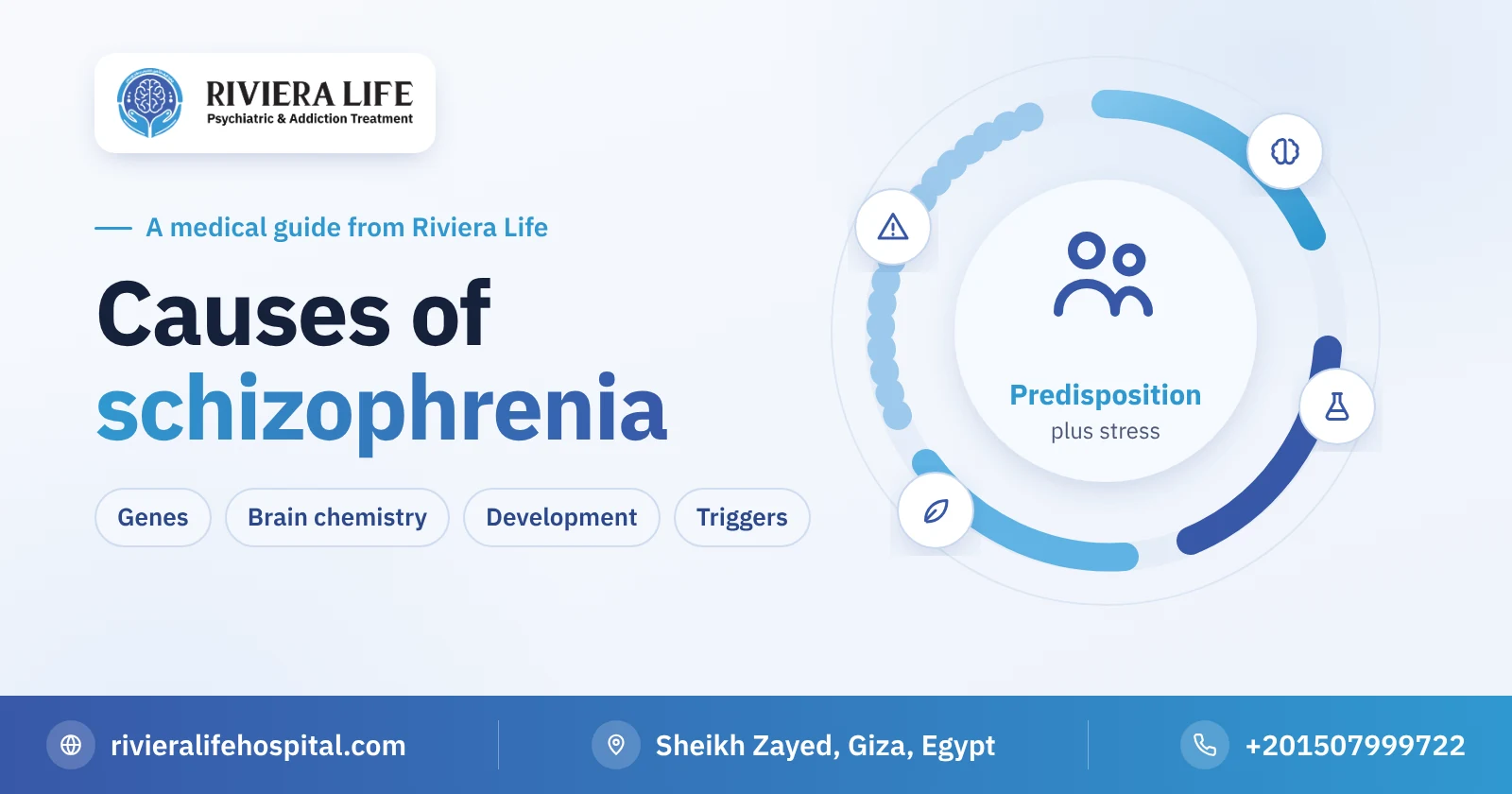
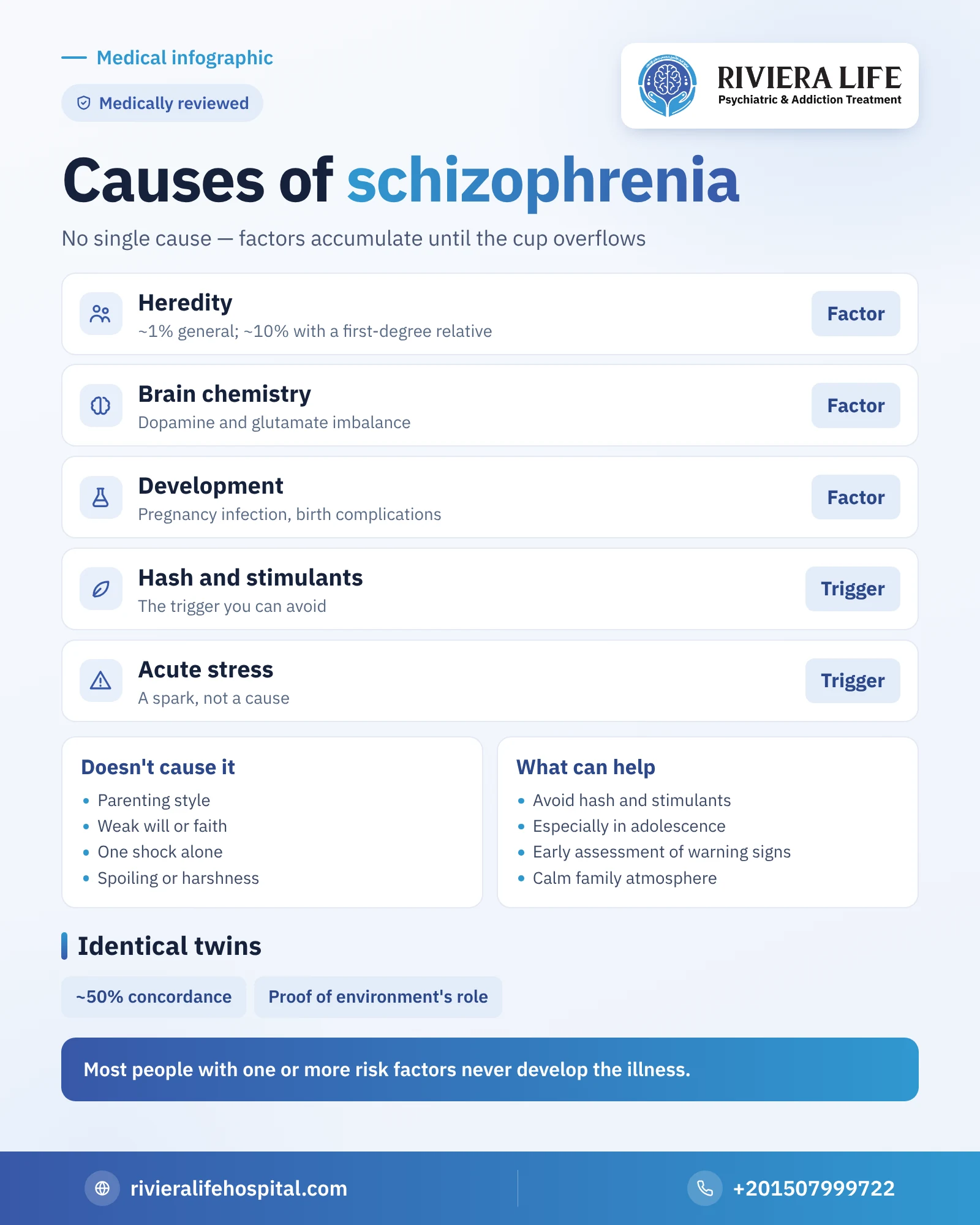
The causes of schizophrenia can’t be reduced to a single cause one can point to; the illness arises from accumulated factors: a genetic predisposition spread across many genes, influences on brain development from pregnancy, then triggers in adolescence and young adulthood such as using hash and stimulants and severe stress. No factor alone is enough to cause the illness, and most people who carry one or more factors never develop it. Here we explain each factor and its real weight as medical references present it, and correct common ideas that burden the family with guilt that has nothing to do with them.
Does schizophrenia have a single cause?
Doctors usually explain schizophrenia with a model called “stress-vulnerability”. Imagine a cup filling gradually: heredity fills part of it, pregnancy and birth complications add some, adversity in childhood adds more, then hash or an acute crisis at eighteen comes and the cup overflows. Another person may carry the same genes but their cup doesn’t fill, so they don’t become ill.
This model explains two observations that puzzle families: why one son is affected while his siblings are fine although they grew up in the same home, and why the illness sometimes appears in a family that knows of no previous case.
Heredity: how big is its role really?
Heredity is the strongest known risk factor, but it isn’t an inevitable fate. Among the approximate figures repeated in references:
- In the general population the lifetime likelihood of developing it is about 1%.
- If a parent or sibling is affected, the likelihood rises to about 10%, meaning nine out of ten first-degree relatives aren’t affected.
- In identical twins, if one is affected, the likelihood of the other being affected is about half, despite their almost identical genes, which is clear evidence of the role of environment.
There is no “schizophrenia gene”. What large genetic studies reveal is hundreds of common variants, each with a tiny effect, alongside rare changes with a larger effect, the best known being the loss of a small part of chromosome 22 known as 22q11.2 deletion syndrome. And there is still no genetic test that predicts a particular person will develop it.
Brain chemistry: dopamine and glutamate
The oldest chemical explanation for schizophrenia is the dopamine hypothesis. It says simply that increased dopamine activity in certain brain pathways is linked to hallucinations and delusions, while its deficiency in the frontal lobe is linked to negative symptoms and thinking difficulties. Two things support this: all known antipsychotics affect dopamine receptors, and stimulants that raise dopamine can cause psychosis.
But dopamine doesn’t explain the whole picture, as some patients don’t respond to these medicines. So interest turned to glutamate, the neurotransmitter responsible for a large part of excitatory signals in the brain, since substances that block one of its receptors, such as ketamine, produce symptoms resembling both positive and negative ones. The most likely explanation is an imbalance between several systems, not a deficiency or excess of a single substance.
The brain before birth: the neurodevelopmental hypothesis
Many researchers believe the roots of schizophrenia begin very early, during the brain’s formation, then symptoms appear years later when the brain passes through its major reorganization in adolescence. Early factors linked to a slight increase in risk include:
- Some infections during pregnancy, and severe maternal malnutrition.
- Birth complications that reduce oxygen to the baby’s brain, and very low birth weight.
- Advanced paternal age at conception.
Each of these factors raises the risk by a small amount, and most who were exposed to them aren’t affected. Mentioning them doesn’t mean the mother “made a mistake” in her pregnancy; most of these circumstances are beyond anyone’s control.
Changes in brain structure
Imaging studies comparing large groups of patients with others have shown differences such as slight enlargement of the fluid-filled cavities inside the brain, and reduced gray matter volume in areas linked to thinking and perception. The natural “pruning” process in which the adolescent brain gets rid of excess connections is thought to be excessive in some patients. But these differences appear in averages, not in every patient, which is why imaging isn’t used to diagnose schizophrenia.
Hash and stimulants: a trigger that can be avoided
Of all the risk factors, substance use stands out as the factor the person and their family can actually control.
Hash and bango
Many studies link regular hash use with a higher risk of psychosis and schizophrenia, and the link grows the younger use starts, the more often it is daily, and the higher the concentration of the active substance. Use is also linked to an earlier onset of the illness in those who carry the predisposition. The details are in the harms of hash and on the bango page.
Methamphetamine and stimulants
Stimulants such as shabu and ice raise dopamine strongly, and may cause a psychotic episode with hallucinations and intense suspicion even in those with no psychiatric history. This episode usually passes on stopping, but it may last longer or recur, and in some people it reveals an underlying schizophrenia. Read more on the methamphetamine page.
Drug-induced psychosis or schizophrenia?
Substance-induced psychosis usually improves within days to weeks of stopping, while schizophrenia persists. Follow-up studies indicate that a proportion of cases of psychosis linked to hash and stimulants later turn into a diagnosis of schizophrenia, which is why anyone who has had such an episode needs psychiatric follow-up, not just addiction treatment.
Childhood adversity and social conditions
Harsh childhood experiences, such as severe neglect and repeated trauma, are linked to an increased risk of psychosis later in life. Research has also found a slightly higher risk with growing up in crowded cities, migration and long social isolation. This doesn’t mean these conditions create the illness alone, but that they add chronic pressure on the stress response system in a brain that already carries a predisposition.
Acute stress: a trigger, not a cause
Families often link the start of the illness to a particular event: a decisive exam, the death of a relative, a separation, or travel. These events may be the spark that preceded the appearance of symptoms, but they don’t cause schizophrenia in a brain that doesn’t carry the predisposition. Understanding this difference eases a common feeling of guilt: “If we hadn’t pressured him in secondary school, he wouldn’t have become ill”.
What doesn’t cause schizophrenia?
- Parenting style: the idea of “the schizophrenogenic mother” is an old theory science has completely moved past.
- Weak will or faith: schizophrenia is a disorder of brain function, not a test of morals or piety.
- A single shock or embarrassing situation: may be a trigger in someone predisposed, but isn’t the cause.
- Excessive spoiling or excessive harshness: there is no evidence that either causes the illness.
Can schizophrenia be prevented?
There is no certain way to prevent schizophrenia, but some factors can be reduced. The most important is staying away from hash and stimulants, especially in adolescence and for those with cases of psychosis in the family. The second is early intervention: if signs of the prodromal stage appear, such as withdrawal, declining performance and suspicion, a quick assessment may shorten the period psychosis stays untreated, which is linked to better outcomes. You will find these signs in detail in schizophrenia symptoms.
Questions families ask about heredity
Will my children inherit schizophrenia if I have it? A child’s likelihood is higher than the general population’s, but the vast majority of patients’ children aren’t affected. Talking with the psychiatrist before having children helps understand the picture specific to each family.
My brother is affected; am I at risk? Your risk is slightly higher than others’, but remains low in absolute terms. The best thing you can do is avoid drugs completely, pay attention to your sleep and stress, and ask for an assessment if you notice changes that worry you.
If you have questions about a particular case, the first consultation at Riviera Life is free and confidential, and is handled by a consultant psychiatrist. To understand how these causes translate into a treatment plan, see schizophrenia treatment.
More from the schizophrenia guide
- Schizophrenia: the complete guide
- Schizophrenia symptoms and early signs
- Types of schizophrenia and the spectrum of psychotic disorders
- Schizophrenia treatment and the relapse prevention plan
- Schizophrenia and marriage: when is marriage possible, and what about pregnancy and heredity?
- Schizophrenia vs bipolar disorder: a comparison table and how the doctor tells them apart
Questions many people ask
Heredity plays a big role but isn't inevitable. The likelihood rises when a first-degree relative is affected, yet most relatives aren't affected, and many patients have no case at all in their families.
Hash doesn't cause schizophrenia in every user, but it clearly raises the risk in those who carry the predisposition, especially with starting in adolescence, daily use and high-potency types.
Acute trauma may be a spark preceding the onset of symptoms in someone predisposed, but it doesn't cause schizophrenia alone. Repeated adversity in childhood is a known risk factor among others.
No. The idea that a mother's or father's style causes schizophrenia is an old theory science has moved past. But a calm family atmosphere helps the patient stabilize after diagnosis.
There is currently no genetic or blood test that predicts a particular person will develop schizophrenia. Family history and psychological assessment when early signs appear are the available tools.