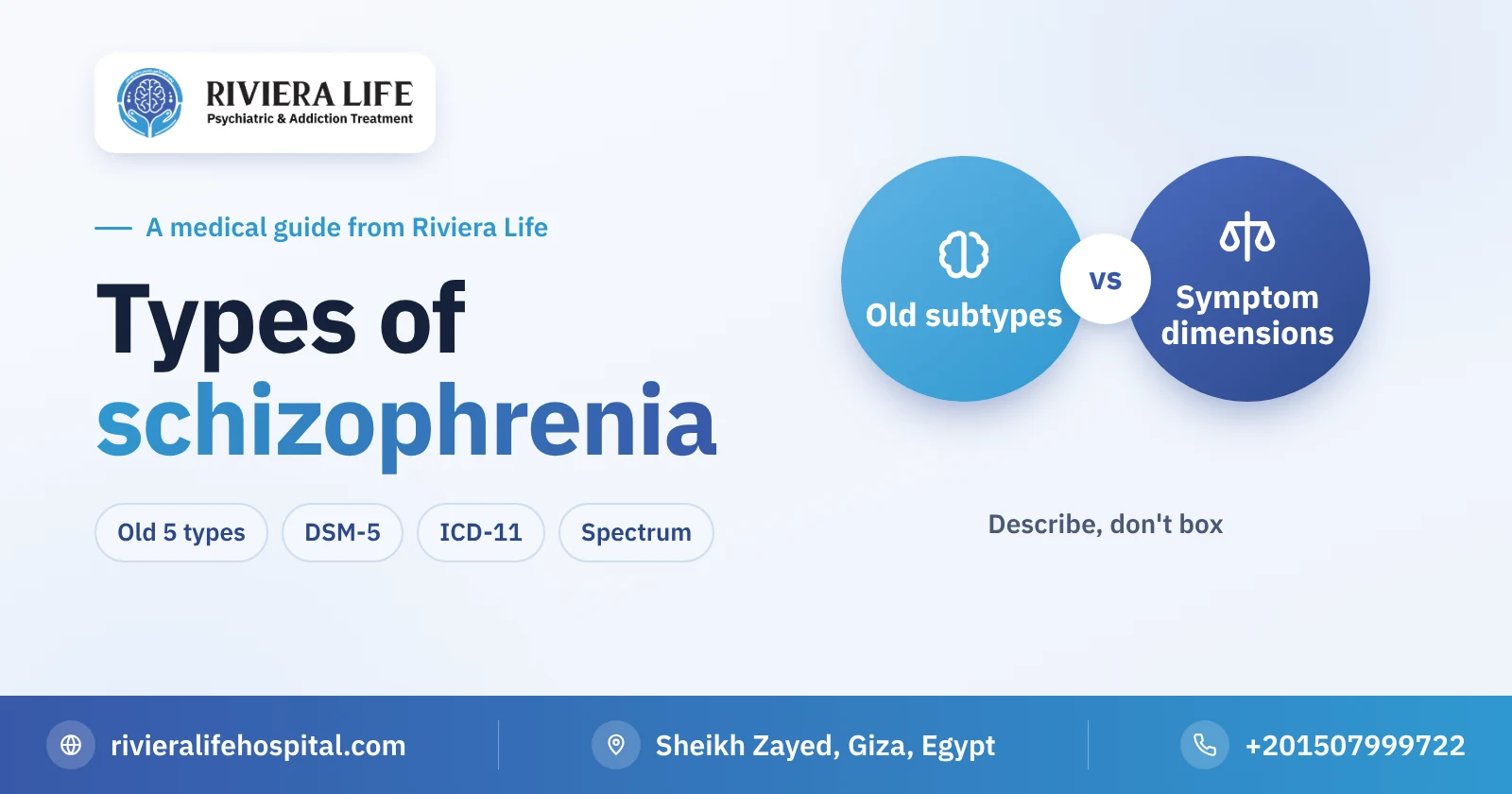
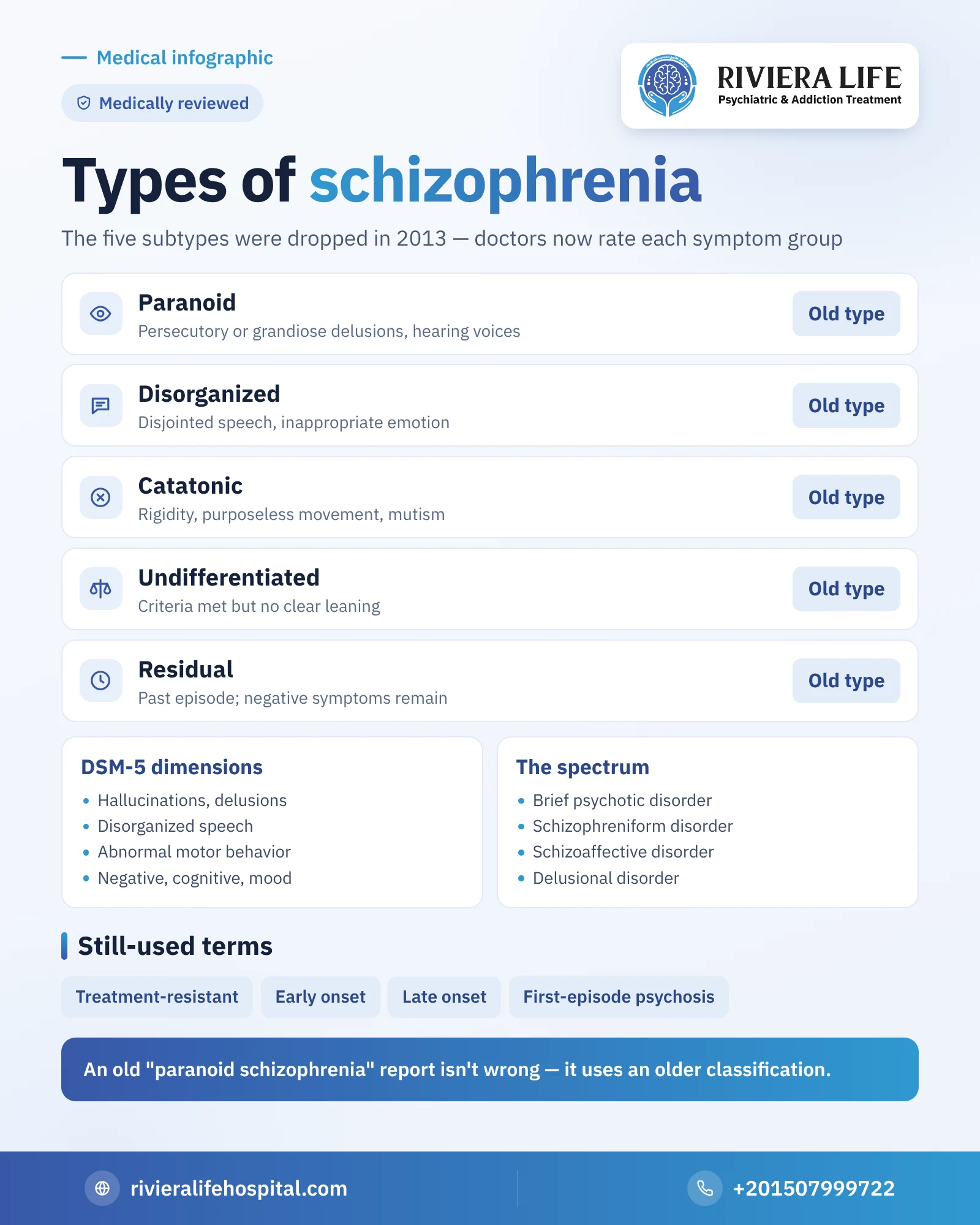
If you ask about the types of schizophrenia you will find two answers: the first, old one talks about five types, the best known being paranoid schizophrenia, and the second, modern one says these types have been abolished. Both are correct for their time. Doctors used the subtypes for decades, then the American diagnostic manual dropped them in its fifth edition in 2013, and the International Classification of Diseases followed in its eleventh edition. This article explains the old types and why medicine abandoned them, how doctors describe schizophrenia today, and the disorders close to it in what is called the schizophrenia spectrum.
Why was schizophrenia divided into types in the first place?
Since psychiatry described this illness in the late nineteenth century, doctors noticed that patients weren’t alike. Some were dominated by ideas of persecution while their speech seemed orderly, some spoke disjointedly and laughed at the wrong moment, and others froze in strange postures for hours. It was natural to give these pictures names, in the hope that each would have a different cause, treatment or course. These names lived long, and many people, and some old medical reports, still use them today.
The five types in the old classification
The fourth edition of the American diagnostic manual adopted five subtypes, determined by the most prominent symptoms at the time of assessment:
Paranoid schizophrenia
Dominated by delusions of persecution or grandeur and auditory hallucinations, with relative preservation of orderly speech, behavior and emotional expression. It was considered the most common type, and often starts at a relatively later age compared with others.
Disorganized (hebephrenic) schizophrenia
Dominated by disjointed speech, disorganized behavior and flat emotion or emotion inappropriate to the situation, such as laughing on hearing sad news. It usually starts earlier and strongly affects daily functioning.
Catatonic schizophrenia
Dominated by movement disturbances: complete rigidity, excessive purposeless movement, mutism, unjustified resistance to any instructions, or echoing others’ words and movements.
Undifferentiated schizophrenia
Used when the criteria for schizophrenia are met but the symptoms don’t clearly lean towards any of the three previous types.
Residual schizophrenia
Used for someone who went through a previous episode and no longer has prominent positive symptoms, but negative symptoms or mild odd thoughts remain.
The tenth edition of the international classification added two types not found in the American manual: simple schizophrenia, in which negative symptoms develop gradually without clear psychotic episodes, and post-schizophrenic depression.
Why were the subtypes abolished?
The division wasn’t abolished because the pictures it describes aren’t real; they do exist in patients. It was abolished because it didn’t achieve what it was made for. The reasons, in brief:
- Instability: one patient may be diagnosed with the paranoid type in one episode and the disorganized type in another, and the symptoms often overlap.
- Poor agreement between doctors: two doctors often disagreed about the same patient’s type.
- Little practical value: the type didn’t help much in choosing a medicine or predicting the response to it.
- Wide use of the “undifferentiated” type: a large proportion of patients didn’t fit the defined types in the first place.
How do doctors describe schizophrenia today?
Instead of putting the patient in one box, the doctor assesses the severity of each group of symptoms separately. DSM-5 proposes eight dimensions, each rated on a scale from zero to four: hallucinations, delusions, disorganized speech, abnormal motor behavior, negative symptoms, impaired cognition, depression and mania.
The result is a more precise picture: one patient may have severe delusions and mild negative symptoms, another the opposite, and each needs a different treatment focus. The doctor adds a description of the course of the illness after a year from its onset: first episode, multiple episodes or a continuous course, and whether the condition is now in an acute episode, partial remission or full remission. The phrase “with catatonia” can also be added if catatonic symptoms appear.
Schizophrenia in ICD-11
The eleventh edition of the International Classification of Diseases, which came into effect in 2022, took the same direction. The subtypes were abolished and replaced by specifiers for the most prominent symptom manifestations: positive, negative, depressive, manic, psychomotor or cognitive. And other specifiers for the course: first episode, multiple episodes or continuous, with the current state stated. Because this classification is the official reference of the World Health Organization, modern medical reports are gradually moving to this wording.
The schizophrenia spectrum and other psychotic disorders
Modern medicine places schizophrenia within a family of related disorders. The most important difference between them is the duration and nature of the symptoms, as in the table:
| Disorder | Duration | Distinguishing feature |
|---|---|---|
| Brief psychotic disorder | From a day to less than a month | Sudden psychotic symptoms that disappear with a full return to the previous level of functioning |
| Schizophreniform disorder | From a month to less than six months | Symptoms resembling schizophrenia but shorter, and it may later turn into schizophrenia |
| Schizophrenia | Six months or more | Psychotic symptoms with a decline in functioning, and usually negative symptoms |
| Schizoaffective disorder | Variable | Major mood episodes coinciding with psychosis, with a period of psychosis of at least two weeks without mood symptoms |
| Delusional disorder | A month or more | One or more delusions without prominent hallucinations, with daily functioning relatively preserved |
| Schizotypal personality disorder | A pattern extending from youth | Oddness in thoughts and behavior and social anxiety without persistent psychosis |
| Substance- or medication-induced psychosis | Linked to use or withdrawal | Usually improves after stopping the substance |
| Psychosis due to a medical condition | Linked to the physical illness | Improves by treating the cause, such as some brain and gland diseases |
This distinction isn’t just linguistic. A young man who went through a two-week psychotic episode after severe stress, then returned to how he was, differs in diagnosis and follow-up from someone whose symptoms lasted a year. And someone who used stimulants before the episode needs the substance assessed first, as we explain on the methamphetamine page.
Terms still in use
Despite the abolition of the subtypes, you will hear useful descriptive terms from doctors that aren’t official types:
- Treatment-resistant schizophrenia: when symptoms don’t improve enough after trying at least two different antipsychotics at an adequate dose and duration. This condition has special treatment options that we explain in schizophrenia treatment.
- Early-onset schizophrenia: when symptoms start before the age of eighteen; it is called childhood schizophrenia if it starts before thirteen, which is rare.
- Late-onset schizophrenia: when symptoms appear after forty; it is more common in women, and delusions usually dominate.
- First-episode psychosis: a description of the first psychotic episode before the final diagnosis becomes clear, and it has special early intervention programs.
Does the classification change the treatment plan?
It changes it to the extent that it reflects the patient’s actual needs, not to the extent of the name. Someone dominated by delusions and hallucinations needs a focus on adjusting medicine, and someone dominated by negative and cognitive symptoms needs more attention to rehabilitation and skills training. Catatonia is a condition with its own urgent treatment. Schizoaffective disorder adds, in many cases, a mood stabilizer or depression treatment to the antipsychotic, and substance-induced psychosis starts with stopping the substance and treating the addiction.
Where do hallucinations fit on this spectrum?
Hallucinations are a symptom, not a diagnosis. They may appear in schizophrenia, mood disorders, drug-induced psychosis and physical illnesses, and may even occur sometimes with severe sleep deprivation or deep grief without any psychotic disorder. That is why someone who hears voices needs an assessment that determines their real place on this map. You will find the types of hallucinations detailed in our article on types of hallucinations, and the signs the family sees in schizophrenia symptoms.
What do you do if you find an old diagnosis in a medical report?
If your relative’s report contains a phrase such as “paranoid schizophrenia”, this doesn’t mean a diagnostic error, but the use of an older classification. Ask the treating doctor about the most prominent symptoms now and the course of the condition, as this is what determines the plan. At Riviera Life you can show previous reports to a consultant psychiatrist in a free, confidential first consultation to review the diagnosis by current standards.
More from our schizophrenia guide
- Schizophrenia: the complete guide
- Schizophrenia symptoms and early signs
- Causes of schizophrenia and risk factors
- Schizophrenia treatment and the relapse-prevention plan
- Catatonia: the signs, causes, malignant catatonia and treatment
- Schizoaffective disorder: symptoms, types and the difference from schizophrenia
- Delusional disorder: types of delusions, the difference from schizophrenia and treatment
- Psychosis vs schizophrenia: a symptom or an illness, and how the doctor finds the cause
Questions many people ask
In the old classification there were five types: paranoid, disorganized, catatonic, undifferentiated and residual. Modern classifications abolished the subtypes and describe the patient by the severity of each group of symptoms they have.
No type is more dangerous by name. Danger is determined by the severity of symptoms, the presence of thoughts of harm, catatonia or accompanying substance use, and adherence to treatment, not the label.
It is no longer an official type in DSM-5 or ICD-11, but the picture it describes, namely predominant delusions and hallucinations, still exists and is described today through symptom dimensions.
In schizoaffective disorder major episodes of depression or mania coincide with the psychotic symptoms for a large part of the illness, with a period of psychosis without mood symptoms. In schizophrenia there may be mood symptoms, but not on this scale.
Many cases of brief psychosis end with a full return and don't recur, and some later develop into another disorder on the spectrum. That is why psychiatric follow-up is advised after any psychotic episode.