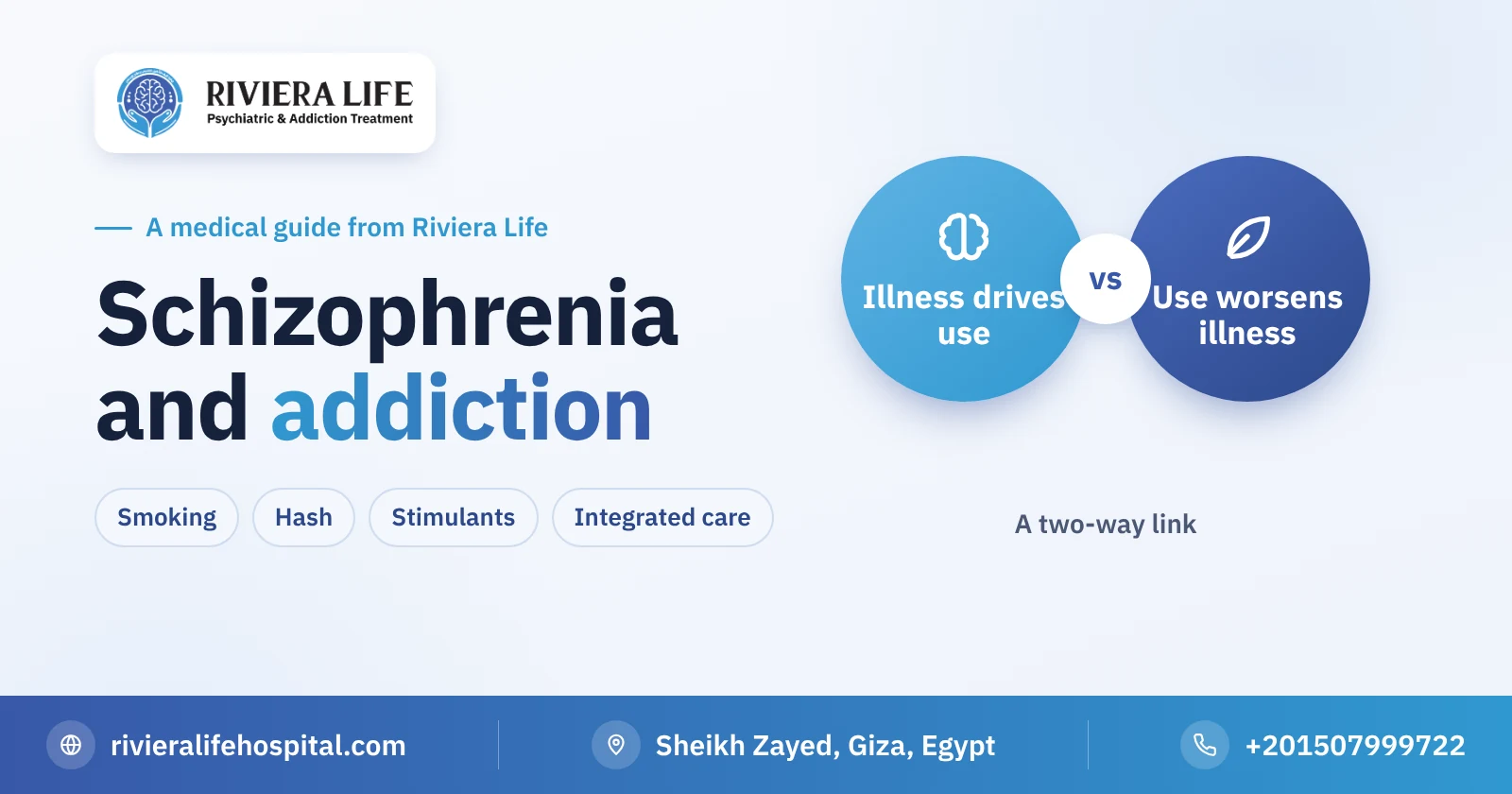
Schizophrenia and addiction come together more than many expect: the rate of smoking among people with schizophrenia is among the highest of any group, and use of hash, alcohol and stimulants is more common among them than in the general population. The relationship runs in both directions: hash may raise the risk of psychosis appearing in those vulnerable to it, and the illness itself pushes some of those affected towards substances in search of temporary relief. In this article we explain why this overlap happens, what each type of substance does to the course of the illness, and why treating one without the other doesn’t succeed. Diagnosis remains for the psychiatrist alone, especially as some symptoms of substance use resemble schizophrenia itself.
The size of the problem of schizophrenia and addiction together
Studies in different countries indicate that roughly half of people with schizophrenia go through a substance problem at some stage of their life, if we don’t count smoking. If we add smoking, the proportion rises much further: smokers make up the majority of patients in many studies, and many of them smoke heavily. The figures differ by country and method of measurement, but the direction is fixed: schizophrenia and substance use meet often, and the doctor should ask about use in every assessment.
Smoking: the addiction no one pays attention to
In many homes cigarettes are considered “the lesser of two evils” and are left without discussion. But smoking is responsible for a large part of the heart and lung diseases that shorten the lives of people with schizophrenia compared with others. And why do they smoke so heavily? Researchers suggest reasons including that nicotine temporarily eases some concentration difficulties and boredom, and that it may ease the feeling of some medication side effects, alongside social factors such as empty time and long-stay residences.
There is an important practical point: cigarette smoke speeds up the breakdown of some antipsychotics in the liver. So quitting smoking or going back to it may change the level of the medicine in the blood, and the doctor should be told before quitting so they can monitor and adjust if needed. Quitting is possible and beneficial for people with schizophrenia, and its options are explained in the article on quitting smoking.
Hash and psychosis: the most dangerous relationship
This is the point families in Egypt most need to understand, because hash and bango are widespread and seen as a harmless “mood”. What research says:
- Raising the risk of psychosis: repeated use, especially in adolescence and with high-potency types, is linked to a raised risk of psychosis and schizophrenia in genetically vulnerable people. Not every user will be affected, but the risk is real.
- Earlier onset: users who develop schizophrenia show the illness, on average, at a younger age.
- A worse course: continuing to use after diagnosis is linked to more relapses, repeated hospital admissions and weaker response to treatment.
The risks extend to synthetic types such as strox and voodoo, which may cause acute psychosis even in those without a clear predisposition. The psychological harms of hash are detailed in the article on the harms of hash.
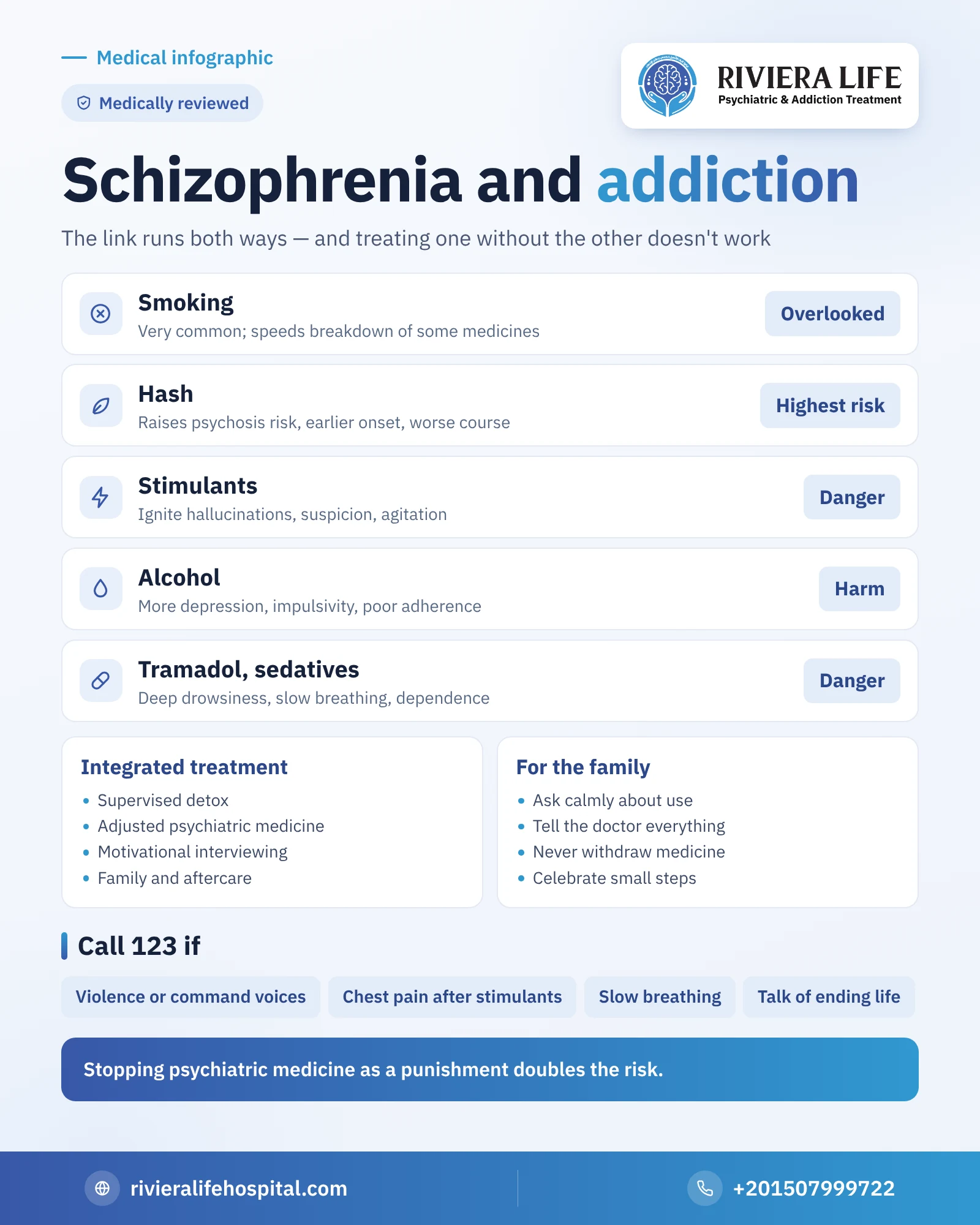
Stimulants, alcohol and narcotic medicines
Stimulants
Ice, Captagon and cocaine raise dopamine strongly, the same substance antipsychotics work to regulate. So they may ignite hallucinations, suspicion and agitation in a stable patient, and may cause a schizophrenia-like psychosis in others, which makes telling them apart difficult at first.
Alcohol
It increases depression and impulsivity, interacts with many medicines, and is linked to lower commitment to treatment.
Tramadol, pregabalin and sedatives
In the Egyptian context we see patients using them for sleep or to calm anxiety. They overlap with antipsychotics in their sedating effect, and combining them may lead to severe drowsiness or slow breathing, in addition to the risk of dependence.
Self-medication: why does the patient turn to the substance?
Many patients don’t use in search of a high, but to escape something. Some say hash “silences the voices” for an hour, or that alcohol eases anxiety in gatherings, or that the cigarette is the only thing that breaks the day’s boredom. Researchers see that this explanation, called the self-medication hypothesis, explains part of the picture but not all of it: there are also genetic factors shared between the two conditions, a similarity in the brain’s reward circuits, and social circumstances such as unemployment, isolation and company.
The problem is that the temporary relief is paid for twice over: relapse, weak commitment to medicine, family disputes, and sometimes legal problems.
The difficulty of diagnosis when the two conditions meet
When a young man arrives at the emergency department with hallucinations after using, the first question is: is this substance-induced psychosis that will go within days or weeks, or the beginning of schizophrenia that the substance uncovered? It can’t be answered immediately. The doctor relies on follow-up after stopping, on the previous history and on information from the family. Studies indicate that a proportion of cases of hash-induced psychosis later turn into schizophrenia or bipolar disorder, an additional reason for follow-up after the episode passes. The wider picture of psychosis and its causes is in the psychosis guide.
Integrated treatment: one plan for both conditions
For many years the patient moved between a place that treats addiction and refuses “psychiatric patients”, and a place that treats schizophrenia and asks them to “stop using first”. This model failed. What the evidence supports today is integrated treatment, in which one team manages both conditions together, as in the dual diagnosis program. It usually includes:
- Supervised detox when needed, with monitoring of psychotic symptoms that may intensify or ease during withdrawal.
- Adjusting the psychiatric medicine: the doctor chooses the suitable antipsychotic, and may prefer long-acting injections for those who find it hard to stay committed; some medicines have a special place for those whose use continues, and the decision is entirely medical.
- Motivational interviewing: a method that doesn’t rely on preaching, but helps the patient discover their own reasons for change.
- Cognitive behavioral therapy to deal with urgent craving and triggers.
- Involving the family and training them to communicate without hurtful criticism.
- Rehabilitation and aftercare: work or activity that fills empty time, and regular follow-up.
The medication and psychological basis for treating schizophrenia itself is explained in detail in the article on schizophrenia treatment.
Seek urgent help immediately if you see
Call an ambulance on 123 or go to the nearest emergency department if a person with schizophrenia shows, after using:
- Severe agitation, violence or hallucinations commanding them to harm
- Chest pain, a very high temperature or seizures after stimulants
- Deep drowsiness or slow breathing after mixing sedatives or alcohol with the medicine
- Talk of ending their life; you can also call the mental health hotline on 16328
Is recovery from both conditions together possible?
Yes, but the road is longer than treating either one alone, and relapse is an expected part of it, not evidence of failure. What we notice is that a patient who stops hash or stimulants while continuing their psychiatric treatment usually stabilizes more clearly: fewer hallucinations, better sleep, and a greater ability to work and keep relationships. Even reducing use, if complete abstinence isn’t possible at first, may be a first step towards a further goal. Most important is that the thread between the patient and their treatment team isn’t cut, and that the family remains a partner, not a judge.
Advice for the family
- Ask frankly and calmly about use, including hash, and don’t assume it is “just a cigarette”.
- Tell the doctor everything you know, even if the patient asks for secrecy; the information changes the plan.
- Don’t make the psychiatric medicine a condition withdrawn if they use; stopping the medicine doubles the risk.
- Celebrate small steps: smoking less or a week without hash is a real achievement.
- Ask for support for yourself too, as living with both conditions is exhausting.
How can Riviera Life help you?
At Riviera Life in Sheikh Zayed, consultants in psychiatry and addiction work in one team on cases where schizophrenia and substance use come together, with round-the-clock medical supervision and complete confidentiality. The plan starts with a free assessment, and extends to the family program and aftercare after discharge. Get in touch at any time: +201507999722.
More from the schizophrenia guide
- Schizophrenia: the complete guide
- The dual diagnosis program
- Causes and risk factors of schizophrenia
- Schizophrenia and marriage
Questions many people ask
It doesn't cause it alone in every user, but repeated use, especially in adolescence, raises the risk of psychosis and schizophrenia in those predisposed, and may bring its onset earlier.
Researchers suggest reasons including temporary relief of concentration difficulties and boredom, and shared genetic and social factors. Smoking here deserves treatment, not to be ignored.
Yes, because smoking affects how fast some antipsychotics are broken down, and the doctor may need to monitor or adjust treatment when quitting.
No. Stopping the psychiatric medicine doubles the risk of relapse, and it is better to treat both conditions together within one plan.
In a dual diagnosis program in which one team manages schizophrenia and addiction together, such as the program at Riviera Life in Sheikh Zayed.