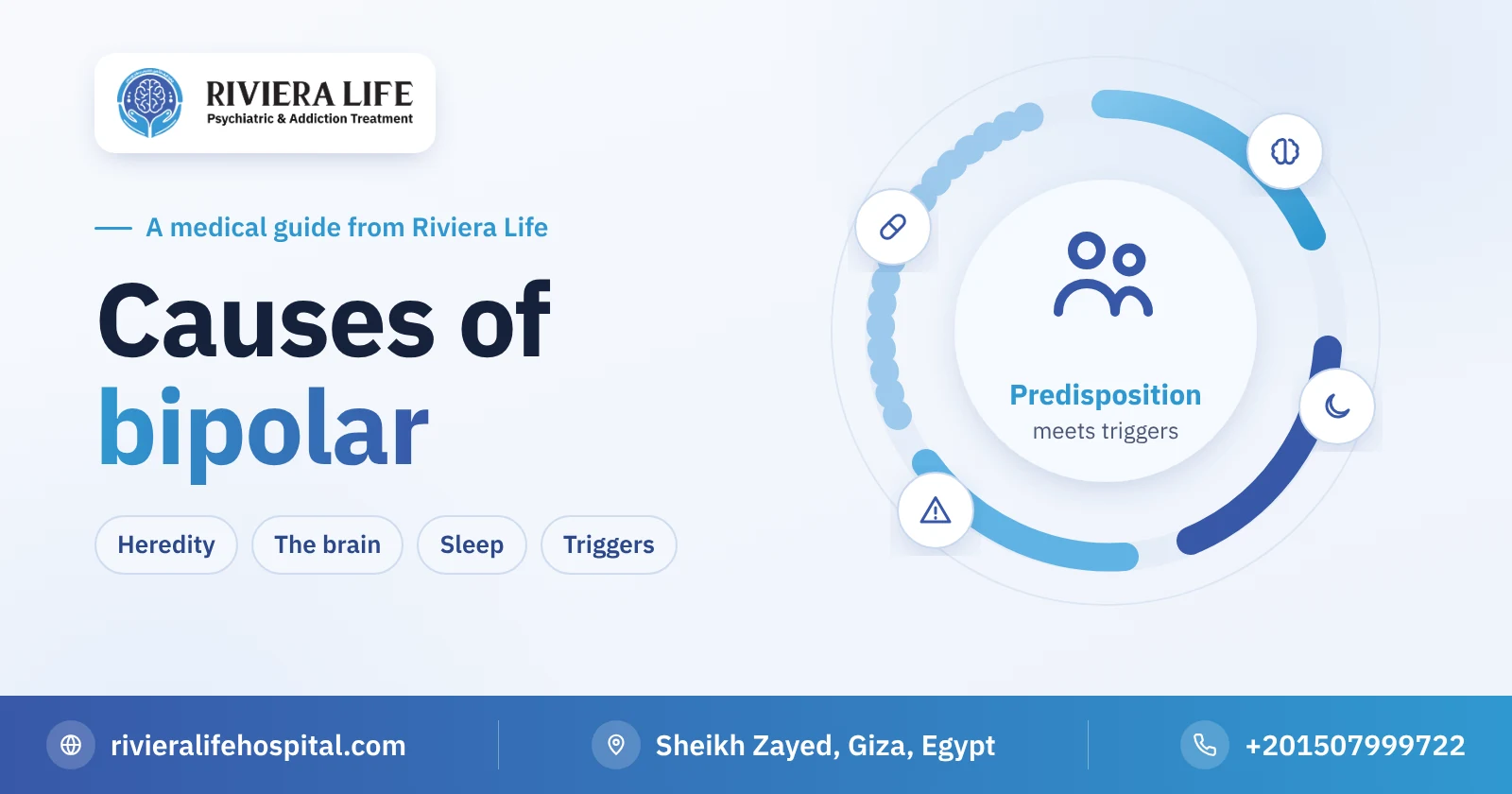
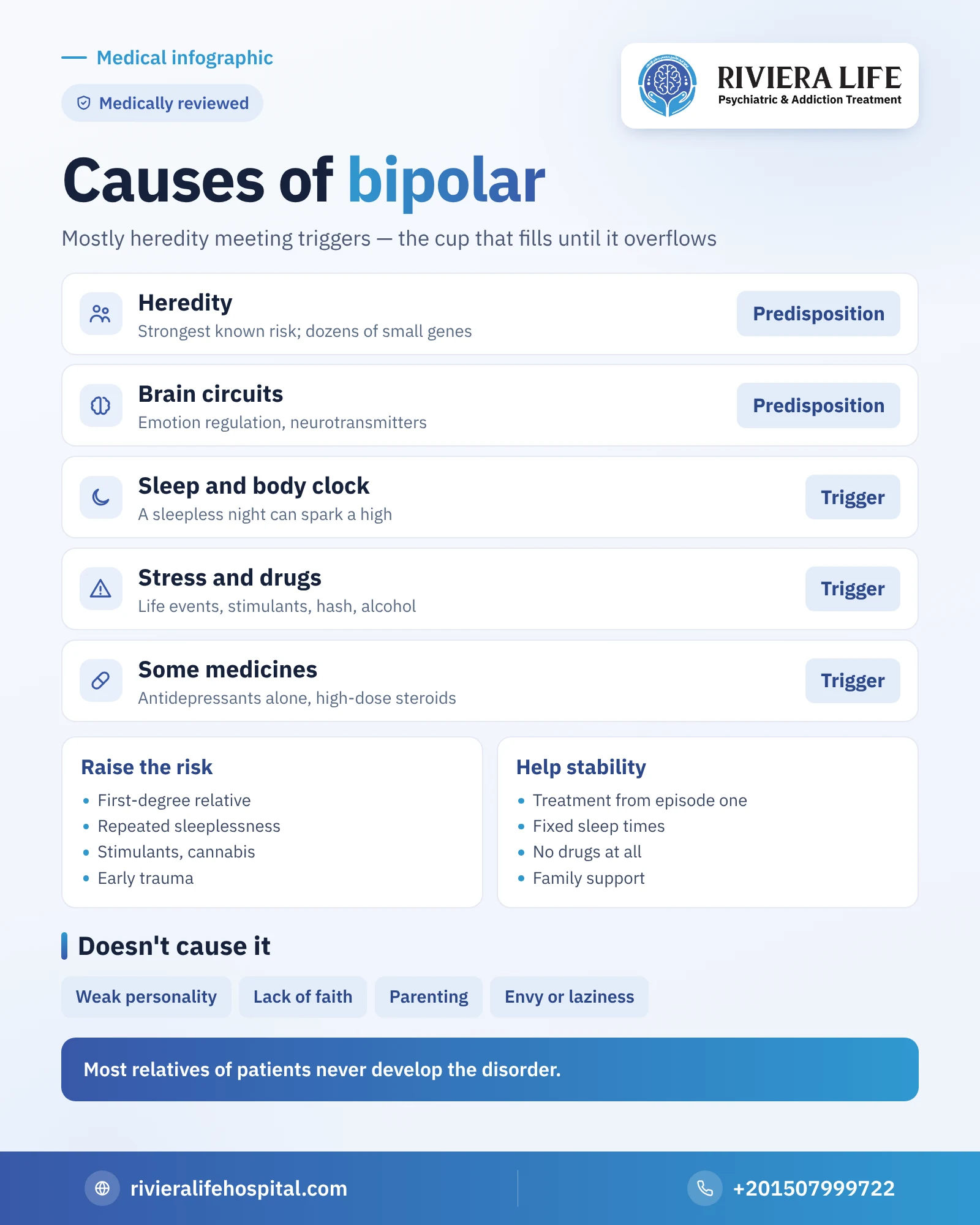
The causes of bipolar disorder can’t be confined to a single cause. Doctors today agree that it results from a biological predisposition, most of which comes from heredity, meeting triggers from the environment and daily life, such as lack of sleep, big stresses, drug use and some medicines. Predisposition alone usually isn’t enough, and a trigger alone doesn’t create the disorder in someone who doesn’t carry this predisposition. This article explains the role of each factor, what raises the risk, what has nothing to do with the illness despite being common among people, and what can be done to reduce the chances of episodes.
Why is there no single cause?
Doctors explain many psychiatric disorders with a model that combines vulnerability and stress. Imagine a cup filling gradually: the genes determine how much is in it from the start, and every sleepless night and every big crisis adds drops. In some people the cup stays far from full however much stress increases, and in others a single crisis is enough for it to overflow. This explains why two people go through the same circumstances, and one has a manic episode while nothing happens to the other.
The same model explains the timing of onset. The disorder usually appears in late adolescence and the early twenties, years in which brain maturation combines with many stresses at once: exams, late nights, moving away from home, and sometimes the first experience with alcohol or hash. That is why a first episode of depression or a severe high at this age shouldn’t be interpreted as “a phase that will pass” without assessment.
Heredity and family history
Heredity is the strongest known risk factor. The risk of the illness is clearly higher in the children and siblings of an affected person compared with the general population, and twin studies show that genetic factors explain the largest part of vulnerability. But this doesn’t mean there is a “bipolar gene” passed from father to son; research has found dozens of genes, each with a small effect, some of which overlap with genes for depression and schizophrenia.
More important for someone with an affected relative is that most relatives of patients never develop it. A family history is a reason for more attention, not for expecting the illness. It is also information the doctor must know before prescribing an antidepressant to any family member.
What happens in the brain?
Research shows differences in the working of brain circuits responsible for regulating emotion, especially in the relationship between the front areas of the brain, which control impulsivity, and the deep areas responsible for emotional response. It also points to disturbance in neurotransmitter systems, such as dopamine, noradrenaline and serotonin, and in the way nerve cells adapt to stress. Brain imaging studies have noted slight differences in the size and thickness of some areas in groups of patients.
But these results describe averages in large groups, and can’t be used to diagnose a particular individual. There is still no test or scan that proves the illness, and the phrase “an imbalance in brain chemistry” is a simplification useful for understanding, but it doesn’t tell the whole story.
The body clock and sleep
One of the clearest distinguishing features of this disorder is its sensitivity to disruption of the daily rhythm. Lack of sleep isn’t only a symptom of mania, but may also be its spark. A long sleepless night before an exam, a trip across time zones, or working night shifts may be enough in a predisposed person to start a high episode. Research points to the role of genes regulating the body clock in this. Some patients notice their episodes are linked to the seasons, such as highs tending towards spring and summer and depressive episodes towards autumn and winter, though this pattern doesn’t apply to everyone.
Stress and big life events
Events such as divorce, the death of someone close, losing a job, or moving to a new city precede many first episodes. Even happy events, such as marriage or promotion, may be a trigger if accompanied by late nights and disrupted routine. Doctors note that first episodes are usually linked to clear stress, while later episodes may come with a smaller trigger or without a visible cause, as if the brain becomes quicker to respond as episodes recur. That is why early treatment after the first episode is very important. Childhood trauma and maltreatment are also linked to an earlier onset and a harder course.
Drugs and alcohol: a trigger and a risk factor
Substance use is one of the most common triggers. Stimulants, such as cocaine and amphetamines including Captagon, may provoke a state exactly resembling mania, and may reveal a hidden disorder in a predisposed person. Regular use of cannabis is linked to earlier onset and more frequent episodes in those predisposed. Alcohol increases depression and impulsivity and weakens the effect of medicines. The relationship here is two-way: the disorder pushes to use, and use makes the disorder worse.
Medicines that may reveal mania
Some medicines may trigger a high episode in those predisposed, the best known being antidepressants if used alone without a mood stabilizer, and high-dose cortisone. That is why a careful doctor asks about any previous high episodes or family history before prescribing an antidepressant. And if unusual energy and impulsivity appear in someone days or weeks after starting a new medicine, this is an observation the doctor must know immediately, and the person shouldn’t stop the medicine on their own.
Childbirth and hormonal changes
The weeks after birth are a high-risk period for women with the disorder or with a strong family history. Sharp hormonal change combines in them with severe sleep deprivation, so the likelihood of a depressive or high episode rises, and sometimes postpartum psychosis. This doesn’t mean pregnancy is forbidden, but that it needs advance planning with the doctor.
Medical conditions that may mimic the disorder
Before making the diagnosis, the doctor rules out organic causes that may produce similar symptoms, such as an overactive thyroid, head injuries, some diseases of the nervous system, and the effect of drugs. In these cases the solution lies in treating the cause itself, which is what makes tests a necessary part of the first assessment.
Risk factors in brief
| Factors that raise the likelihood of the illness or episodes | Factors that help stability |
|---|---|
| An affected first-degree relative | Early diagnosis and treatment from the first episode |
| Repeated late nights and disturbed sleep times | Regular sleep at fixed times |
| Using stimulants, cannabis or alcohol | Complete abstinence from drugs |
| An antidepressant without sufficient assessment | Telling the doctor about any previous high episodes |
| Acute stresses and early trauma | Family support and regular psychotherapy |
What doesn’t cause bipolar disorder?
The disorder isn’t the result of weak personality, lack of faith, or wrong upbringing by the parents. Nor is it caused by envy, laziness or being spoiled. These explanations are widespread, and their price is high: they push the family to blame the patient or blame themselves instead of seeking treatment. Yes, a tense family atmosphere may increase the frequency of episodes, but it doesn’t create the predisposition from nothing, and improving it is part of treatment, not an occasion to hand out accusations.
Can it be prevented?
Genes can’t be changed, but triggers can be reduced. Someone with a family history benefits a lot from protecting their sleep, staying away from drugs, and telling any doctor about this history. For someone already diagnosed, prevention means preventing the next episode, which the plan for bipolar disorder treatment details. To learn the signs worth noticing early, see the article on bipolar disorder symptoms. And at Riviera Life the consultant psychiatrists help families draw a map of their patient’s specific triggers, in a free and confidential first consultation.
More from the bipolar disorder guide
- Bipolar disorder: the complete guide and types
- Bipolar disorder symptoms and early signs
- Bipolar disorder treatment and the recovery plan
- The causes of depression
- Bipolar disorder and marriage: disclosure, pregnancy and the partner’s role
- Cyclothymic disorder: symptoms, the difference from bipolar disorder and treatment
Questions many people ask
No. The risk rises in the children of those affected, but most never develop it. It helps you to protect your sleep, stay away from drugs and tell any doctor about this family history.
It isn't considered a sole cause, but regular use is linked to earlier onset and more episodes in those predisposed, and it weakens the response to treatment.
Traumas and big stresses may ignite the first episode in a predisposed person, and childhood trauma is linked to a harder course, but they don't usually create the disorder alone.
This may happen in those predisposed, especially if it is used alone without a mood stabilizer. That is why any unusual energy or impulsivity after starting the medicine must be reported to the doctor immediately.
No. The disorder rests mainly on a biological predisposition. A tense family atmosphere may increase the frequency of episodes, but improving it is part of treatment, not evidence of guilt.