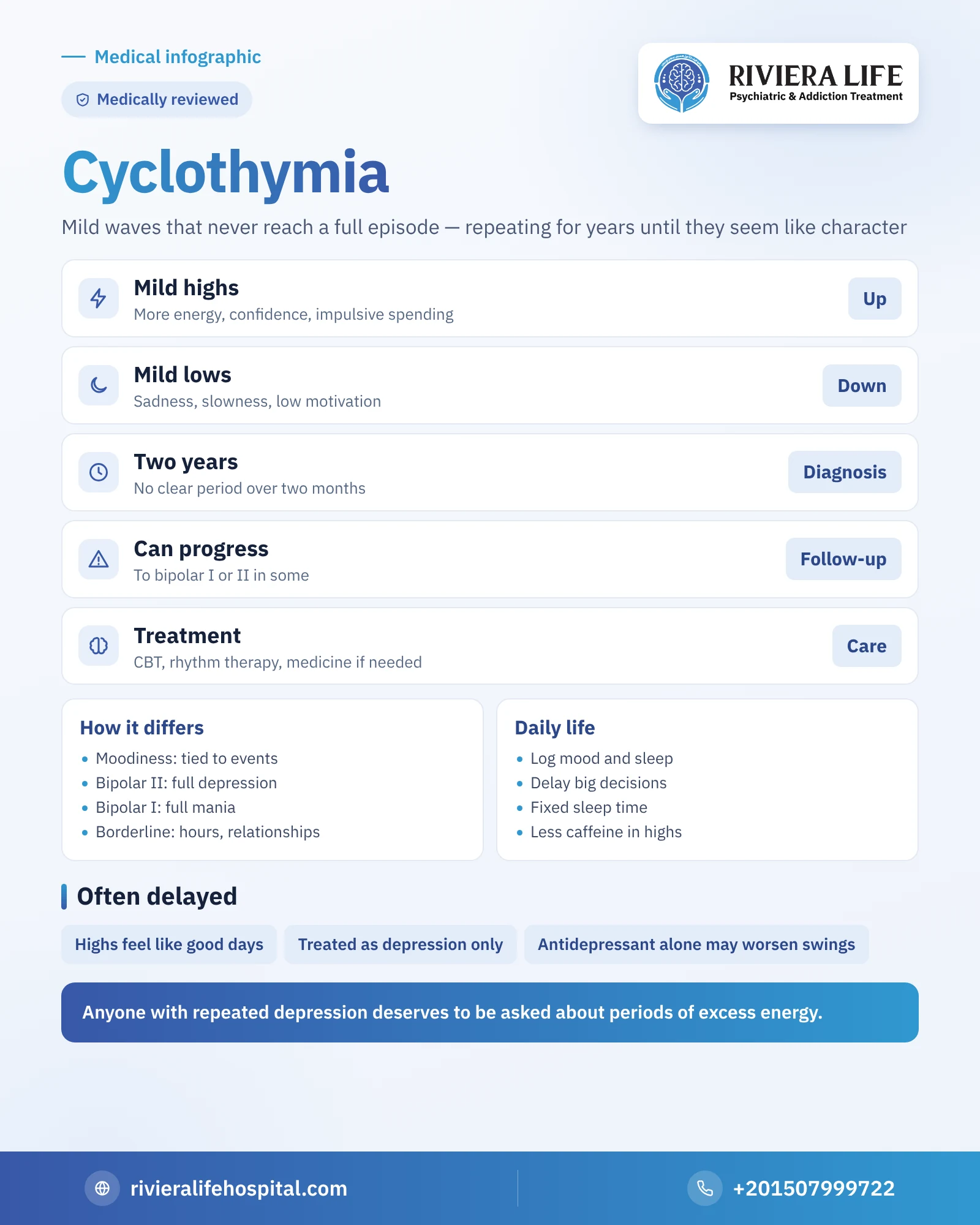
Cyclothymic disorder, medically called cyclothymia, is a long-term pattern of mood swings between mild periods of energy, openness and impulsivity, and mild periods of sadness and lethargy, without any of them reaching a full manic or depressive episode. The person lives in “waves” that repeat for years until they think they are their character, and they affect work, relationships and sleep. It belongs to the bipolar family but is milder, and needs follow-up because in some of those affected the illness develops later. Diagnosis is done by the psychiatrist alone.
What is cyclothymic disorder?
The diagnosis rests on a time criterion: symptoms between hypomania and mild depression that last at least two years in adults, and one year in teenagers and children, present for about half the time or more, and during which the person doesn’t go through a clear period exceeding two consecutive months. The symptoms don’t meet the criteria for a full manic, hypomanic or major depressive episode, otherwise the diagnosis changes to one of the types of bipolar disorder. In the international classification, cyclothymia is listed among the mood disorders related to bipolar disorder, and you can refer to the types of bipolar disorder to see its place among the types.
What does it look like in daily life?
In the high periods
- Higher energy than usual and slightly less sleep without clear tiredness.
- Excess confidence and more talking, and enthusiasm for new projects that usually end before they are complete.
- Impulsivity in spending, relationships or decisions, and sometimes irritability.
- Creativity and productivity on some days, which makes the person not see it as a problem.
In the low periods
- Sadness, emptiness or crying easily without sufficient reason.
- Slowness, tiredness and lack of motivation, and difficulty concentrating.
- A change in appetite and sleep, and withdrawal from people.
- A feeling of low worth or self-blame, without reaching the level of major depression.
These periods change over days or weeks, and may overlap. Those around describe the person as “moody” or “not steady”, and they describe themselves as not understanding themselves.
The difference between cyclothymia and normal moodiness
Everyone’s moods fluctuate, so what is the dividing line? The dividing line is in duration, frequency and effect. Normal moodiness is usually linked to events and calms quickly, and doesn’t spoil work, study or relationships continuously. Cyclothymia, however, is a continuous fluctuation that hardly calms for more than weeks, repeats for two years, and leaves real effects: jobs left, relationships faltering, and spending that can’t be understood. For a detailed comparison read the moody personality and mood swings.
The difference from bipolar disorder and borderline personality
| Condition | What most distinguishes it |
|---|---|
| Cyclothymia | Mild waves that don’t reach a full episode, lasting two years or more |
| Bipolar II disorder | A full major depressive episode with hypomania |
| Bipolar I disorder | A full manic episode that clearly weakens functioning |
| Borderline personality | Fast swings within hours or days, linked to relationships and fear of abandonment |
To distinguish between the last two, the article on the difference between bipolar disorder and borderline personality helps.
Why is diagnosis delayed?
Because the person rarely complains. The high periods seem to them and to people as “good days”, and the low ones are attributed to life’s pressures. They usually ask for help at the time of the low, so they are diagnosed with depression and given an antidepressant only, without being asked about periods of energy. This may be insufficient or unsuitable in some cases, because antidepressants alone may increase swings in someone with a bipolar tendency. That is why everyone with repeated depression deserves to be asked by the doctor about periods of excess activity, and to bring someone close who notices the differences.
Causes and risk factors
There is no single cause. Heredity seems to play a role, as the condition is more common in those with a relative who has bipolar disorder or depression. Factors such as disturbed sleep rhythm and the body clock, severe pressures, childhood trauma and substance use interact with it. The condition usually starts in late adolescence or early adulthood. For the broader picture of the causes of this family of illnesses see the causes of bipolar disorder.
Does it turn into bipolar disorder?
In a proportion of those affected, and not a small one, the condition may develop over the years into type I or type II, which is what makes follow-up important. But not everyone with cyclothymia will progress, as some stay in their pattern for many years. Most importantly, regular follow-up catches the change early so that treatment changes in time.
Cyclothymia and substance use
Alcohol, hash and stimulants are common in this condition because the person sometimes looks to calm the low or prolong the high. But they worsen the swings and reduce sleep. If you notice that substance use is escalating with mood changes, mention it to your doctor, as the two conditions are treated together. For comparison with bipolar disorder see bipolar disorder and addiction.
Treatment: what helps?
There are no medicines approved specifically for this disorder, and most treatment is psychological and behavioral, with medicine in some cases.
- Psychotherapy: cognitive behavioral therapy to understand the thoughts and feelings that accompany the swings, and interpersonal and social rhythm therapy that regulates times of sleep, eating and activity.
- Psychoeducation: for the person and family to learn their early signs and what ignites the waves.
- Lifestyle: regular sleep, exercise, and reducing caffeine, late nights, alcohol and stimulants.
- Medicine when needed: the doctor may see that mood stabilizers are needed in cases of severe swings or possible progression. The decision, choice and duration are theirs alone, and no medicine is started or stopped without their supervision.
The doctor may treat depression with a medicine very cautiously so as not to trigger mania. To learn about the options in the closest family: bipolar disorder treatment.
How do you deal with daily life?
- Record your mood and sleep daily for a few weeks, as the chart reveals patterns you don’t see from memory.
- Postpone big decisions in periods of impulsivity, and don’t sign financial commitments in an enthusiastic week.
- Keep a fixed time for sleeping and waking even on holidays.
- Reduce caffeine and stimulants in the high periods.
- Tell someone you trust about your early signs so they can help you notice.
When should you see a psychiatrist?
Don’t wait for a major episode. The matter deserves assessment if your mood swings continue for months and affect your work, study or relationship, or if those around you have said “you’re not steady” more than once, or if you repeat impulsive decisions then regret them, or if repeated depression appears that hasn’t improved with treatment alone, or if you have started relying on alcohol, hash or stimulants to control your mood. Go with someone who knows you well, and bring your notes about sleep and mood.
Questions that help you notice the pattern
- Have you had periods of excess activity and little sleep without tiredness, then periods of lethargy?
- How long does the change usually take, and how long has this pattern been going on?
- Has there been a clear period lasting more than two consecutive months?
- Have the swings affected your job, relationships or finances?
- Is there anyone in the family who has suffered bipolar disorder or repeated depression?
These questions don’t diagnose, but they help organize the conversation with the doctor.
Ask for urgent help immediately if you see
Call an ambulance on 123 or the mental health hotline 16328 or go to the nearest emergency department:
- Thoughts of death or ending life
- Days without sleep with impulsivity and unrealistic thoughts
- Severe sadness with inability to take care of yourself
How does Riviera Life help you?
At Riviera Life in Sheikh Zayed, Giza, psychiatrists assess mood, sleep and substance use together, and set a follow-up plan for the condition. The first consultation is free and confidential on +201507999722.
More from the bipolar disorder guide
- Bipolar disorder: the complete guide
- Types of bipolar disorder
- Bipolar disorder symptoms
- The moody personality and mood swings
Questions many people ask
A chronic pattern of mild periods resembling hypomania and other mild depressive periods, which don't reach the level of a full episode.
At least two years in adults and one year in children and teenagers, without a clear period lasting more than two months.
No, but it belongs to its family and is milder. In some of those affected it may develop into type I or type II.
Not always. Psychotherapy and regulating sleep are the foundation, and the doctor may add a medicine in some cases.
When the swings continue and affect work or relationships, and immediately when thoughts of ending life appear.