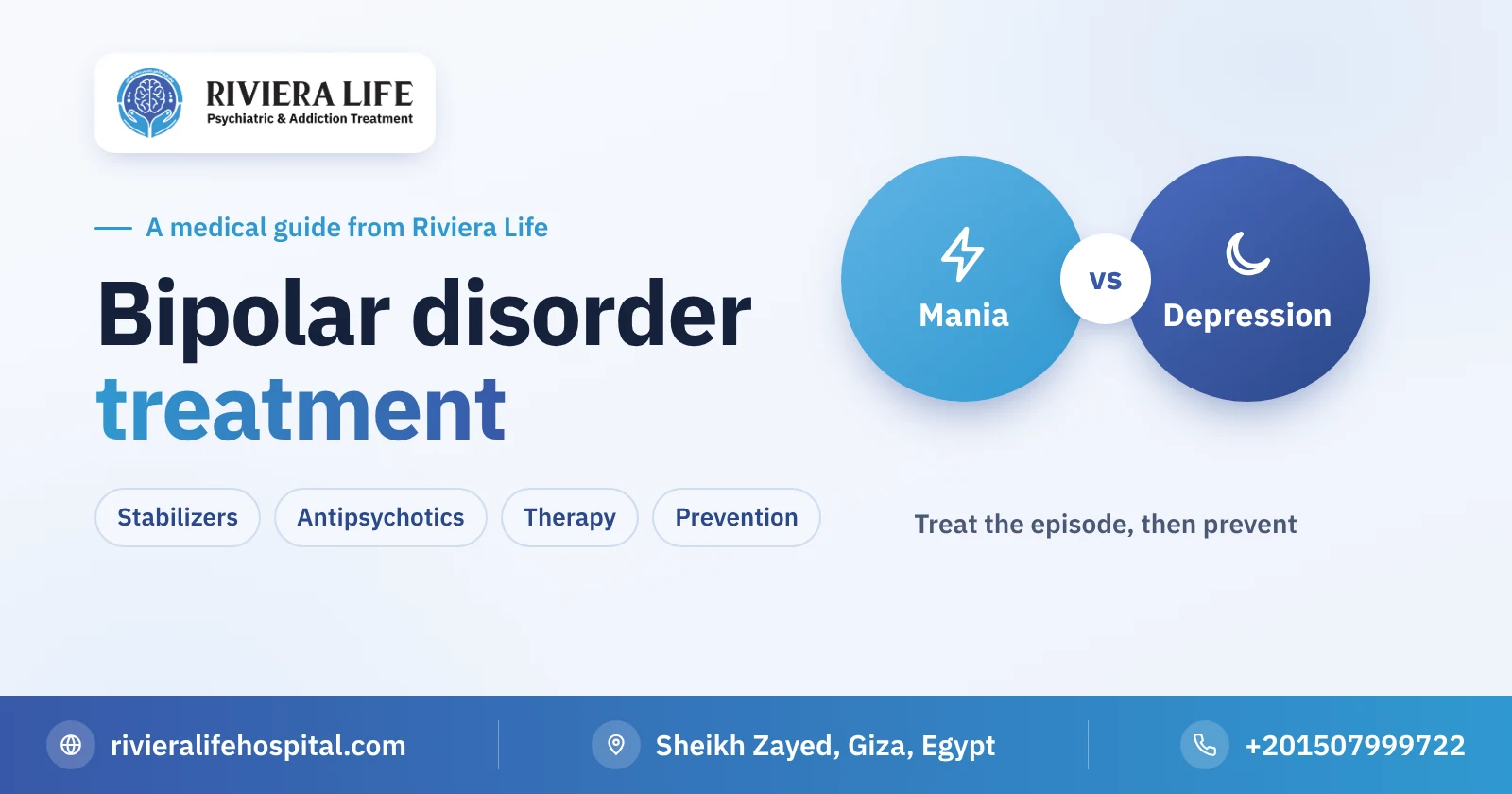
Bipolar disorder treatment is possible and effective, but it differs from treating a cold that ends when the medicine ends. A successful plan works on two levels: putting out the current episode, whether mania or depression, then preventing the next episodes for years. It is based on mood stabilizers or some modern antipsychotics, with psychotherapy that teaches the patient and his family how to read early warnings. This article explains the medication and psychological options, when the patient needs hospital admission, how a relapse prevention plan is built, and then how to choose the right place for treatment. Only the treating psychiatrist determines or changes the medicine.
What exactly does the doctor treat?
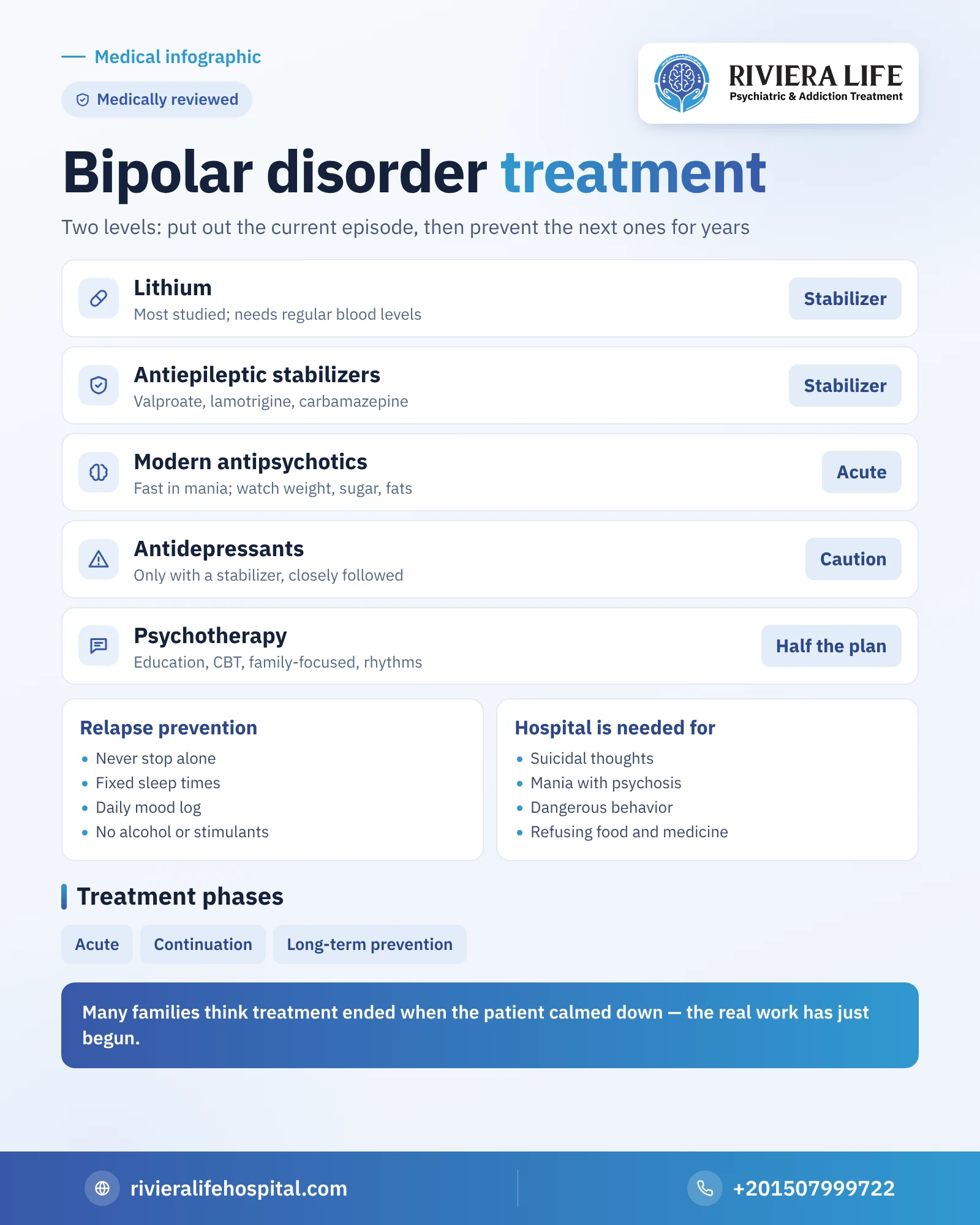
Treatment usually passes through three overlapping phases. The first is the acute phase, whose goal is to control the current episode and protect the patient from its decisions and dangers. The second is the continuation phase, in which improvement is consolidated over the following weeks and months so the same episode doesn’t relapse. The third is the long-term prevention phase, the most important and longest, because the disorder tends to recur. Many families think treatment is over when the patient calms down, while the real work has only just begun.
Mood stabilizers
They are the cornerstone of bipolar disorder treatment, and work to reduce the severity and frequency of episodes.
Lithium
The oldest and most studied mood stabilizer, and many guidelines consider it the first choice for long-term prevention, and it is also linked to a lower risk of suicide. Lithium needs regular blood tests to measure its level, because the gap between the useful level and the harmful level is narrow, and it also needs kidney and thyroid follow-up. Its blood level rises with dehydration or with some painkillers and diuretics, which is why every doctor treating the patient should know he takes it.
Antiepileptics used to stabilize mood
Some epilepsy medicines have a mood-stabilizing role. Valproate is effective in manic episodes, but doctors usually avoid it in girls and women of childbearing age because of its known danger to the fetus. Lamotrigine is more useful in preventing depressive episodes, and is started with a slow, gradual increase set by the doctor to reduce the risk of a rare but serious skin rash. Carbamazepine is used in certain cases with attention to its interactions with other medicines.
Modern antipsychotics
The use of these medicines isn’t limited to psychosis, as a number of them are approved for treating manic episodes, and some for treating bipolar depression or for prevention. They work relatively quickly in calming agitation and lack of sleep, which is why they are often used in the acute phase, alone or with a mood stabilizer. Among their possible side effects are weight gain and raised sugar and fats, which is why the doctor follows weight and tests periodically. The doctor chooses the medicine according to the type of episode, the previous history and the side effects the patient tolerates.
Antidepressants: why do doctors handle them with caution?
It may seem logical to treat bipolar depression with an antidepressant, but using it alone without a mood stabilizer may push some patients into a manic or mixed episode or speed up the cycles. That is why these medicines are usually used only with a mood stabilizer, under close follow-up, and for the shortest possible time. This is one of the most important reasons for distinguishing this disorder from unipolar depression, whose plan differs, as our article on depression treatment explains.
Treatment by type of episode
A manic episode
The priority here is safety: calming agitation, restoring sleep and preventing destructive decisions. The doctor starts a modern antipsychotic or a mood stabilizer or both, and stops any antidepressant the patient was taking. In severe episodes, a hospital stay is the safest route.
A depressive episode
It needs longer patience, because bipolar depression sometimes responds more slowly. Specific medicines proven effective in this type of depression are used, with psychotherapy and careful monitoring of suicidal thoughts, especially in the first weeks.
Psychotherapy: half the plan
Medicine prevents the episode, and psychotherapy helps the patient live his life without every day becoming a struggle. Among the evidence-based methods:
- Psychoeducation: understanding the disorder, its medicines and its early warnings, one of the most effective interventions in reducing relapse.
- Cognitive behavioral therapy: dealing with depressive thoughts, and controlling impulsivity in periods of elevation.
- Family-focused therapy: improving communication at home and teaching the family how to support without clashing.
- Interpersonal and social rhythm therapy: regulating times of sleep, eating and work, because disruption of the daily rhythm is one of the strongest triggers of episodes.
When does the patient need hospital admission?
Not every patient needs a stay, as many are treated with outpatient follow-up. But a stay becomes necessary if suicidal thoughts or attempts appear, severe mania with psychotic symptoms, aggressive or reckless behavior that threatens safety, refusal of food and medicine in deep depression, or when medicines need adjusting under close monitoring. The goal of the stay is to protect the patient in the most dangerous days of the episode, then move gradually to outpatient follow-up.
Electroconvulsive therapy and stimulation treatments
Electroconvulsive therapy is carried out today under full anesthesia and medical monitoring, and is considered one of the most effective treatments in severe cases: deep depression with a high suicide risk, severe mania that doesn’t respond to medicine, psychotic symptoms, or when some medicines aren’t suitable, as in some cases of pregnancy. Magnetic stimulation of the brain still has a less clear place in bipolar depression, and the doctor decides on it in selected cases.
The relapse prevention plan
What protects the patient most after stabilization:
- Continuing the medicine and not stopping it by personal decision, even after months of improvement.
- Fixed sleep and waking times, and caution with long late nights and travel across time zones without a plan.
- Recording mood and sleep daily to detect any change early.
- Staying away from alcohol, drugs and stimulants, including energy drinks in large amounts.
- A written plan agreed with the family and the doctor that sets out what everyone does when early signs appear.
Knowing personal triggers is part of this plan, with details in our article on causes of bipolar disorder.
Cases that need special care
Pregnancy needs advance planning with the doctor, because some mood stabilizers need adjusting, and because the period after childbirth raises the risk of episodes. Teenagers need a program in which the family and school take part. And a patient who uses substances, such as alcohol or cannabis, needs dual treatment of the disorder and the addiction together, because continued use defeats the best medication plan.
The recovery rate from bipolar disorder: what does improvement mean?
There is no single recovery rate that can be trusted, and any figure announced as a “guaranteed cure” deserves suspicion. Bipolar disorder is a chronic disorder by nature, and the logic of managing it is closer to diabetes and blood pressure: it isn’t uprooted for good, but it can be controlled for many years. The more precise question is: is a stable life achieved? The answer is yes for many, especially with early treatment and regular follow-up, while others need repeated adjustments before they find the plan that suits them.
What doctors measure in practice is remission, meaning months or years passing without an episode with a return to work and relationships. This varies according to:
- Regularity on the medicine and not stopping it by personal decision.
- How quickly early warnings are detected.
- Staying away from alcohol and stimulants.
- Stable sleep times.
- The family’s participation in the plan.
Episodes may return even with commitment, and their return doesn’t mean the patient has failed but that the plan needs adjusting. For the factors that affect the course see causes of bipolar disorder, and for how the family can support how to deal with a bipolar patient.
The right hospital for bipolar disorder treatment: how to choose
The right hospital for bipolar disorder treatment is the one that offers what this patient specifically needs: an accurate diagnosis that distinguishes it from depression, safe handling of manic episodes and suicidal thoughts, and long follow-up that doesn’t end with the patient’s discharge. Ask before you decide:
- Is the diagnosis made by a consultant psychiatrist after a full assessment that includes the family’s accounts?
- Is there a medical team present night and day that can contain an acute manic episode or deal with suicide risk?
- Does the team follow the blood tests needed for medicines such as lithium and monitor side effects?
- Does the place offer psychoeducation and psychotherapy to the patient, not just medicines?
- Does it treat accompanying addiction within the same plan, if present?
- Does the program include the family and a clear follow-up plan after discharge?
Beware of any party that promises you a guaranteed final cure or an end to the disorder within days.
How Riviera Life meets these standards
Here is how Riviera Life meets each of these conditions:
- Ministry of Health accreditation: a psychiatric facility officially licensed to treat mood disorders and addiction.
- Extended experience: fourteen years treating psychiatric cases, and thousands of recovered cases.
- Specialist consultants: consultant psychiatrists make the diagnosis, choose the appropriate mood stabilizer and follow it.
- Safety in acute episodes: 24-hour medical supervision for severe manic episodes and cases of suicide risk.
- Dual diagnosis: treating the disorder and accompanying addiction in one plan by one team.
- Complete confidentiality: the data of the patient and his family are fully protected.
- Family and follow-up: a family program and aftercare that help detect early warnings and prevent relapse.
Assessment of the case at the first consultation is free of charge, the line +201507999722 is available night and day, and the hospital is located in Sheikh Zayed, Giza.
And if a manic or depressive episode requires a short stay, see our guide to psychiatric hospitals in Egypt.
More from our bipolar disorder guide
- Bipolar disorder: the complete guide and types
- Bipolar disorder symptoms and early signs
- Causes of bipolar disorder and risk factors
- Depression: the complete guide
- Quetiapine (Seroquel): uses and the risks of using it for sleep
- How to deal with a bipolar patient in mania, depression and stability
- Lamotrigine (Lamictal): bipolar disorder, skin rash and interactions
- Carbamazepine (Tegretol): uses, tests and interactions
- Cariprazine (Reagila): uses, side effects and akathisia
Questions many people ask
Many patients need long preventive treatment because the disorder tends to recur, but the duration is an individual decision the doctor reviews with the patient according to the number and severity of episodes and his stability.
Usually not, as medicines are the basis for preventing episodes, especially in type I. Psychotherapy complements the medicine and reduces relapse, but doesn't replace it.
The risk of episodes returning, especially mania, rises in the following weeks and months. Any reduction or stopping should be gradual and by the doctor's decision.
Today it is carried out under full anesthesia and medical monitoring, and it is one of the most effective treatments in severe or resistant cases. Its most common effects are headache and temporary disturbance of short-term memory.
Look for a licensed hospital with consultant psychiatrists, round-the-clock supervision for acute episodes, blood-test monitoring for medicines like lithium, psychotherapy, a family program and follow-up after discharge. Riviera Life in Sheikh Zayed meets these criteria, and the first consultation is free.