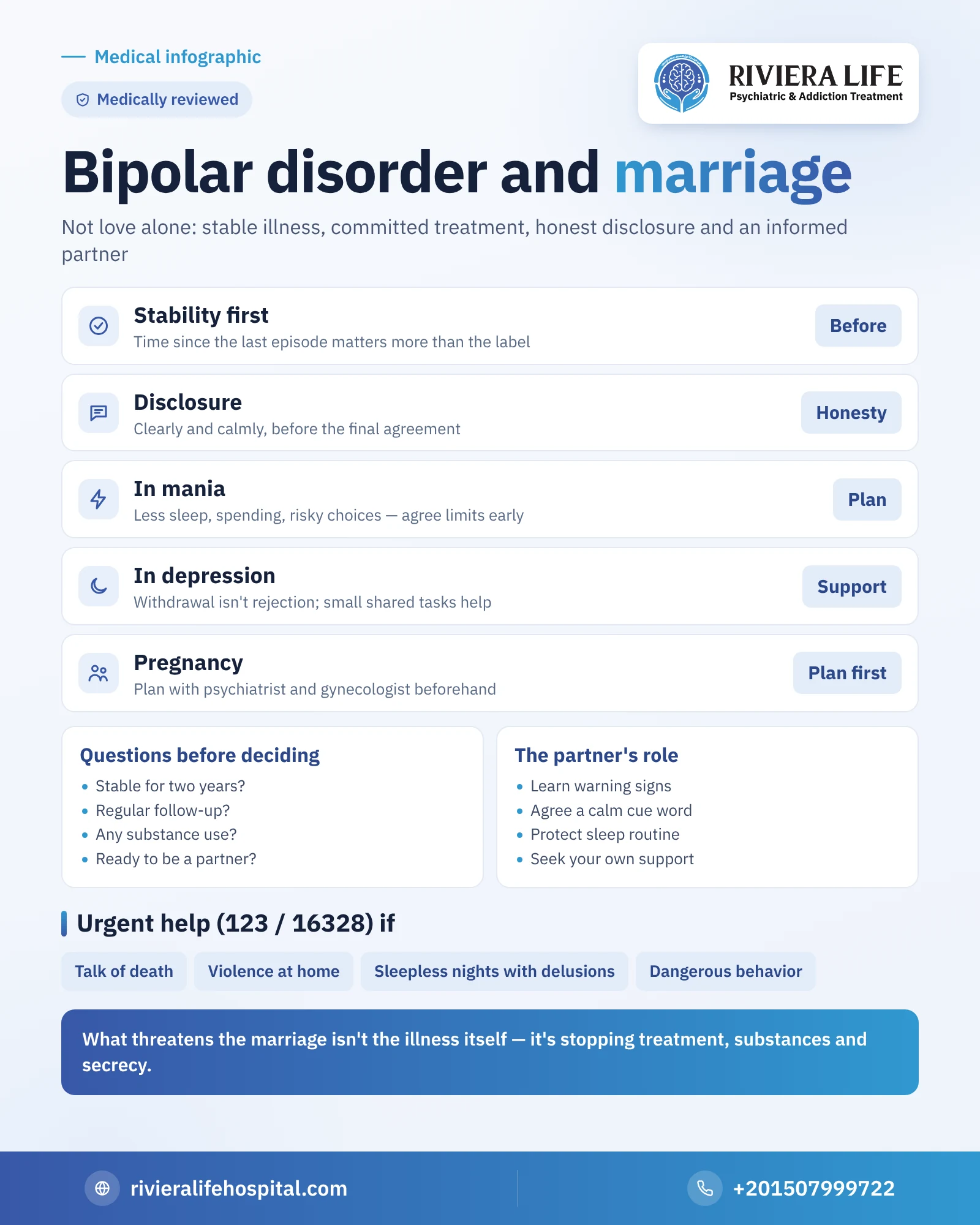
Bipolar disorder and marriage aren’t incompatible: many of those affected can marry and build stable, happy marriages, but success doesn’t come from love alone, rather from four things: an illness that has been stable for a while, commitment to treatment, honest disclosure before commitment, and a partner who understands what he is facing. This article is aimed at engaged couples, spouses and families: what to ask before the engagement, how the relationship is affected in mania and depression, and how sensitive matters such as money, intimacy and pregnancy are handled. Diagnosis and treatment are the psychiatrist’s domain alone.
Bipolar disorder and marriage: does the diagnosis prevent commitment?
There is nothing in medicine that prevents a person with bipolar disorder from marrying, and the most important measure isn’t the diagnosis itself but the patient’s condition today: has a long time passed without an episode? Does he take his treatment regularly? Does he know his early signs? A person stable for two years with a doctor following him is closer to a calm married life than someone who has just come out of a violent manic episode, even if the diagnosis is the same. That is why it is preferable for the engagement decision to come after assessment with the treating doctor, not before it.
Disclosure before engagement: how and when?
Hiding the illness from the other person seems an easy solution, but after marriage it turns into a crisis of trust bigger than the illness itself, especially if an episode comes in the first months. It is better for the matter to be said clearly and calmly after the two have got to know each other enough and before the final agreement is made:
- Mention the name of the diagnosis and what it means in simple words, not medical terms.
- Explain what has changed thanks to treatment, and how long it has been since the last episode.
- Tell the other person that they can ask the doctor or attend a session with him, as this reassures them.
- Give them time to think without pressure or blame.
Families also have a role: hiding the diagnosis during the engagement is a risk that protects no one. On hereditary transmission and marriage in general, read hereditary mental illnesses.
Questions to ask before the decision
- How stable has the illness been over the last two years, and does he follow up with his doctor regularly?
- What happens when he feels an episode coming, and does he have a known plan?
- Does he use alcohol, hashish or stimulants? Substance use is one of the strongest disruptors of stability, as discussed in bipolar disorder and addiction.
- Can he cope with stress, broken sleep, household responsibilities and his job?
- Am I ready to be a partner in the plan, not a watchman over it?
How is the marriage affected in mania?
In an episode of mania or hypomania, the partner sleeps less and has more energy, talk and irritability. The personality may seem completely different: bolder, quick to anger, full of promises and projects. Reckless financial decisions may appear during it, spending on big things, sudden travel, and relationships outside the marriage that don’t resemble the person in his stable days. The pain here is double: the other partner is hurt by the actual behavior, and the patient feels intense guilt and shame after the episode ends.
The solution isn’t holding him to account during the episode, which doesn’t help, but an agreement made in advance during stability: what ceiling is set for spending, who keeps the cards, and when the spouse calls the doctor. The details of financial and physical safety are explained in how to deal with a bipolar patient.
And how is it affected in depression?
In depression the partner withdraws: longer sleep, less desire to go out and talk, crying or silence. The other partner thinks he is the cause, or that he is no longer loved, which is usually not true. He may ask: does she still want me? And the affected person asks himself: how can I be a husband when I’m like this? Here simple sentences help: I’m beside you, and we’ll get through this. Small shared tasks help even more: a short outing or a meal together.
If the partner starts talking about death, pointlessness or disappearing from their lives, this isn’t postponed. A direct, calm question doesn’t plant the idea, but opens the door to help.
Money and intimacy
Spending in mania is one of the most common causes of disagreements and debts, but it can be controlled if agreed on in advance. As for intimacy, sexual drive sometimes increases in mania and may be accompanied by recklessness, while in depression interest decreases and may be wrongly interpreted as personal rejection. Some medicines may also affect desire or performance, and this deserves to be said frankly to the doctor instead of the patient secretly stopping his medicine. Frankness between spouses, without accusation, is the strongest protection.
Pregnancy and treatment: a plan before it happens
This topic in particular isn’t left to chance. Some bipolar medicines, the best known being valproate, are known for their danger to the fetus, and others need follow-up with blood tests during pregnancy. But stopping the medicine suddenly out of fear is more dangerous, because it may bring on a severe episode. The rule is that the plan is discussed with the psychiatrist and gynecologist before trying for pregnancy, not after.
The period after childbirth is a sensitive stage for women with this disorder, as the chance of an episode of mania, depression or psychosis rises in it, and broken sleep for breastfeeding is one of the causes. That is why it is preferable for a plan for sleep and follow-up to be set in advance. And if you are wondering about the children: the illness in one parent raises the likelihood of the child being affected compared with others, but the great majority of children aren’t affected, as the causes are genetic and environmental together. You can read more in causes of bipolar disorder.
The partner’s role: what is his and what isn’t
The husband or wife doesn’t have to be a doctor or a policeman. His role is to learn the early signs of relapse, encourage treatment without stifling monitoring, and set clear limits when behavior becomes harmful. And he has the right to rest and seek support for himself.
- Memorize the warning signs together: little sleep without tiredness, or unusual withdrawal.
- Agree on a calm word that alerts without argument: “I think we need to see the doctor”.
- Keep regular sleep and a fixed routine, as they are the strongest protection after medicine.
- Decide who takes over responsibilities in an episode week.
- Don’t hold yourself responsible for the illness, and don’t consider it the fate of the relationship.
What really threatens the marriage?
Not the illness itself but what surrounds it: stopping treatment, using alcohol and drugs, concealment that destroys trust, chronic exhaustion in the partner, and avoiding conversation. The couples who get past this are usually those who dealt with episodes as something managed with a plan, made during stability, not as a recurring surprise.
Couples and family therapy
Psychoeducation sessions for couples help, as does family therapy that teaches how the two partners communicate at times of tension and reduces relapse. Alongside medicine, psychotherapy and regulating the daily rhythm are part of the prevention plan, as bipolar disorder treatment explains. And if the disagreement has reached violence or threats of harm, everyone’s safety comes first, and medical and family help is sought immediately.
Seek urgent help immediately if you see
Call an ambulance on 123 or the mental health hotline on 16328, or go to the nearest emergency department:
- Talk of death or ending life
- Agitation or violence that threatens a member of the household
- Several nights without sleep with unrealistic ideas or severe suspicion
- Dangerous behavior such as reckless driving or leaving children without care
How can Riviera Life help you?
At Riviera Life in Sheikh Zayed we offer a psychiatric assessment and sessions for the family and partner within the family program and aftercare, and round-the-clock medical supervision if hospital admission is needed. The first consultation is free and confidential on +201507999722.
More from our bipolar disorder guide
- Bipolar disorder: the complete guide
- How to deal with a bipolar patient
- Bipolar disorder treatment
- Schizophrenia and marriage
Questions many people ask
Yes, many marry and live stable lives. What matters most is that the illness is stable, treatment is regular and disclosure is honest before commitment.
It is preferable to do so clearly and calmly before the final agreement, as concealment turns after marriage into a crisis of trust bigger than the illness.
It is usually possible, but the treatment plan is reviewed before pregnancy with the psychiatrist and gynecologist, and the medicine isn't stopped suddenly.
The likelihood of being affected is slightly higher than for others, but most children aren't affected, as the causes are genetic and environmental together.
By learning the early signs, agreeing on a plan during stability and encouraging treatment, while keeping your own limits and seeking support for yourself.