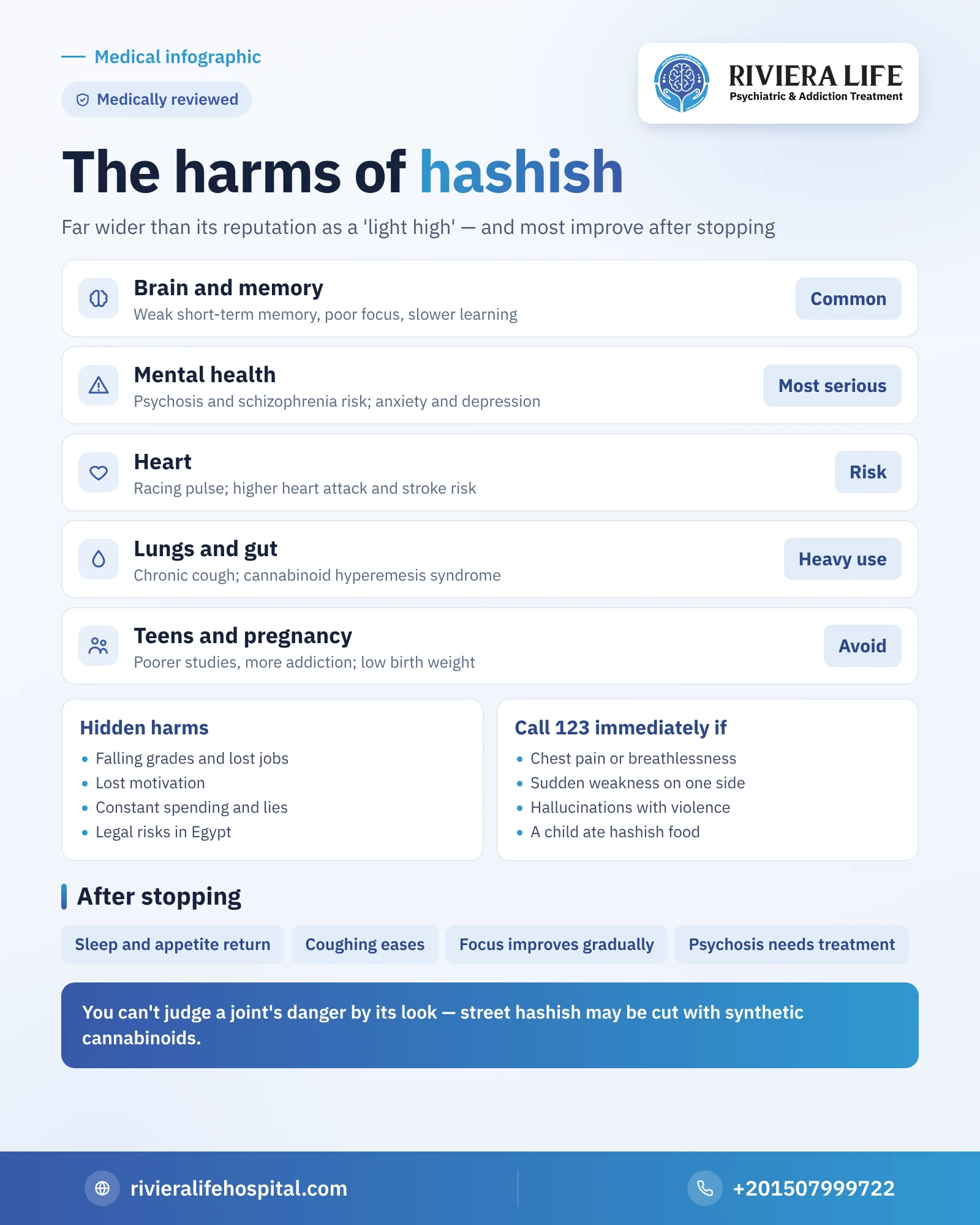
The harms of hashish are far wider than its reputation as a “light high” suggests. In the brain it weakens memory and concentration, and in some people it raises the risk of psychosis and schizophrenia, especially when use starts in adolescence and with high-strength types. In the heart it speeds up the pulse and raises the likelihood of attacks in people who are predisposed. In the lungs, mixing it with tobacco adds harm on top of harm. Then come the less visible harms that are most painful for families: falling behind in study and work, and losing motivation. This article sets out these harms organ by organ, and what improves after stopping.
The short-term harms of hashish
Some harms don’t take years; they happen in the hours after a joint. The best known are anxiety and panic attacks, when the expected relaxation turns into intense fear and a feeling that the heart will stop or the person is losing their mind. There is also impaired judgment and slowed reactions that make driving or operating machinery a real danger. With large amounts or edible hashish, a state of confusion and temporary hallucinations may appear that sometimes needs the emergency department.
The harmful effects of hashish on the brain and memory
The network hashish acts on in the brain is concentrated in the areas responsible for memory, learning and decision-making. That is why regular use is linked to clear problems:
- Weak short-term memory: forgetting appointments, what was just said, and where things were put.
- Difficulty concentrating and following long tasks.
- Slower processing of information and decision-making.
- A decline in the ability to learn, which shows clearly in studies.
Some of these effects improve after stopping, but research suggests that someone who started in adolescence and used heavily for years may keep part of them for longer.
Hashish and mental health: psychosis, anxiety and depression
This is the most dangerous side of hashish’s harms, and the one people in Egypt are least aware of. Daily use, especially of high-strength types, is linked to a clear increase in the risk of psychotic episodes — a state in which a person loses touch with reality, hearing voices or believing someone is plotting against them. In people with a genetic predisposition, hashish may bring forward the onset of schizophrenia or worsen its course. Pathological suspicion in particular is one of the most common complaints from users’ families, and we devote an article to it, hashish addiction and suspicion.
The relationship with anxiety and depression is complicated: many people start hashish to escape them, and then find they have increased with continued use. Heavy use at a young age is linked to a higher risk of depression and suicidal thoughts later on.
The harmful effects of hashish on the heart and blood vessels
Within minutes of smoking the heart rate rises, and it may stay high for hours; sometimes blood pressure drops on standing, so the person feels dizzy. For a healthy young man this may pass without clear effect, but in someone with heart disease or high blood pressure, or who smokes cigarettes heavily, this burden increases the likelihood of angina and heart attacks. Recent studies link frequent use to a higher risk of heart attacks and strokes, even at younger ages than usual.
The harmful effects of hashish on the lungs
Hashish smoke carries many of the same irritants found in tobacco smoke. It is usually inhaled deeply and held in the chest, so it reaches deep into the lungs. The common result is a chronic cough, phlegm, wheezing and repeated bouts of bronchitis. In Egypt the problem is doubled, because hashish is mostly mixed with cigarette tobacco or smoked in a water pipe with tobacco, so the user is exposed to the full harms of tobacco on top of the harms of hashish.
The digestive system: cannabinoid hyperemesis syndrome
Some people who use heavily for years develop a strange condition: bouts of nausea, repeated vomiting and abdominal pain, recurring every few weeks or months. The telltale sign is that the patient feels much better under a hot shower, so they spend a long time under it. This condition is called cannabinoid hyperemesis syndrome, and it is often misdiagnosed as a stomach or gallbladder problem because the patient doesn’t mention hashish. Its danger lies in dehydration and salt imbalance, and the only real treatment is stopping completely.
The harmful effects of hashish on teenagers
The adolescent brain is still building its connections, and the areas responsible for planning and self-control aren’t complete until the mid-twenties. Using at this age is linked to a clearer decline in studies, a greater risk of addiction, and a higher risk of psychosis and depression than in people who start after adulthood. Our article on the causes of hashish addiction explains why the age of starting is the most important risk factor.
Pregnancy and fertility
The active substance crosses the placenta to the fetus and is linked to low birth weight, and it is also detected in breast milk. That is why health bodies advise complete abstinence during pregnancy and breastfeeding. In men, chronic use is linked to changes in sperm count and motility, and to reduced desire in some. We cover this side in detail in our article on hashish and sex.
Driving and accidents
Hashish slows reactions and weakens attention and the judgment of distance and speed — exactly the skills driving needs. The danger doubles when it is combined with alcohol or sedative pills. Some drivers believe they “drive better” under its influence because they drive slowly, but slowness doesn’t make up for weak attention in a sudden moment.
The harmful effects of hashish on daily life
There may be no harm families complain about more than this. A student who used to excel starts missing classes and then failing; an employee starts arriving late and then loses their job; a young man loses enthusiasm for everything and settles for sitting with “the group”. This comes with constant spending on the substance, lies, ongoing tension at home and real legal risks, since hashish is a banned drug in Egypt despite how widespread it is. In many cases hashish is the start of trying other substances in the same circle, such as tramadol or Strox.
Cutting and adulteration: a harm you can’t see on the piece
Someone buying a piece of hashish on the illegal market doesn’t know the strength of its active substance, or what has been added to it to increase its weight or strengthen its effect. Emergency departments sometimes receive cases of agitation, seizures or loss of consciousness after a joint said to be hashish, which then turns out to have been mixed with synthetic cannabinoids or other substances. The danger grows when the user combines hashish with tramadol, pregabalin or alcohol on the same night, multiplying the effect of each on consciousness, breathing and driving. That is why you can’t judge the danger of a “joint” by its appearance or from a previous experience with the same source.
Do the harms of hashish go away after stopping?
The good news is that most of the harms improve. Sleep, appetite and mood return within weeks to months, coughing eases with stopping smoking, concentration and memory improve gradually, and bouts of vomiting disappear with complete stopping. Psychotic symptoms that have appeared, however, need psychiatric treatment and follow-up, and some memory weakness may remain in those who started early and used for a long time. The practical steps are explained in our article on hashish addiction treatment, and the stages of the body’s recovery in when does the body return to normal after quitting hashish?
Symptoms of a hashish overdose
Hashish rarely kills through direct toxicity the way opioids or sedatives do, but that doesn’t mean poisoning with it is minor. An overdose — or acute intoxication, as doctors call it — happens when the effect exceeds what the body can tolerate, and it is more common with high-strength types and with foods whose effect is delayed, so people take more without noticing.
Common symptoms:
- A panic attack with intense fear of dying or losing one’s mind.
- Paranoia and a feeling of being watched, and hallucinations may appear.
- Strong palpitations and a raised pulse.
- Nausea, vomiting, dizziness, a drop in blood pressure and fainting.
- Confusion, very slow responses and difficulty speaking.
Most cases settle by staying in a quiet place with someone who reassures and watches the person until the effect wears off, but the danger is greater in children who eat sweets containing hashish by accident, and in anyone with heart disease. If psychosis lasts or becomes severe, call an ambulance and read drug overdose and what to do until the ambulance arrives and drug-induced psychosis.
When do the harms of hashish become an emergency?
Call an ambulance immediately (123 in Egypt) if you see
Some harms of hashish can't wait until the effect wears off.
- Chest pain, severe shortness of breath or palpitations that won’t settle
- Sudden weakness on one side of the body, or slurred speech
- Hallucinations or acute paranoia with violence or attempts at self-harm
- Repeated vomiting that won’t stop, with dizziness and dehydration
- A child who has eaten sweets or food containing hashish
More from our hashish guide
- Hashish: the complete guide
- Hashish addiction symptoms
- The causes of hashish addiction
- Hashish and sex
- The benefits of hashish: what science has really proven and what remains a myth
Questions many people ask
Its effect isn't described as destroying cells, but it changes how the areas responsible for memory, learning and concentration work. Much of this improves after stopping, while some may persist in those who started in adolescence and used heavily.
Not every user develops schizophrenia, but heavy use — especially at a young age and with strong types — raises the risk of psychosis and brings forward the onset of schizophrenia in those predisposed to it.
It raises the heart rate and increases the burden on the heart, and it may raise the risk of heart attacks and strokes in people with risk factors or who use it a lot.
It may be cannabinoid hyperemesis syndrome, which affects some people who use heavily for long periods. It improves with complete stopping, and needs the emergency department if it causes dehydration.
Most improve within weeks to months — sleep, mood, coughing and concentration. Psychotic symptoms, however, need psychiatric treatment and follow-up.