How to deal with a hashish addict differs from dealing with a user of any other drug in one important point: he usually doesn’t see himself as addicted at all. He will tell you it is “a natural plant”, that it is “lighter than cigarettes”, and that half his friends smoke it and nothing has happened to them. So don’t start the battle over the word “addiction”, but over the change you see in his life. This guide gives the family a practical plan: how to prepare, when to talk, how to answer his usual arguments, what boundaries to set, and how to turn the conversation into agreement to a medical assessment.
Why does persuading a hashish user seem harder?
Someone addicted to a substance that causes painful withdrawal sees for himself that there is a problem. But hashish creeps in slowly. There is no overdose that takes him to the emergency department, and no acute pain that forces him to admit it. What happens is a gradual dimming: he leaves the gym, then is late for work, then his whole day is arranged around “the last cigarette before sleep”. And when you confront him, he compares himself with someone using heroin or shabu, and comes out of the comparison innocent in his own eyes.
On top of that, hashish is widespread in many social circles in Egypt, and circulates as a “mood” rather than a drug. So your words become, in his view, the words of an old generation that doesn’t understand. This doesn’t mean he is right, but it means that scaremongering won’t work with him, and that calm, accurate information is stronger than frightening.
Before you talk: three preparatory steps
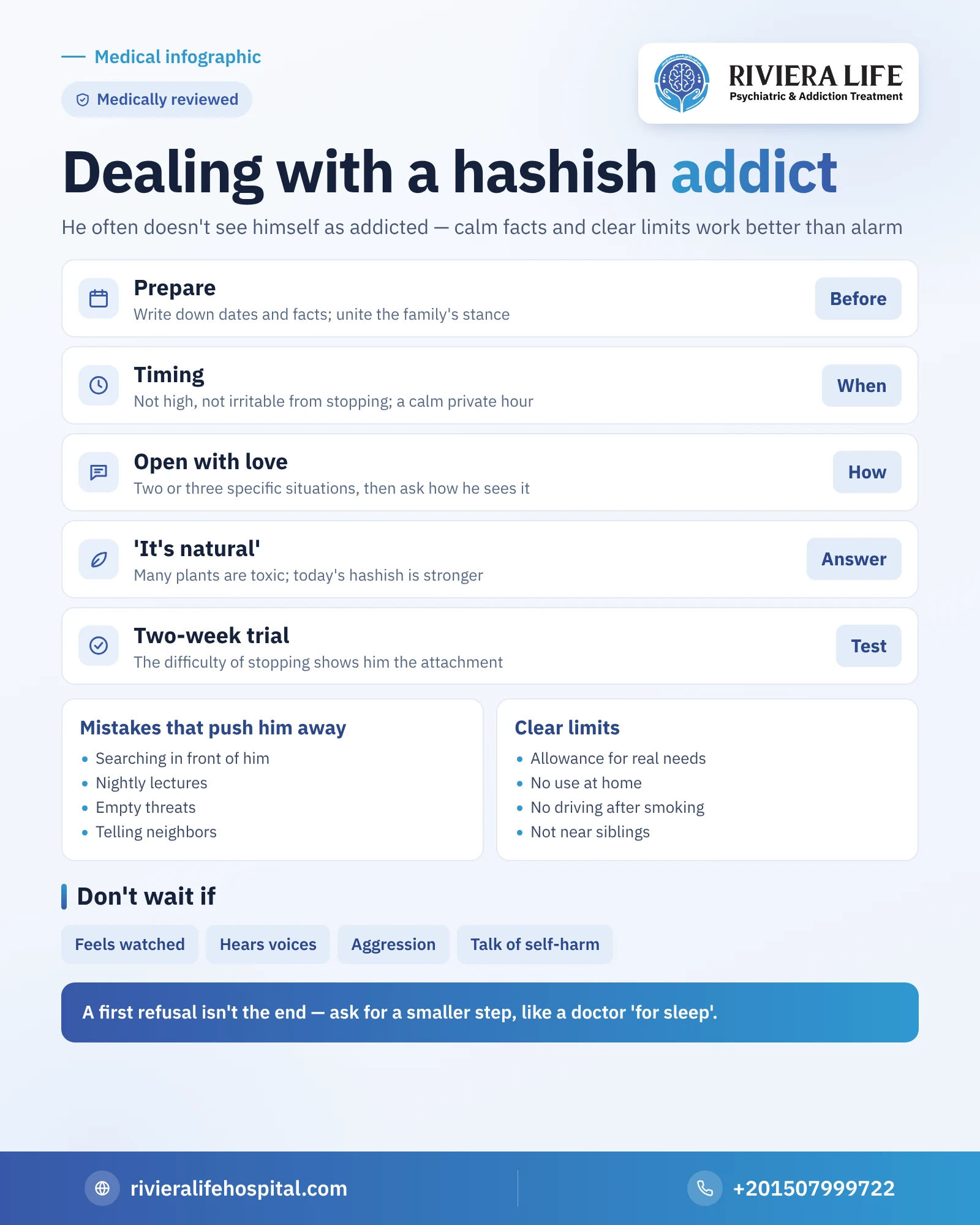
- Write down what you saw with dates: days of absence from university or work, the sums he asked for, and the times he came back with red eyes or a pungent smell. Written facts stop the conversation from turning into “you’re imagining it”.
- Unite the stance at home: a father who threatens and a mother who covers for him secretly send two contradictory messages, and he knows how to exploit the gap between them.
- Understand the medical picture: read about hashish addiction symptoms to know the difference between a passing experience and real dependence, as this changes the whole tone of the conversation.
Choosing the right timing
The worst time to talk is the moment he comes back under the influence, as hashish slows comprehension and makes words slide off him or provoke his laughter or suspicion. The second worst time is the morning of a day he hasn’t smoked, when he is irritable and impatient. Usually the most suitable is a calm hour in the middle of the day, after food, in a closed place where no one can hear. And if a small crisis happens, such as failing an exam or a warning at work, it may be a good window because he sees with his own eyes that something is slipping from his hands.
How do you start the conversation?
Start from your relationship with him, not from the drug. A sentence like “I’ve noticed you’ve moved away from us, and you sleep until the afternoon, and this worries me because I love you” opens a door. While “I know you smoke hashish and I won’t keep quiet” closes it at once. Mention two or three specific situations, then stop and ask him: “And you, how do you see it?”.
Listen more than you talk. Many young people smoke hashish to calm anxiety, insomnia or sadness no one knows about. If he says “it’s the only thing that makes me sleep”, he has given you a key: the real problem may be insomnia or anxiety that needs treatment, and hashish was a wrong solution for it. This explains part of what our article on the causes of hashish addiction explains.
Answering his usual arguments
| What he says | A calm reply based on information |
|---|---|
| Hashish isn’t addiction | A proportion of regular users really do develop cannabis use disorder, and the question isn’t about the name but about your ability to stop |
| It’s a natural plant | Many plants are toxic, and the hashish around today is more potent than it was years ago |
| I can stop whenever I want | Great, try two weeks without smoking and we’ll see together how sleep and mood go |
| It’s better than alcohol and pills | Comparing with worse doesn’t make something safe; what matters is what it does to you |
| All my friends smoke it | I’m not talking about your friends, I’m talking about you and what has changed in you |
Don’t try to win every point. It is enough to plant a small doubt in his conviction, then leave him time. And the “two-week trial” offer specifically is useful, because the difficulty of sticking to it reveals to him alone the extent of his attachment without you saying anything.
Mistakes that push him away
- Searching his room and phone in front of him, then confronting him with what you found in an atmosphere of accusation.
- Long, repeated lectures every night, which turn into noise he learns to ignore.
- Threatening to report him to the police or throw him out without real intention to carry it out.
- Telling relatives and neighbors, as scandal pushes him to denial and stubbornness.
- Mocking his slowness or forgetfulness, which hurts him and doesn’t change his behavior.
Understanding what specifically annoys him helps you avoid these mistakes without giving up your position, which is the subject of our article on what a hashish user hates.
Clear boundaries without shouting
Boundaries aren’t punishment, but a declaration of what you will no longer take part in from today. Say them calmly once and then carry them out:
- Allowance: given according to actual needs, and paid directly for transport and study where possible.
- The home: no smoking or storing inside it, as the presence of the substance in the house exposes the whole family to legal liability.
- The car: no driving after smoking, because hashish slows reactions and weakens judgment of distances.
- Younger siblings: no using in front of them and no taking them to his using friends.
If he refuses treatment completely
The first refusal isn’t the end of the road. Ask for a smaller step: one session with a doctor “about sleep” or “about irritability”, without calling it an addiction session. Many accept talking about insomnia or anxiety before they accept talking about hashish, and a specialist doctor can open the subject in his own way. At the same time, keep the boundaries, and reward good days with attention and time with him, as a warm home makes leaving the substance easier than a charged one.
And the family has the right to ask for a consultation for itself even before he agrees, to learn how to deal with daily situations. Experience indicates that training the family in this gradual approach brings more users to treatment than sharp confrontation.
When not to wait for his agreement?
There are cases that call for an urgent psychiatric assessment: if he starts talking about someone watching him or conspiring against him, hears voices, becomes aggressive, or talks about harming himself. These are signs that may point to hashish-related psychosis, and their details are in our article on the hashish addict and suspicion. Egypt’s mental health care law regulates involuntary admission in specific cases decided by a psychiatrist when there is serious danger, a medical and legal decision the family doesn’t take alone.
After he agrees
Call the same day and don’t postpone. Hashish treatment usually doesn’t need an ambulance or machines, but it needs a plan: a psychiatric assessment to detect any accompanying anxiety or depression, dealing with the first days of withdrawal dominated by insomnia, irritability and loss of appetite, then behavioral treatment that teaches him how to fill the void that smoking used to fill. You will find the stages in detail in our article on hashish addiction treatment. As for you, your role in the first weeks is to bear his irritability without taking it personally, and to celebrate small progress.
How can Riviera Life help you?
Many families call us before their son is convinced, and this is exactly what we advise. In a free, confidential first consultation, the Riviera Life team in Sheikh Zayed helps you set a conversation plan suited to your son’s personality and age, then takes on the assessment, treatment, family program and follow-up after discharge. Contact us around the clock: +201507999722.
More from our hashish guide
- Hashish: the complete guide
- The behavior of a hashish user
- Hashish withdrawal symptoms and their duration
- When the body returns to normal after quitting hashish
Questions many people ask
Don't argue over the word, but ask him about his ability to stop. Suggest two weeks without smoking; the difficulty of sticking to it shows him the extent of his attachment without confrontation.
Hostile searching followed by confronting him with what you found pushes him to hide more. It is better to note the behavior you observe and talk to him with facts.
Yes, the family can get a consultation for itself first to learn how to talk and set boundaries, which increases the chances of him accepting treatment later.
Not always; many cases are treated with an outpatient plan. But a stay may be better when there is suspicion, hallucinations, severe depression or use of other substances with it.
A calm time when he isn't under the influence or tense from not using, often in the afternoon in a private place, and a small crisis he is going through may be a good opportunity.