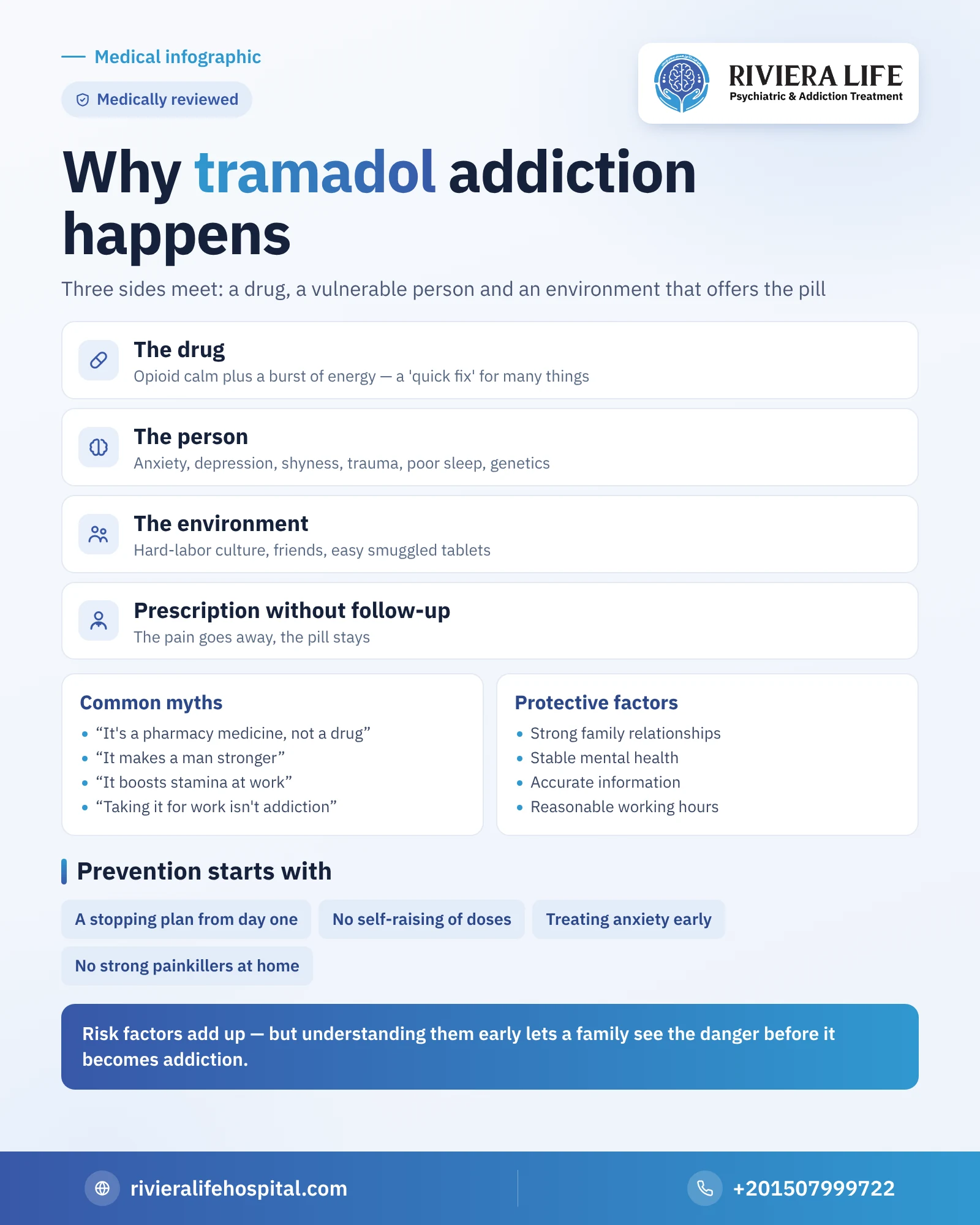
The causes of tramadol addiction are never just one factor. There is a drug that combines an opioid effect that calms and relieves pain with another effect that gives temporary energy; a person carrying a genetic or psychological vulnerability; and an environment at work or among friends that keeps the pill within reach and presents it as a “helper” rather than a drug. When these three sides come together, the road to dependence becomes short. This article explains why tramadol addiction is so widespread in Egypt in particular, who is most at risk, and what practical steps reduce the risk before it starts.
Why does tramadol cause addiction in the first place?
Part of the answer lies in the drug itself. Tramadol stimulates the opioid receptors that bring relief and ease pain, and at the same time it raises serotonin and noradrenaline, so some people feel energetic and their mood improves. This mix makes the brain record the pill as a quick fix for many things at once: tiredness, distress, pain and shyness. With repetition the brain adapts and the same dose has less effect, so the person needs more — and then discovers that going without the pill now means headaches, sweating and irritability. At that point, use continues to avoid collapse rather than to feel good.
From prescription to dependence: how does it start?
Many cases begin entirely legitimately: pain after surgery, a slipped disc or an injury at work. The doctor prescribes tramadol for a short time, and the patient notices that the pill doesn’t just relieve pain — it lifts their mood and gives them energy. The pain goes away; the pill stays. Then they find it at another pharmacy or from a friend, and start taking it “when needed”, and “when needed” becomes every day. This path doesn’t mean the patient had bad intentions; it means follow-up after the first prescription was missing. The same path repeats with other opioid painkillers, as described on our page about the causes of opioid painkiller addiction.
Psychological causes that increase vulnerability
Many people who became addicted to tramadol were treating themselves without realizing it. The main psychological conditions that raise the risk include:
- Chronic anxiety and stress, where the pill gives a temporary calm the person can’t find any other way.
- Depression, where the temporary lift in mood becomes a powerful reason to repeat it.
- Social anxiety and low self-confidence, as some people feel a boldness they don’t otherwise know.
- Trauma and difficult childhood experiences, which are linked to a higher risk of addiction in general.
- Sleep problems, when the pill becomes a way to fall asleep after a long shift.
The problem is that this “self-medication” works in the first weeks, so the person becomes convinced they have found what they need. In reality it postpones the original problem and adds a second one. Anxiety comes back stronger when the pill wears off, depression deepens with dependence, and sleep gets worse. That is why, when assessing anyone addicted to tramadol, doctors look for the psychological disorder that may have been the first gateway, because treating it is a key part of preventing relapse.
Hard work and the pill culture in Egypt
In Egypt, tramadol became tied to a particular image: the laborer carrying heavy loads from dawn, the microbus driver behind the wheel for twelve hours, the craftsman who wants to finish the job before the deadline. In these settings the pill is offered as a work tool and handed to a newcomer on the first day the way a cup of tea would be. With the pressures of life and the need to work longer hours, the pill seems a logical solution. But it is a borrowed solution: the energy it gives is taken back later with interest, in the form of exhaustion, irritability and dependence. On top of this, smuggled tablets were widely available and relatively cheap for years, which widened the circle of use.
False beliefs about tramadol
Among the strongest reasons for its spread are widely shared ideas that many people believe:
- That it is “a pharmacy medicine”, so it can’t be a drug.
- That it makes a man stronger and makes sex last longer, so some newly married men take it without advice.
- That it increases stamina at work and in sport.
- That someone who takes it for work is not an addict.
Each of these ideas lowers a person’s guard and delays the moment they admit there is a problem. The truth is that delayed ejaculation is a temporary side effect followed by weakness, and the extra energy is followed by irritability and exhaustion, as our article on the harmful effects of tramadol explains.
Genetic and biological factors
Family and twin studies show that a considerable part of the vulnerability to addiction in general is inherited, so someone whose father or brother struggled with addiction is more at risk. With tramadol specifically there is an extra genetic dimension: a liver enzyme converts tramadol into its active substance, and its activity varies from person to person. So some people feel a strong effect from a small amount, while others need larger amounts for the same effect, which may push them to raise the dose quickly. Genetics does not decide anyone’s fate here, but it explains why not everyone responds the same way to the same pill.
Chronic pain and prescribing without follow-up
A patient living with chronic back or joint pain is more at risk than others, especially if they stay on tramadol for months without review or an alternative plan. Factors that raise the risk in this group include getting prescriptions from more than one doctor, raising the dose on their own, and the absence of physiotherapy or non-drug approaches. For anyone living with real pain, there are pain relief options that can be discussed with a doctor in our article on the strongest alternatives to tramadol by type of pain.
Adolescence and starting early
The teenage brain is still developing, especially the areas responsible for controlling impulses and weighing consequences. So anyone who starts using a substance at a young age is more likely to develop addiction later. Teenagers usually come across tramadol through friends, or at work if they start working early, and it often comes with pregabalin or hashish. It helps families to know the early signs described in our article on tramadol addiction symptoms.
Why do some people become addicted faster than others?
Because the factors add up. A young man with untreated anxiety, working where pills are passed around, whose father struggled with addiction and who believes tramadol is a “booster”, carries four factors at once. On the other hand, someone else may try the pill once or twice and never go back, because they have protective factors: strong family relationships, stable mental health, accurate information, and work that doesn’t depend on late nights and exhaustion. Understanding this picture helps families see the danger before it turns into addiction.
How to prevent tramadol addiction
For a patient taking it on prescription
- Ask the doctor from the start how long you are expected to take it and what the plan for stopping is.
- Don’t raise the dose on your own, and don’t keep leftover tablets once the pain is gone.
- Tell the doctor about every medication you take, especially antidepressants.
For families
- Talk to your children about tramadol with accurate information, not only with warnings.
- Pay attention to anxiety and depression and treat them early, before the pill “treats” them.
- Don’t keep strong painkillers at home when they are not needed.
In the workplace
- Reasonable working hours and enough rest reduce the need for an artificial “stimulant”.
- Raising awareness that the pill slows reactions and increases the risk of accidents and seizures.
How Riviera Life can help
If these causes apply to someone close to you who has already started using, early intervention is far easier than waiting. The Riviera Life team assesses the situation in confidence and addresses the root cause — whether anxiety, pain or work pressure — within a plan for tramadol addiction treatment.
More from our tramadol guide
- Tramadol: the complete guide
- Tramadol addiction symptoms
- The harmful effects of tramadol
- Tramadol vs Tramundin
Questions many people ask
Because it became linked to hard physical work and long hours, and to false beliefs about boosting sexual performance — together with years of relatively cheap smuggled tablets and its image as a medicine rather than a drug.
Yes, especially if they keep taking it after the pain has gone or raise the dose without advice. Follow-up with the doctor and a stopping plan from the start reduce this risk.
Genetics explains part of the vulnerability to addiction in general, and the activity of the liver enzyme that converts tramadol also varies between people — but environment and early treatment change the course.
It may delay ejaculation temporarily as a side effect, but chronic use is linked to weaker desire and erections and lower testosterone, so it is not a performance enhancer.
Talk to him with accurate information, pay attention to his anxiety and mood and treat any psychological problem early, don't leave strong painkillers lying around at home, and get to know his friends and his work environment if he works.