No single medication can be called “the strongest alternative to tramadol” for everyone, because a painkiller’s strength depends on how well it fits the type of pain, not on how powerful it looks on paper. An anti-inflammatory may beat tramadol for inflamed joints, nerve-pain medications work where ordinary painkillers fail, and physiotherapy may be the strongest solution for chronic back pain. This article sets out the general options available for each type of pain so readers can discuss them with their doctor. It does not give doses and is no substitute for a consultation, because choosing a painkiller depends on your age, your illnesses and the medications you take.
Why do people look for an alternative to tramadol?
The reasons vary: one patient notices they now need the pill every day and fears addiction; another has suffered nausea, dizziness and constipation; a third takes antidepressants and has been warned by the doctor about the risk of combining them; a fourth can no longer find tramadol easily because of dispensing controls in Egypt. And some have had a seizure and cannot continue taking it. In all these cases the right question is not “what is the strongest pill?” but “what type of pain do I have, and what treatment suits it best?”
First: identify the type of pain
Doctors divide pain into main types, each with its own treatment logic:
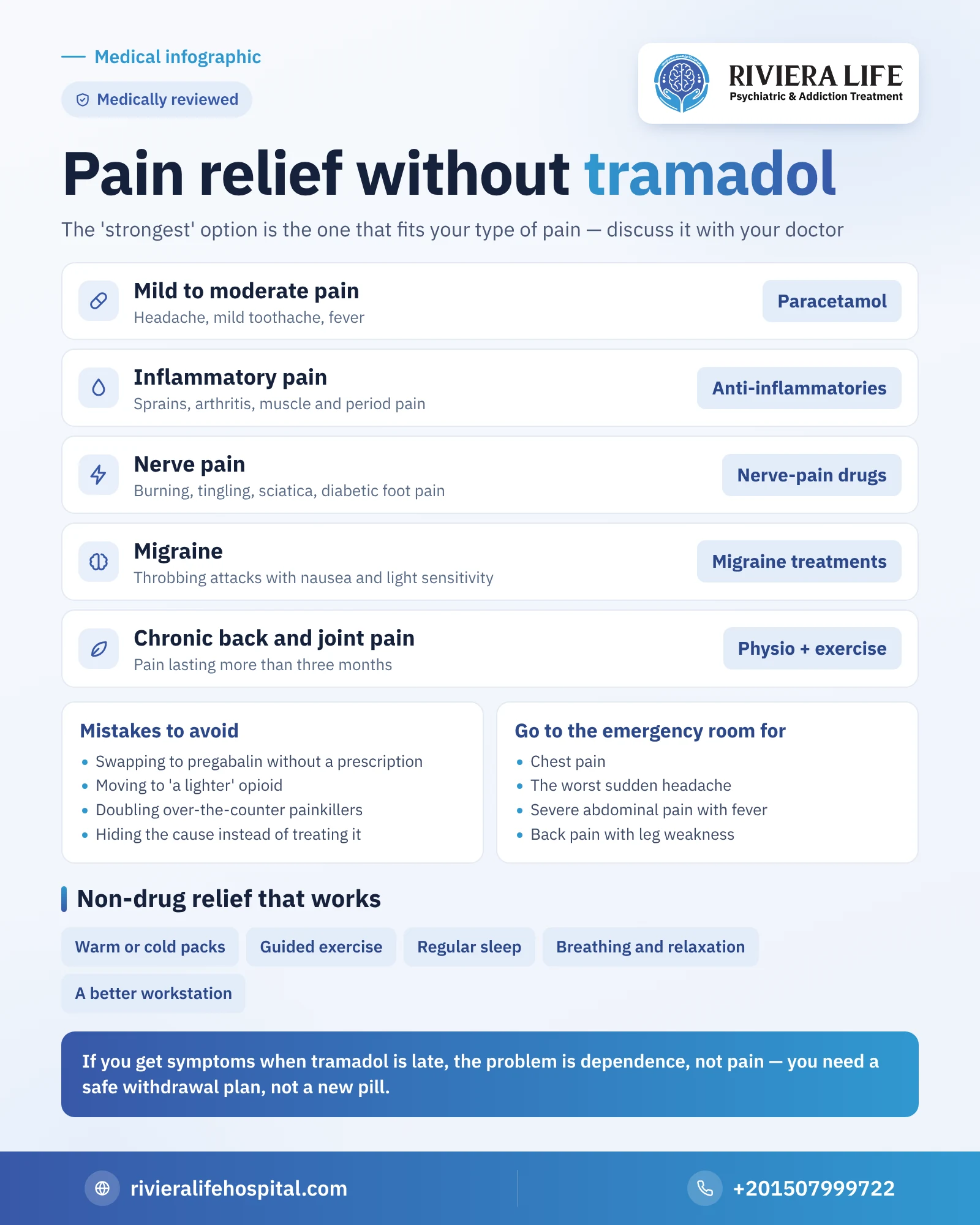
| Type of pain | Examples | Options a doctor usually discusses |
|---|---|---|
| Mild to moderate pain | Ordinary headache, mild toothache, fever | Paracetamol |
| Inflammatory pain | Sprains, arthritis, muscle pain, period pain | Non-steroidal anti-inflammatory drugs, as tablets or topically |
| Nerve pain | Diabetic foot pain, chronic sciatica, pain after shingles | Prescription medications specific to nerve pain |
| Migraine | Throbbing headache attacks with nausea and light sensitivity | Treatments for the attack, and others for prevention |
| Chronic back and joint pain | Pain lasting more than three months | Physiotherapy and exercise, with medication when needed |
| Severe acute pain | A fracture, renal colic, after surgery | Assessment in hospital and a plan set by the doctor |
Mild and moderate pain: paracetamol
Paracetamol is one of the most widely used and safest painkillers when the dose set by the doctor or the leaflet is respected. It suits ordinary headaches and mild toothache and brings down fever, and it is gentle on the stomach compared with anti-inflammatories. Its main danger is to the liver when the limit is exceeded — which sometimes happens unintentionally, because paracetamol is found in many cold remedies and combination products, including tablets that combine it with tramadol itself. So read the active ingredient on every pack, avoid taking two products that both contain it, and talk to your doctor if you have liver disease or drink alcohol.
Inflammatory pain: non-steroidal anti-inflammatory drugs
This group includes well-known medicines such as ibuprofen, naproxen and diclofenac. They reduce the inflammation itself, not just the sensation of pain, so they are very effective for sprains, muscle pain, arthritis and period pain, and doctors often rely on them for renal colic. But they don’t suit everyone, and they need caution in these situations:
- A stomach ulcer or previous bleeding in the digestive tract.
- Kidney or heart disease, or uncontrolled high blood pressure.
- Taking blood thinners.
- Pregnancy, especially in its later stages.
- Older age and long-term use.
Topical creams and gels
For pain in a single joint or a specific muscle, such as the knee or shoulder, topical anti-inflammatories can be a good option, because far less reaches the bloodstream than with tablets, so there are fewer side effects on the stomach and kidneys.
A planned combination of two painkillers
For some types of acute pain, such as toothache after an extraction, the doctor may prescribe paracetamol and an anti-inflammatory together on a set schedule, giving good relief that can make opioid painkillers unnecessary. This combination needs the doctor to set the timing and duration, and it must not turn into random increases in the amounts.
Nerve pain: a completely different logic
Nerve pain is usually described as burning, prickling, electric shocks or numbness, and it does not respond well to ordinary painkillers — sometimes not even to opioids. It is treated, on prescription, with medications from other families, including certain antidepressants at doses specific to pain and certain epilepsy medications that calm irritated nerves. Pregabalin and gabapentin belong to this last group. A clear warning is needed here: pregabalin itself is widely misused in Egypt and is often mixed with tramadol, so one should never be swapped for the other without a prescription and follow-up. The comparison between them is explained in our article on pregabalin vs tramadol.
Migraine
Tramadol is not a suitable treatment for migraine, and overusing painkillers in general can cause rebound headaches that make the problem worse. Attacks have dedicated treatments prescribed by a doctor that act on the mechanism of the headache itself, and anti-inflammatories may be enough for mild attacks. Someone whose attacks come several times a month may need preventive treatment to reduce their number, along with regular sleep and meals and avoiding their known triggers.
Chronic back and joint pain
This is the group in which many people stay on tramadol for years — and it is also the group with the strongest non-drug alternatives. Evidence shows that guided exercise, physiotherapy, weight loss and better sitting and working posture achieve a long-term benefit that tablets do not. A non-opioid medication can be added when needed, and sometimes cognitive behavioral therapy for chronic pain, which helps patients manage pain and reduce its impact on their lives.
Severe acute pain
Fractures, major injuries, severe renal colic and post-surgical pain need direct medical assessment, not a search for a pill at home. In these cases the doctor may decide to use a strong painkiller for a very short time under supervision, with a clear plan for stopping. The difference between this and self-medication is follow-up: a calculated dose, a fixed duration and a review of other medications.
Some pain should not be silenced with any pill before an examination, including chest pain, the most severe sudden headache of a person’s life, severe abdominal pain with fever or persistent vomiting, and back pain with weakness in the legs or problems passing urine. These signs need the emergency department, because a painkiller may mask an illness that needs urgent treatment. You can learn about the types of opioid painkillers and their medical uses in our article on types of opioid analgesics.
Non-drug methods that ease pain
- Warm compresses for muscle pain and stiffness, and cold ones for recent injuries and swelling.
- Physiotherapy and gradual exercise under specialist supervision.
- Regular sleep, because lack of sleep lowers the body’s ability to tolerate pain.
- Managing stress with breathing and relaxation exercises.
- Adjusting the work environment, such as desk and chair height and how heavy loads are lifted.
Common mistakes when looking for an alternative
- Replacing tramadol with pregabalin or a sedative without a prescription, which starts a new dependence.
- Switching to another opioid in the belief that it is “lighter”.
- Doubling over-the-counter painkillers to make up for tramadol’s effect.
- Combining several products that contain the same ingredient without noticing.
- Ignoring the cause of the pain and simply silencing it.
Lyrolin as a tramadol substitute: is it a safe option?
Lyrolin is a brand name for pregabalin. It is not a painkiller in the usual sense, nor a direct substitute for tramadol. It works on overactive nerves, so it helps with nerve pain and fibromyalgia, but it should not be expected to ease knee or back pain caused by inflammation or a strained muscle.
The problem is that many people switch to it believing it is milder, trading one dependence for another. Pregabalin itself is misused; it causes drowsiness, dizziness and poor concentration, and its danger rises sharply when it is mixed with tramadol, as the suppression of breathing and consciousness multiplies.
- It is best to identify the type of pain first, because a medication suited to nerve pain does nothing for muscle pain.
- If the doctor prescribes it for confirmed nerve pain, stick to the plan and don’t change anything yourself.
- Don’t take it as a substitute for tramadol without a medical assessment of the cause of the pain.
- Don’t stop it suddenly after long-term use, as withdrawal symptoms may appear.
You will find a detailed comparison in our article on pregabalin vs tramadol, and for anyone who has become dependent on the medication, the treatment steps are in Lyrolin (pregabalin) addiction treatment.
If you are dependent on tramadol
If you have been taking tramadol daily for some time and get headaches, sweating and irritability when a dose is late, the problem is no longer about a painkiller; it is dependence that needs a safe withdrawal plan. Stopping suddenly and switching to another painkiller won’t prevent withdrawal symptoms, as our article on tramadol withdrawal symptoms explains. The right step is a medical assessment that deals with both the pain and the dependence, within a program of tramadol addiction treatment.
More from our tramadol guide
- Tramadol: the complete guide
- The harmful effects of tramadol
- The causes of tramadol addiction
- Tramadol vs Tramundin
Questions many people ask
There is no single alternative for everyone; the strongest is the one that fits the type of pain. Anti-inflammatories may do better for inflammatory pain, nerve-pain medications for nerve pain, and physiotherapy for chronic back pain — the doctor decides which option is right.
Pregabalin is a prescription medication for nerve pain, but it is widely misused in Egypt and often mixed with tramadol. Swapping one for the other without supervision can start a new dependence.
For mild to moderate pain it is often enough, and for some acute pain the doctor may prescribe it together with an anti-inflammatory. Be careful not to exceed the dose, because paracetamol is found in many products.
Evidence suggests that physiotherapy, guided exercise, weight loss and better working posture give the best long-term benefit, with a non-opioid painkiller when needed, as decided by the doctor.
If you get symptoms when a dose is late, that is dependence that needs a medical withdrawal plan, and switching suddenly to another painkiller won't prevent withdrawal. See a doctor before making any change.