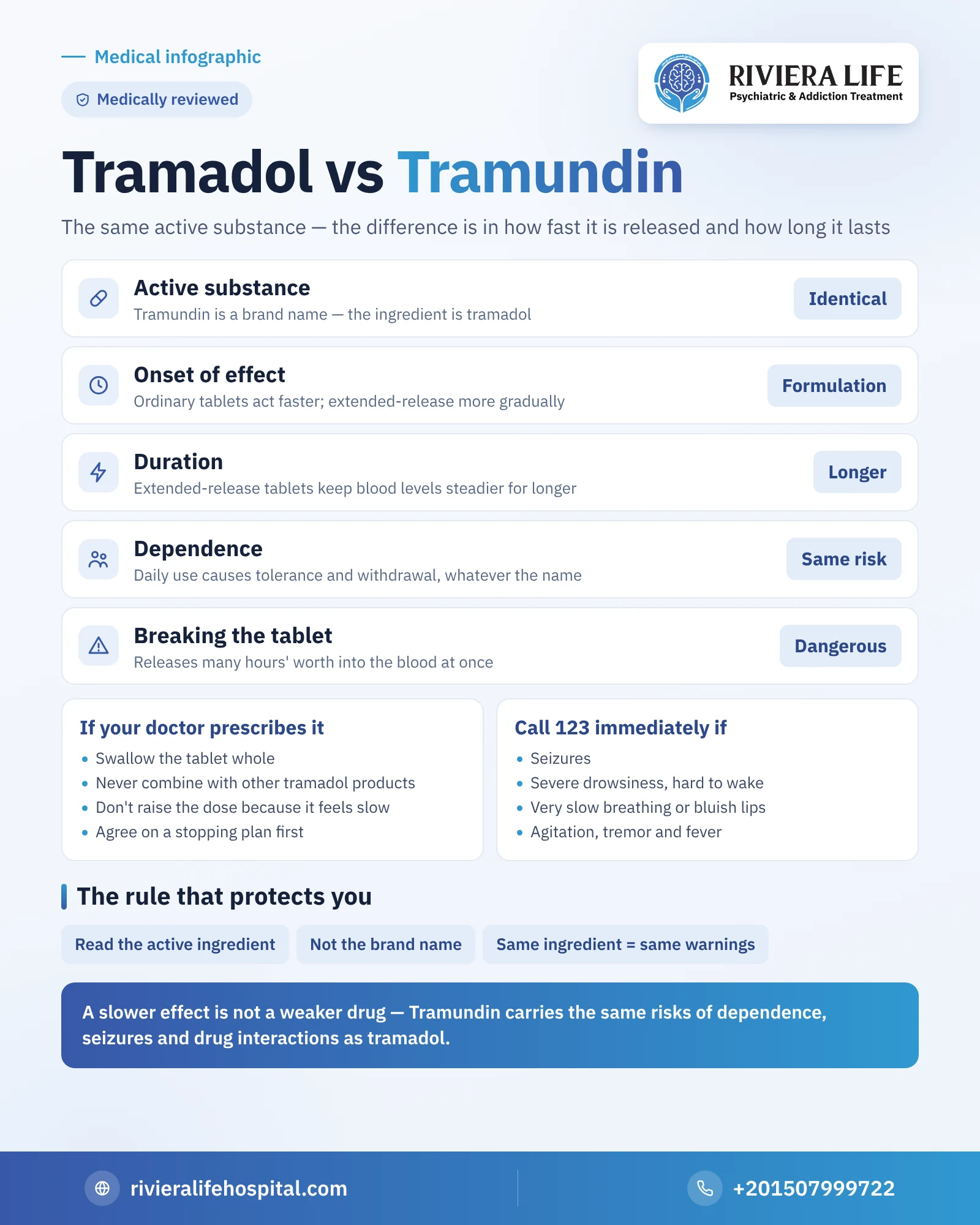
Tramundin is not a different substance from tramadol; it is a brand name for a medicine whose active ingredient is tramadol itself, and in the markets where it is available it is mostly known as extended-release tablets that release the substance slowly over hours. So the real difference between tramadol and Tramundin is not in their composition but in how fast the substance is released, how long the effect lasts and how it is used. The risks of addiction, seizures and drug interactions are roughly the same — and may be greater if the extended-release tablet is misused. This article explains these differences and corrects a common belief that Tramundin is “milder” or “safer”.
Tramadol vs Tramundin at a glance
| Point of comparison | Tramadol (generic name) | Tramundin (brand name) |
|---|---|---|
| Active substance | Tramadol | Tramadol itself |
| Forms | Immediate-release, extended-release, injections and combinations with paracetamol | Mostly extended-release tablets |
| Onset of effect | Faster with ordinary tablets | Slower and more gradual |
| Duration of effect | Shorter with ordinary tablets | Longer |
| Risk of dependence | Present | Present to roughly the same degree |
| Seizures and serotonin syndrome | Possible | Possible |
| Breaking or chewing the tablet | No tablet should be altered without advice | Dangerous, because it releases the whole amount at once |
What is Tramundin?
Tramundin is a brand name used by a pharmaceutical company for a product containing tramadol hydrochloride. It is marketed in a number of countries, and its best-known form is the extended-release tablet known by the word “retard”. Whether it is available in Egyptian pharmacies depends on its registration and supply, which may change from time to time. So if you come across a pack bearing this name outside a pharmacy, nothing guarantees it is the genuine product — a question discussed in more detail in our article on tramadol vs Tamol.
A well-known foreign name on the box does not mean the product is stronger or purer than registered local tramadol. All licensed products are subject to standards that ensure they contain the stated amount of the active substance; the difference between them lies in the dosage form and the way the substance is released, not in the “strength” of the substance itself.
Generic name and brand name: a rule that protects you
Much of the confusion comes from mixing up the name of the substance with the name of the product. Tramadol is the name of the active substance, and it is the same everywhere. Brand names differ from one company and one country to another, and the same medicine may carry ten names. The practical rule is simple: read the active ingredient written under the brand name. If it is tramadol, you are dealing with tramadol whatever the name on the box, and every warning that applies to tramadol applies to it. This rule prevents a common mistake: someone taking two tablets with different names, thinking they are two medicines, when they are the same substance.
What does “extended-release” mean?
An ordinary tablet dissolves quickly in the stomach, so the level of the substance in the blood rises within a short time and then falls, and the patient needs repeated doses through the day. An extended-release tablet is designed with a special coating or structure that makes it release the substance gradually over many hours, so its level in the blood stays more stable. This formulation is medically useful for patients with persistent pain who need continuous relief with fewer doses, and only the doctor decides when it suits a patient.
When does a doctor prefer the extended-release form?
Doctors usually turn to extended-release tablets when pain lasts throughout the day, as in some cases of chronic joint or back pain, and the patient has tried non-opioid options without enough benefit. Their advantage is fewer tablets a day and steadier relief instead of waves of comfort and pain. But they are not a suitable choice for sudden, short-lived pain, such as after a tooth extraction or a minor injury, because their effect is delayed and lasts longer than the patient needs.
Older people and patients with liver or kidney disease also need special consideration, because the substance already stays in their bodies longer, so it builds up more easily. That is why a patient should not switch from ordinary to extended-release tablets, or the reverse, on their own, even though the active substance is the same, because the daily dose is calculated differently for each formulation.
Do tramadol and Tramundin work differently?
The mechanism is the same: binding to opioid receptors and raising serotonin and noradrenaline. But how it feels differs with the formulation. With an ordinary tablet the effect comes faster and more noticeably and then fades; with an extended-release tablet it comes more slowly and gently and lasts longer. That is why some people who misuse it describe the extended-release tablet as “weaker” and take more of it or add ordinary tablets on top — and that is where the danger begins.
Is Tramundin milder or less addictive?
No. Dependence on tramadol develops from continuous daily use of the substance, whatever the name on the box. It is true that gradual release reduces sharp swings in the level of the substance, but it does not prevent tolerance, dependence or withdrawal symptoms on stopping. In fact, a patient taking extended-release tablets for long periods may be dependent without noticing, because symptoms only appear if a dose is delayed for a long time. The signs that reveal this stage are explained in our article on tramadol addiction symptoms.
The danger of breaking or chewing an extended-release tablet
An extended-release tablet usually contains enough of the substance to last many hours. If it is broken, chewed or dissolved, it loses its slow-release property and the whole amount enters the blood within a short time. This can cause deep drowsiness and depressed breathing, seizures, or symptoms of serotonin syndrome, especially with alcohol, pregabalin or sedatives. That is why the leaflets for these tablets say they must be swallowed whole.
Call an ambulance immediately (123 in Egypt) if you see
After an extended-release tablet has been taken the wrong way or in a larger amount than prescribed.
- Seizures or an epileptic fit
- Severe drowsiness or difficulty waking up
- Very slow breathing or bluish lips
- Agitation and tremor with sweating and a high temperature
Side effects and drug interactions
Since the substance is the same, the side effects are almost the same: nausea, dizziness, constipation, sweating and drowsiness. The same warnings apply to Tramundin: it should not be combined with certain antidepressants except on a doctor’s decision because of the risk of serotonin syndrome, it is used with great caution in anyone with a history of seizures, and it needs an adjustment or an alternative in patients with liver or kidney disease. For the full picture of harm with long-term use, see our article on the harmful effects of tramadol.
Withdrawal and drug testing: do they differ?
With extended-release tablets, withdrawal symptoms usually appear later after the last dose, because the substance stays in the blood longer, and the withdrawal period may also last longer. In testing, Tramundin shows up as tramadol and needs the same test used for tramadol, and the detection window may be slightly longer with daily use. The details are in our articles on tramadol withdrawal symptoms and how long tramadol stays in your system.
Tips if your doctor prescribes Tramundin
- Swallow the tablet whole; don’t break, chew or dissolve it.
- Don’t combine it with any other product containing tramadol, whatever its name.
- Tell your doctor about all your medications, especially antidepressants, epilepsy medicines and sedatives.
- Don’t raise the dose because the effect feels slow; that is normal for the extended-release form.
- Agree on a stopping plan with your doctor before you start, and don’t stop suddenly after long-term use.
If you find yourself regularly breaking these rules, the problem is no longer the name of the medicine. The Riviera Life team can assess the situation in confidence and determine whether it calls for an adjustment to the pain plan or is a dependence that needs tramadol addiction treatment.
More from our tramadol guide
- Tramadol: the complete guide
- Tramadol vs Tamol
- The strongest alternatives to tramadol
- The causes of tramadol addiction
Questions many people ask
Yes. Tramundin is a brand name for a product whose active ingredient is tramadol, usually available as extended-release tablets that release the substance gradually.
The substance is the same; the difference is the formulation. Ordinary tablets act faster and for a shorter time, extended-release ones more slowly and for longer — and a slower effect does not mean it is weaker or less dangerous.
Yes. It is tramadol itself, and continuous daily use can lead to tolerance, dependence and withdrawal symptoms on stopping, whatever the brand name.
Because breaking or chewing it cancels the slow-release design, so an amount meant for many hours enters the blood at once, which can cause poisoning or seizures.
It shows up as tramadol and needs the test specific to tramadol rather than the standard opioid strip; with daily use the detection window may be slightly longer.