A moody personality and mood swings are common descriptions of a person whose state changes quickly: cheerful in the morning, glum in the afternoon, flaring up at a word and then apologizing. Mood swings in themselves aren’t an illness; every human being goes through good days and heavy ones. But swings that come without a clear reason, or last for days,
or spoil work and relationships, may be a sign of a disorder that deserves assessment. In this article we explain the difference between moodiness as an ordinary temperament and swings that point to bipolar disorder, borderline personality, depression, premenstrual dysphoric disorder or substance use, how to monitor your own mood, and when to ask for help.
Are mood swings normal?
Yes, to a large extent. Mood is affected by sleep, hunger, exhaustion, hormones, and good and bad news. A student who breaks down before an exam and then laughs with friends after it isn’t “ill”, and a mother who flares up after a sleepless night with her baby isn’t “irritable by nature”.
Some people are also born with a more sensitive temperament: they feel things deeply and are quickly affected by situations. This is part of personality, not a diagnosis. But the dividing line appears when the swings become bigger than the situation, longer than usual, or out of control.
Ordinary moodiness or a disorder? Four questions that tell them apart
An article can’t diagnose you; diagnosis is the task of the doctor or psychologist. But these questions help you know whether the matter deserves a visit:
- Is there a reason? Understandable swings are linked to an event, while pathological swings may come “out of nothing”.
- How long does it last? Hours of distress are familiar, while days or weeks of depression or excess activity are something different.
- How big is it? Does the reaction fit the situation, or does a minor disagreement turn into an explosion or a break in the relationship?
- What is its impact? Have you lost work, relationships or money because of your moods?
If the answers point to swings without a reason that last long and leave a clear impact, it is better to look at the following causes.
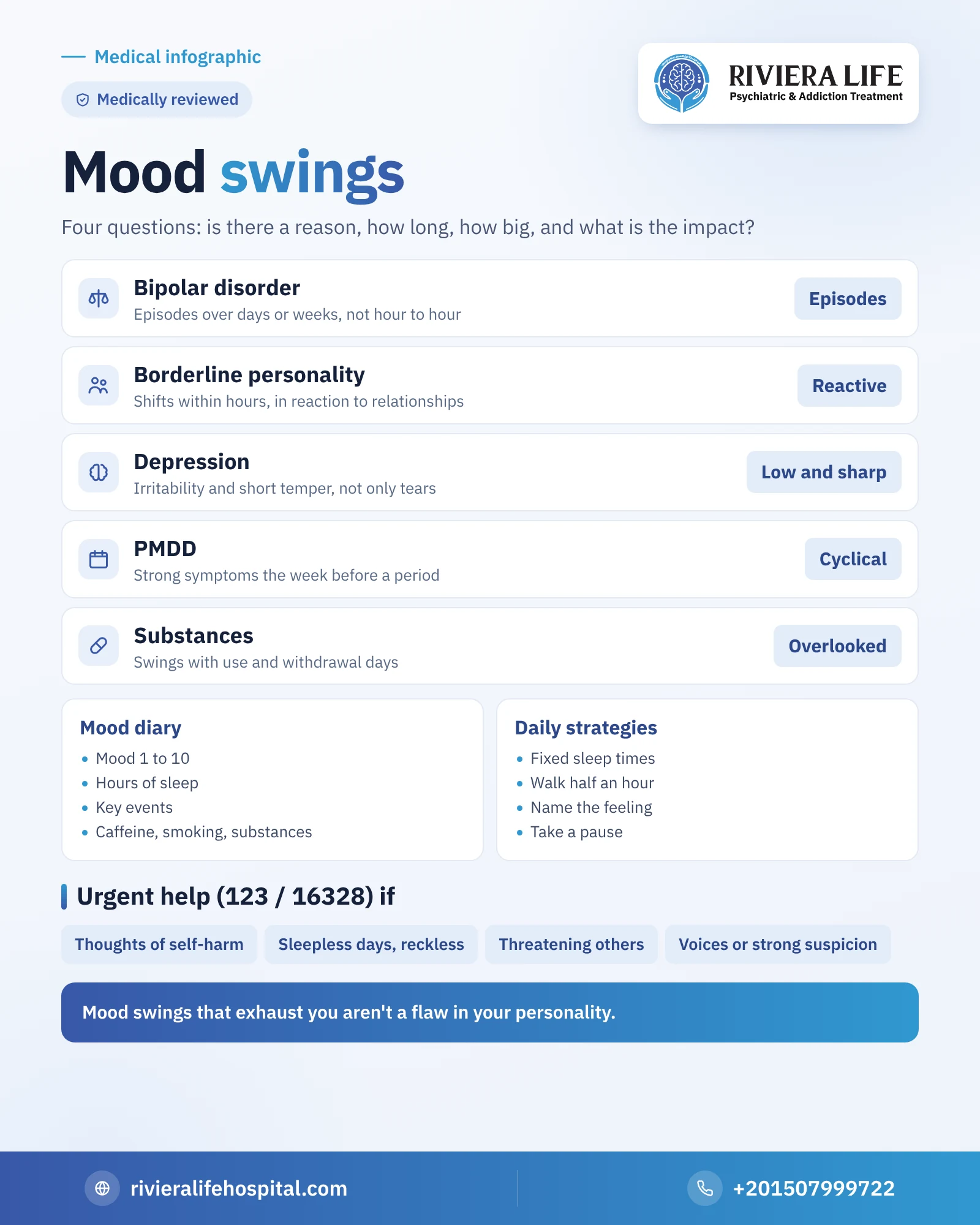
When the swings come in episodes: bipolar disorder
In bipolar disorder mood doesn’t usually swing within a single day; it comes in episodes: a period of depression lasting weeks, and a period of mania or hypomania lasting at least days, in which sleep decreases without feeling tired, speech speeds up, and projects and spending multiply. Between episodes the person usually returns to their usual state. So someone who says “I’m bipolar because my mood changes every hour” is usually confusing daily swings with an episodic disorder.
When the swings are a reaction to people: borderline personality
In borderline personality disorder feelings change quickly, within hours, and often in reaction to situations in relationships: a message that wasn’t answered, a tone of voice, or a feeling of rejection. This is accompanied by an intense fear of abandonment, a feeling of emptiness, impulsiveness, and sometimes self-harm. If you want a detailed comparison of the two disorders, our article on the difference between bipolar disorder and borderline personality has full details.
When mood is low with an edge: depression
Many don’t imagine that irritability and quick distress may be one face of depression. A depressed person may not cry, but becomes quick to anger and impatient, bothered by sounds and questions, and feels everything is a burden. This is common especially in men and teenagers. When this mood continues most of the day for more than two weeks, with loss of pleasure and changes in sleep and appetite, an assessment is necessary.
When the swings are linked to the menstrual cycle
Many women notice a change in mood before their period. But there is a more severe form called premenstrual dysphoric disorder, in which strong symptoms of sadness, tension, anger or emotional swings appear during the week before the period, then improve within days of menstruation starting. The clearest way to distinguish it is to record symptoms daily for at least two cycles. Our article on excessive irritability in women covers other hormonal causes of reactivity.
When a substance is the cause
Drugs and alcohol are among the causes of mood swings that people most often overlook. Stimulants raise mood and energy and then drop them, hash may cause apathy and then anxiety, and alcohol is a depressant that leads to sadness and irritability after its effect wears off. Withdrawal symptoms themselves, from tramadol or sedatives for example, come with sharp swings and irritability. If mood changes with days of use and abstinence, this is a strong signal. Our article on depression and addiction explains how the two intertwine.
Physical causes not to forget
- Thyroid disorders, overactive or underactive.
- Chronic lack of sleep or sleep apnea.
- Fluctuating blood sugar.
- Some medicines, such as cortisone.
- Changes after childbirth and before menopause.
That is why the doctor may request simple tests before concluding that the cause is psychological.
How do you monitor your own mood?
The simplest and most useful tool is a mood diary. For two or three weeks, record each evening:
- Your mood score from 1 to 10.
- Hours of sleep.
- Any important event of the day.
- Coffee, smoking or any substance.
- The timing of the menstrual period for women.
After a few weeks a pattern appears: are the swings linked to sleep? To the cycle? To certain people? Or do they come in long waves? This small page saves the doctor and patient a lot of time.
Strategies that ease daily swings
- Stabilize your sleep: fixed times for sleeping and waking are the strongest natural mood stabilizer.
- Move your body: walking half an hour daily improves mood and reduces tension.
- Name your feelings: saying “I’m upset because I’m hungry and exhausted” reduces the intensity of the outburst.
- Take a pause: before replying in a moment of anger, step away for a few minutes and breathe slowly.
- Cut down stimulants: excess caffeine and energy drinks raise irritability.
- Stay away from substances: don’t calm your mood with hash or sedatives; they increase the swings later.
How do you deal with a moody person in your life?
Living with a spouse, sibling or colleague whose state changes quickly is exhausting. Some principles ease the friction without erasing yourself:
- Don’t take every reaction as directed at you personally; sometimes it reflects exhaustion or illness.
- Postpone important discussions to a time when they are calm, and don’t try to persuade at the peak of anger.
- Set clear limits: “I understand you’re upset, but I won’t continue the conversation if voices are raised”.
- Notice the patterns with them; talking about sleep, substance use or the cycle may be a way in to asking for help.
When should you ask for help?
Ask for an assessment by a psychiatrist if the swings continue for weeks, affect your work, studies or marriage, long periods of depression appear, or periods of excess activity, little sleep and reckless spending, or if you are using substances to adjust your mood. And ask for urgent help if there is a risk:
Seek urgent help immediately if you see
Call an ambulance on 123 or go to the nearest emergency department, or contact the mental health hotline on 16328.
- Thoughts of ending life or self-harm
- Days without sleep with severe recklessness in driving or spending
- Anger reaching threats against others or harming them
- Hearing voices or intense suspicion along with mood swings
How can Riviera Life help you?
Mood swings that exhaust you aren’t a flaw in your personality. At Riviera Life, consultant psychiatrists help you find out whether a mood disorder, a personality disorder, substance use or a physical cause lies behind them, then set a plan that suits you, in complete confidentiality, and the first consultation is free.
Read also
- Bipolar disorder
- Borderline personality disorder
- The difference between bipolar disorder and borderline personality
- Excessive irritability in women
- Menopause and mental health: mood swings or depression? And what helps
- Sadness for no reason: hidden causes and when it is a sign that needs a doctor
Questions many people ask
No, moodiness describes a sensitive temperament that is quickly affected and isn't a diagnosis. It becomes a concern if the swings come without a reason, last long and affect life.
Usually not; bipolar disorder comes in episodes lasting days or weeks. Rapid swings within the day may be linked to stress, borderline personality or other causes the doctor determines.
He may request thyroid function, a blood count, blood sugar or a drug test depending on the case, to rule out physical causes before concluding the cause is psychological.
There is no single medicine for the swings themselves; the doctor treats their cause, and may prescribe mood stabilizers, antidepressants or psychotherapy. Don't take any medicine without a prescription and follow-up.
Yes, lack of sleep is one of the strongest causes of irritability and swings, and regulating it is one of the first steps of treatment. Severe lack of sleep without tiredness may be a sign of a manic episode.