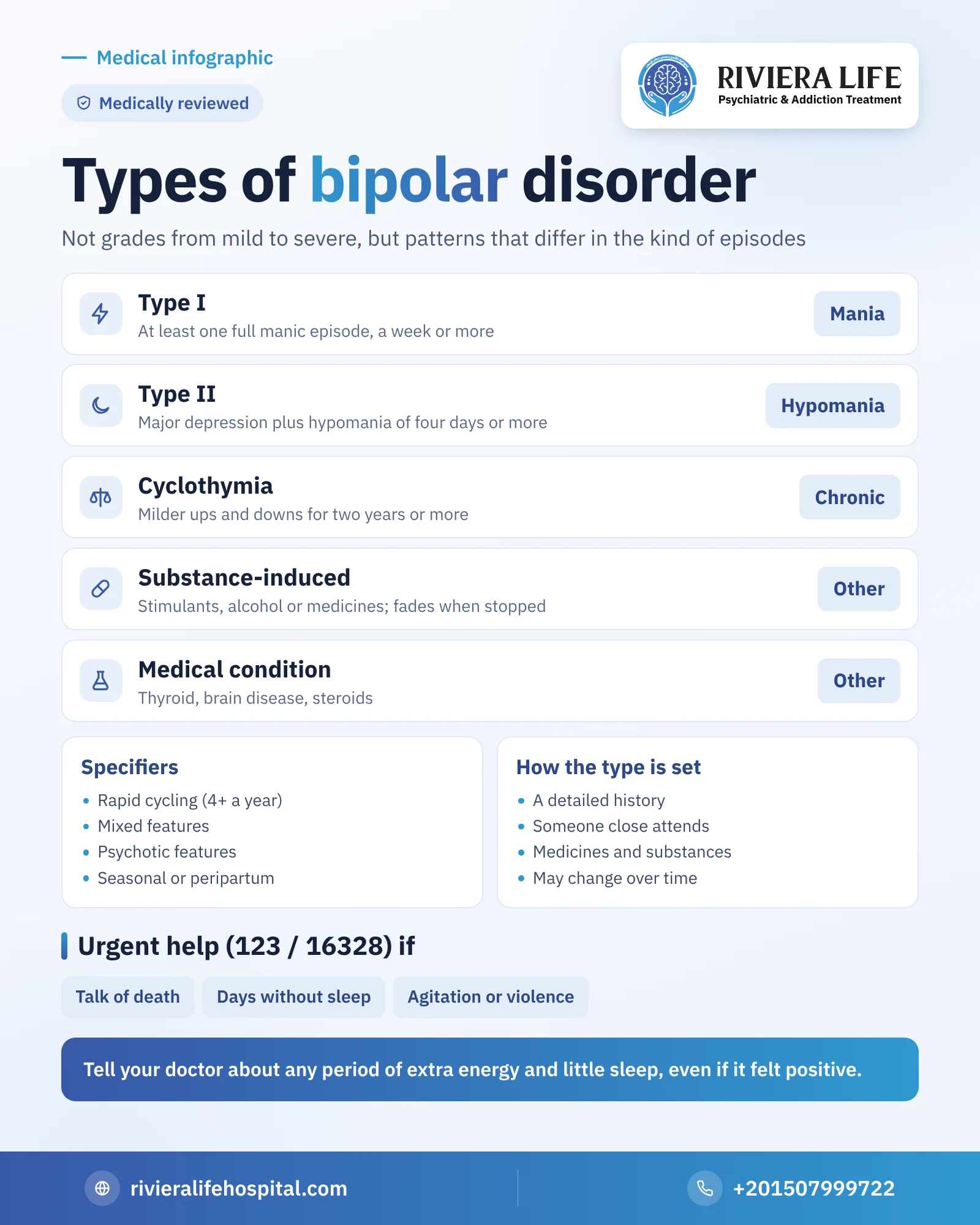
The types of bipolar disorder don’t mean grades “from mild to severe” as many imagine, but patterns that differ in the kind of episodes that occur and their severity. The best known is type I, which includes a full manic episode, type II, which combines depression with hypomania, then the milder cyclothymic disorder. There are also additional specifiers such as rapid cycling and mixed features. Knowing your type or your relative’s type changes the treatment plan, but the classification is determined by a psychiatrist after a full assessment, not by reading alone.
Why does the type matter?
Two people may carry the same illness’s name and live two different lives. One went into hospital during a manic episode in which they lost contact with reality, and the other lived for years thinking they were only depressed and didn’t know their periods of excess activity were part of the picture. Classification maps out expectations of the course and determines the suitable medicines and what to avoid, as antidepressants alone may be insufficient or unsafe for some of those affected. For the signs themselves in detail see bipolar disorder symptoms; here we explain the types.
Type I: a full manic episode
Type I is diagnosed when at least one manic episode occurs, meaning a period of clearly elevated or irritable mood with excess energy, lasting a week or more or requiring hospital admission for any duration. The episode is marked by less need for sleep, rapid speech, racing thoughts, impulsiveness, and sometimes ideas of grandeur, delusions and hallucinations. It isn’t required that the patient goes through a depressive episode, but most do. This type greatly affects work and relationships during the episode, and the patient may need hospital admission for their protection.
Type II: depression and hypomania
In type II a full manic episode never occurs, but at least one major depressive episode and at least one hypomanic episode occur. Hypomania lasts four days or more, in which the person feels more energy and productivity than usual and sleeps less, but remains able to work and doesn’t lose contact with reality. That is why the person doesn’t consider it an illness, but thinks of it as “their good days”.
This point makes type II one of the types most often misdiagnosed as ordinary depression. Its depression may be heavy and recurrent, and it is in no way “milder” than type I; the burden of depression in it is great. Anyone who wants to know the difference between ordinary depression and bipolar depression should read types of depression.
A quick comparison between the two types
| Aspect | Type I | Type II |
|---|---|---|
| The high | Full mania | Hypomania only |
| Duration of the high | A week or more, or hospital admission | Four days or more |
| Effect on functioning | Clear impairment, and psychosis may appear | A noticeable change without severe impairment |
| Depression | Common but not required for diagnosis | Required for diagnosis |
| The common mistake | Sometimes confused with psychosis | Confused with ordinary depression |
Cyclothymic disorder
It is a chronic pattern of mild to moderate swings: periods of symptoms resembling hypomania and periods of depressive symptoms, none reaching the level of a full episode, but continuing for at least two years in adults. Its details are in a separate article on cyclothymic disorder, and in some people it may turn into type I or II over time.
Other types in the classification
- Substance- or medication-induced bipolar disorder: similar episodes appear because of stimulants, alcohol or some medicines, and usually disappear when the cause is removed. If they persist after stopping, the doctor reconsiders the diagnosis.
- Bipolar disorder due to a medical condition: such as thyroid disorders, some brain diseases or raised steroids; here the underlying illness is treated first.
- Unspecified or other specified bipolar disorder: when the symptoms are clear but don’t match any complete type, such as hypomanic episodes being very short.
Specifiers: details added to the type
After determining the type, the doctor adds specifiers describing the current episode or the pattern of the illness:
- Rapid cycling: four or more episodes within one year. In some patients it may be linked to substance use, thyroid disorder or treatment with antidepressants alone, matters the doctor reviews.
- Mixed features: depressive symptoms during mania or vice versa, which increase the risk of harm because the energy of mania combines with the despair of depression.
- Anxious distress: severe tension accompanying the episode.
- Psychotic features: hallucinations or delusions during the episode, which may or may not match the mood.
- Seasonal pattern: episodes linked to particular seasons, usually depression in winter.
- Peripartum: episodes occurring in pregnancy or after childbirth.
What about “type III” and “type IV”?
You sometimes hear phrases such as “bipolar type III” or “type IV”. These aren’t types in the two internationally adopted classifications, the American DSM-5 and the International Classification of Diseases (ICD-11), both of which list type I, type II, cyclothymia and related conditions. So if you read these names in an article or hear them from someone, don’t base a decision on them, and ask your doctor about the approved classification in your case.
How does the doctor determine the type?
There is no blood test or scan that determines the type. The doctor relies on a detailed history: what happened in the patient’s best and worst periods, how long they lasted, and their effect on work and sleep. That is why it helps a lot for someone close who knows the patient to attend with them, as families often remember the days of impulsiveness and little sleep better than the patient. The doctor also reviews medicines, substance use and the thyroid. The classification may change over time if a new episode appears, and this doesn’t mean a previous error.
Does treatment differ by type?
The foundation is usually the same: mood stabilizers or other medicines suited to the case, psychotherapy, regulating sleep, and avoiding triggers. The difference is in the details, such as how much treatment relies on depression treatment in type II, or hospital admission during a severe manic episode in type I. The choice of medicine and its duration is the doctor’s decision alone, and the treatment options are explained in bipolar disorder treatment. If you confuse sharp mood swings with a personality disorder, the comparison of bipolar disorder and borderline personality may help you.
Does the type change over time?
Sometimes, yes. Someone diagnosed with type II may have a full manic episode years later and be reclassified as type I. And someone diagnosed with major depression may turn out, after a hypomanic or manic episode, to have bipolar disorder. This doesn’t mean the doctor was wrong the first time, as the illness reveals itself with time. That is why the patient should tell their doctor about any period of excess energy and little sleep, even if it seemed positive to them.
Questions families often ask
- Is type II milder? Not necessarily. Its high episodes are milder, but its depression is recurrent and long and may be very heavy.
- Can someone move from one type to another? It is possible, and regular follow-up reveals it early.
- Does each type have its own medicine? The medicine groups are similar, but the choice is determined by the symptoms, side effects and medical history.
- Does the risk to life differ? The risk exists in all types, especially with depression and mixed features, and any talk of death must be taken seriously.
Seek urgent help immediately if you see
Call an ambulance on 123 or the mental health hotline on 16328, or go to the nearest emergency department:
- Talk of death or ending life
- Days without sleep with impulsiveness and unrealistic ideas
- Agitation, violence or danger to oneself or others
How can Riviera Life help you?
At Riviera Life in Sheikh Zayed, Giza, psychiatrists assess the full picture to determine the type and the plan, with round-the-clock medical supervision when needed. The first consultation is free and confidential on +201507999722.
More from our bipolar disorder guide
- Bipolar disorder: the complete guide
- Bipolar disorder symptoms
- The causes of bipolar disorder
- Cyclothymic disorder
- Schizophrenia vs bipolar disorder: a comparison table and how the doctor tells them apart
- Schizoaffective disorder: symptoms, types and the difference from schizophrenia
- Bipolar test: an instant result
Questions many people ask
Type I involves a full manic episode, while type II involves depression with hypomania only, without full mania.
Not necessarily. Its highs are milder, but its depression is recurrent and may be very heavy.
In the two approved classifications there is no type III by that name; the types are type I, type II, cyclothymia and related conditions.
It is possible; over time it may become clear that the episodes are more severe or that the picture is bipolar, and regular follow-up reveals this.
It is four or more episodes within one year, and the doctor reviews its possible causes such as substance use and the thyroid.