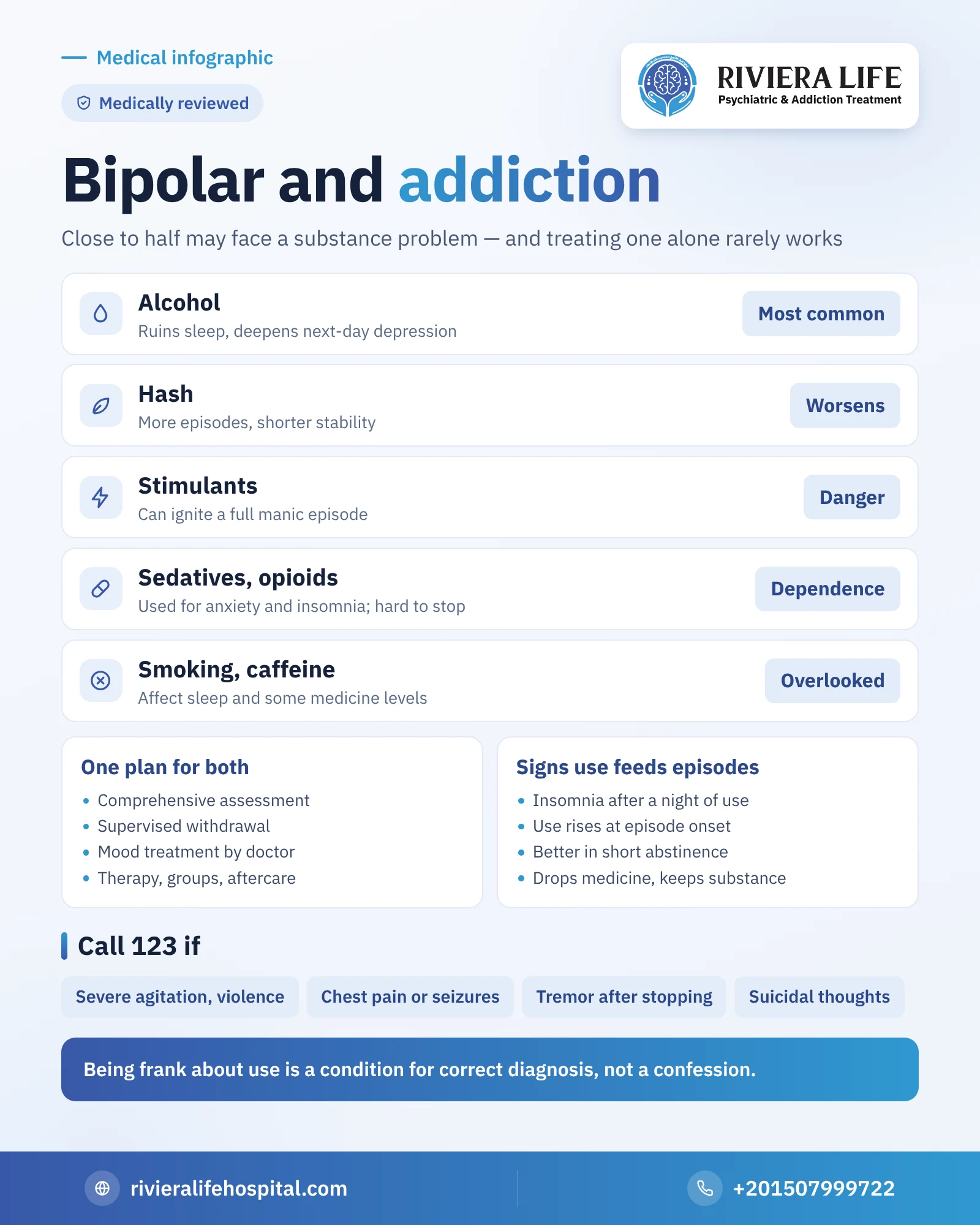
Bipolar disorder and addiction coming together is more common than people think: studies indicate that a large proportion of those affected, possibly approaching half, go through a substance use disorder in their lives. The relationship runs both ways, as the substance ignites episodes and episodes push towards the substance. What matters in practice is that treating one of them alone rarely succeeds, and that the best plan treats them together under one medical supervision. This article explains how the two conditions intertwine and what changes in treatment; the assessment is carried out by the psychiatrist.
Why do the two conditions so often come together?
There is more than one explanation, and they don’t contradict each other. First, self-medication: the person looks for relief from heavy depression so tries alcohol or sedatives, or for the elevated state to continue so tries stimulants, or for sleep on nights of mania so turns to what they think is a sleeping aid. Second, impulsivity and poor judgment in mania make experimenting and excess easier. Third, the two illnesses probably share some genetic factors and the brain’s reward system. And fourth, disturbed sleep and routine, which are fertile ground for both episodes and substance use.
The substances most linked
Alcohol
It is the most common among those affected. It seems calming in the moment, but it ruins sleep, deepens depression the next day, increases impulsivity in mania, and interacts with many medicines. Stopping it suddenly may be dangerous. For details: alcohol withdrawal symptoms.
Hash
Many think it calms mood, but research has linked its use with more episodes and shorter periods of stability in people with bipolar disorder, and it may hasten the appearance of mania in vulnerable people. Read about hash and cannabis and about hash addiction symptoms.
Stimulants
Ice, Captagon, cocaine and their like stimulate the brain in the same way mania does, so they may set off a full episode with delusions, hallucinations and severe insomnia. After the effect wears off comes a sharp drop that overlaps with depression. Their details are in amphetamines.
Sedatives, sleeping pills and opioids
They may be used to calm anxiety and insomnia during episodes, and stopping them is sometimes hard. Dependence on these medicines is a problem in its own right, and stopping them has its own medical method. A golden rule: don’t add a substance or stop a treatment yourself.
Smoking and caffeine
Less striking but common. They affect sleep and the levels of some medicines, and anyone who wants to cut down on smoking should tell their doctor first.
How does the substance affect the course of the illness?
Research agrees that substance use changes the picture for the worse: more frequent episodes, shorter periods of stability, a higher risk of hospital admission, greater difficulty sticking to medicine, and a higher risk of self-harm. The medicine may also lose part of its effectiveness if the substance is upsetting sleep and mood, and the substance may interact with the medicine itself, increasing side effects or weakening its effect. That is why some patients think their medicine “doesn’t work” when in fact it is working in conditions that don’t help it.
Why is diagnosis difficult?
Stimulants, alcohol and hash may mimic the symptoms of mania and depression. So is the patient in true mania or under the effect of a substance? To answer, the doctor needs to know the timeline: did the disturbed mood begin before the use? And did it continue weeks after stopping? This is what makes frankness with the doctor a condition for sound diagnosis, not a confession of guilt. Hiding use may lead to an inaccurate diagnosis or to an unsuitable medicine. To go deeper into combining the two conditions in general: the dual diagnosis program.
Treating bipolar disorder and addiction together: one plan for both
The basic idea is that the two conditions are treated together and at the same time, not one after the other. Postponing mood treatment until “after quitting”, or postponing quitting until “after mood stabilizes”, leaves each illness feeding the other. The plan usually includes:
- A comprehensive psychological assessment: the history of mood, substance use, sleep and medicines.
- Safe withdrawal under medical supervision: this is necessary especially with alcohol and sedatives, because some withdrawal symptoms may be dangerous.
- Mood treatment: the doctor decides on mood stabilizers or other medicines according to the case, without the patient doing so themselves, with caution about medicines that may cause dependence.
- Psychotherapy: cognitive behavioral therapy, motivational interviewing, and regulating daily rhythm and sleep.
- Support groups and work with the family.
- Aftercare: long follow-up of mood and substance use, as relapse in either may drag the other along.
Medicine and substance use: what should you watch for?
Not everything the patient uses conflicts with the medicine to the same degree, but some combinations are dangerous. Alcohol with antipsychotics or mood stabilizers may increase drowsiness and dizziness, and stimulants may completely counter the treatment’s effect. Some patients decide to stop the medicine in order to “enjoy the substance’s effect”, which is one of the shortest roads to relapse. Express these thoughts to your doctor so they can help you find a safe balance instead of making the decision alone. For comparison: schizophrenia and addiction shares some principles of integrated treatment.
Signs that the substance is feeding the episodes
It isn’t easy for the patient or their family to link the two, but there are patterns that repeat:
- A period of insomnia or impulsivity begins after a night of use or staying up late.
- Consumption rises in weeks of depression or at the start of mania, then falls or stops between episodes.
- The condition clearly improves in short periods of abstinence and then worsens on returning.
- The patient gives up the medicine and keeps the substance, or argues that the medicine “kills feeling”.
- Emergency calls repeat after fights, accidents or excessive spending under the influence of the substance.
Noticing these patterns and recording them with dates helps the doctor a lot, because it turns the conversation from accusation into information on which to build the plan.
Preventing relapse: practical steps
- Agree with your doctor on a written plan for risky days: what the signs are, who calls whom, and what you do if the urge to use comes.
- Stay away from places and friends linked to use and replace them with an exercise routine, fixed sleep and alternative activities.
- Keep follow-up appointments even in periods of stability, as they are the time for adjusting medicine, not for emergency treatment.
- Don’t treat a single slip as the end of the road; tell the treatment team quickly instead of hiding it.
- Review your needs around sleep, caffeine and smoking, as they are small triggers that add up.
Advice for the family
- Ask calmly and without accusation about substance use, and start with a question about sleep and mood.
- Don’t make taking medicine a reward or punishment, and encourage regular follow-up.
- Watch for signs of relapse: less sleep, impulsivity, withdrawal. And take them together with signs of substance use. See how to deal with someone with bipolar disorder.
- Celebrate small progress and don’t treat a relapse as final failure.
- Take care of yourself and ask for support, as living with both conditions is exhausting.
Is recovery possible?
Yes. Many stabilize when mood and substance use are treated together and they continue with follow-up. The road isn’t a straight line, but it usually improves with every month of stability: better sleep, fewer episodes and calmer relationships. The key is for the patient to find a team that treats them neither only as an addict nor only as a psychiatric patient.
Call an ambulance on 123 immediately if you see
After using, or with a severe episode:
- Severe agitation, violence, or frightening hallucinations and delusions
- Chest pain, a very high temperature or seizures
- Severe tremor or confusion after suddenly stopping alcohol or sedatives
- Thoughts of suicide or self-harm
- Very slow breathing or loss of consciousness
How can Riviera Life help you?
At Riviera Life in Sheikh Zayed, Giza, we treat both conditions together through the dual diagnosis program, with psychiatry and addiction doctors supervising around the clock, in complete confidentiality, with a family program and aftercare. The first consultation is free on +201507999722.
More from the bipolar disorder guide
- Bipolar disorder: the complete guide
- Bipolar disorder treatment
- The dual diagnosis program
- Depression and addiction
Questions many people ask
For reasons including self-medicating depression and insomnia, impulsivity in mania, and some shared genetic and brain reward factors.
It may seem calming temporarily, but research has linked it with more episodes and shorter periods of stability.
It is best to treat them together in one plan, as postponing one makes it feed the other.
Yes, it may increase drowsiness and dizziness and weaken stability, and the medicine is only adjusted by the doctor's decision.
Yes, many stabilize when mood and substance use are treated together and they continue with follow-up and support.