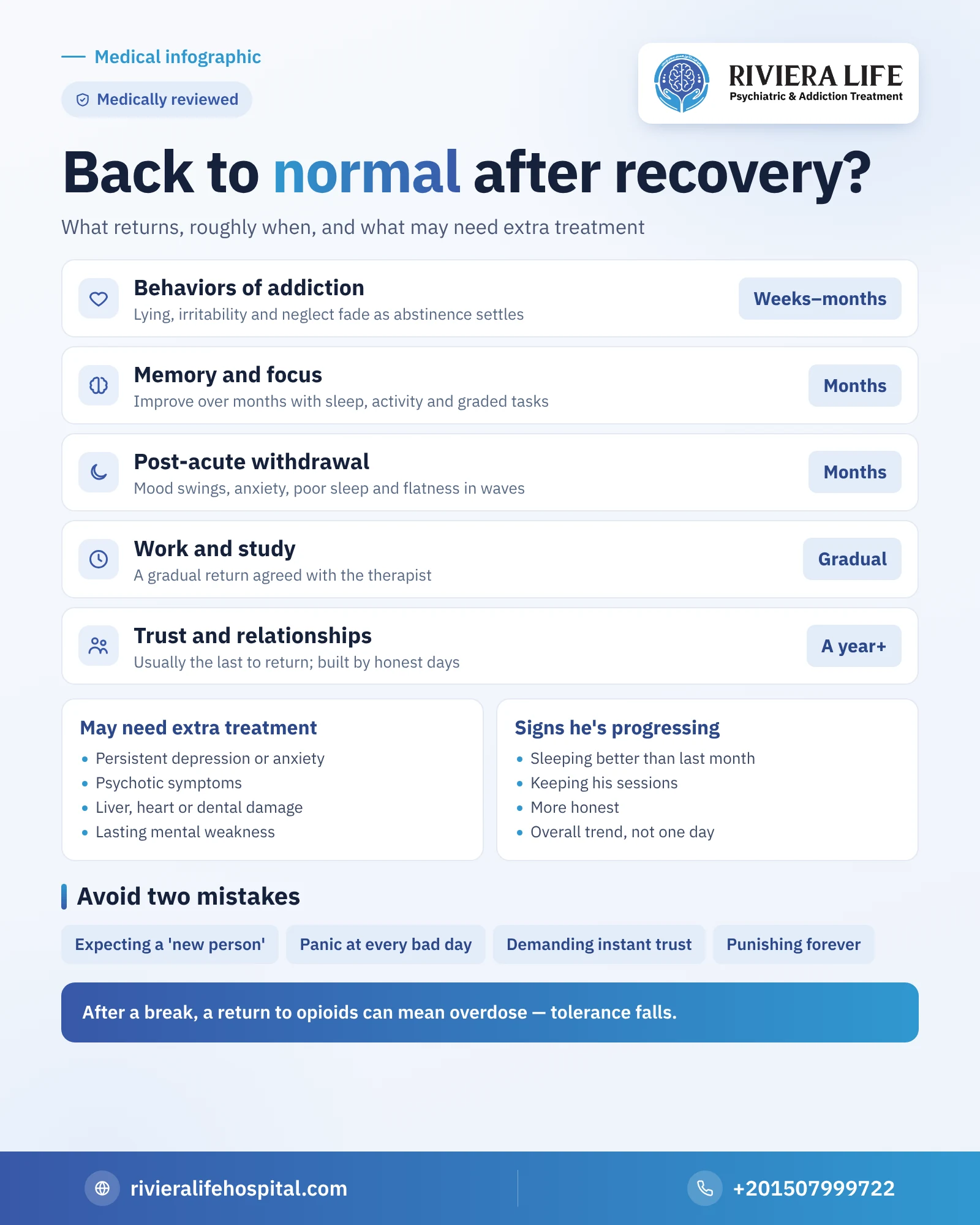
Does an addict return to normal after treatment? The honest answer: yes in most cases, but not immediately on leaving hospital, nor all at once. Much of the lying, irritability and neglect the family sees was the behavior of addiction, not the person’s character, and it disappears gradually with abstinence. Memory, concentration and mood improve over months, while trust, relationships and work need longer. And some effects, such as previous depression or physical damage that has already happened, may need special treatment. Here we explain what returns and when, what is meant by post-acute withdrawal symptoms, and how the family can set its expectations.
Does an addict return to normal after treatment? What we mean by “normal”
When a mother or wife asks this question, she usually means the person she knew before the addiction: his laugh, his care and his honesty. This is a legitimate goal, but there are two important details.
The first is that someone who began using in adolescence may not have fully matured before the addiction, so he doesn’t so much “return” as grow up now and learn skills he missed. The second is that good recovery doesn’t only return a person to how they were, but adds a self-awareness and an awareness of their triggers that they didn’t have before. Many families say years later: “He came back — and better, too.”
Personality: does it return to how it was?
Addiction pushes a person into behaviors that look like fixed traits: lying, selfishness, manipulation and quick temper. Most of these behaviors serve a single goal, getting the substance and hiding it, so they clearly ease once abstinence settles and the person in recovery finds healthy ways of dealing with pressure.
But not everything is caused by the drug. Some traits existed before the addiction, and some people have a psychiatric disorder or personality disorder that drug use was an attempt to escape from. Here stopping isn’t enough; the person needs ongoing psychiatric treatment, which is what the dual diagnosis program provides.
Memory and thinking: when does concentration return?
In the first weeks after stopping, many complain of forgetfulness, slow understanding and difficulty concentrating on reading or work. This is expected, and usually improves over months with regular sleep, physical activity and keeping the mind busy with simple, graded tasks.
After long-term use of some substances, such as alcohol, solvents and stimulants in large amounts, some weakness may remain for longer, and it is assessed with cognitive tests, not by impression. We detail physical and mental recovery by each body system in our article when does the body return to normal after quitting drugs.
Post-acute withdrawal symptoms: why does he seem tired months later?
Many families are surprised that their son left treatment physically well, but is still moody, anxious or not sleeping well two or three months later, and may complain of headaches or fatigue for no clear reason. This is sometimes called “post-acute withdrawal syndrome”, a common clinical description of psychological and physical symptoms that continue after acute withdrawal ends, even though it isn’t an independent diagnosis in the official diagnostic manuals. It shows more clearly after long-term use of opioids, sedatives, alcohol and stimulants, and increases with pressure and lack of sleep.
| Symptom | How it shows in daily life |
|---|---|
| Mood swings | Distress or irritability for no clear reason, then a sudden improvement |
| Anxiety and tension | Difficulty relaxing and tension over simple situations |
| Disturbed sleep | Insomnia or disturbing dreams about using |
| Loss of pleasure | A feeling of emptiness and boredom even in favorite things |
| Poor concentration | Forgetting appointments and slowness in getting tasks done |
These symptoms usually come in waves, a good day and a hard day, and ease gradually over months. The most dangerous thing about them is that the person in recovery or their family interprets them as “the treatment failed”, so he returns to the substance looking for quick relief. Knowing they are temporary and expected is half of treating them; the other half is follow-up with the treatment team.
Work and study
Returning to work or study is a healthy sign, but timing matters. Returning too early to a stressful environment or to colleagues who were part of the drug use may threaten recovery, and a long delay leaves a dangerous gap. The solution is usually a gradual return agreed with the therapist: fewer hours at first, clear tasks, and follow-up sessions that don’t clash with work.
Some people in recovery discover that their old job itself was a trigger, such as night work or work in places where drugs are available, so they decide to change course. This isn’t a step back but part of building a new life. Most people in recovery regain their ability to achieve and their discipline within the first months, and some even describe their performance after recovery as better than it has ever been, because the energy that using and hiding it consumed is now available for work.
Relationships and trust
Relationships are usually the last thing to return, because the other person needs time to believe the change. The person in recovery may be completely honest, but his wife or mother still smells his clothes and checks his phone out of fear. This is expected, and eases as honest days accumulate.
Patience is needed from both sides here: the person in recovery shouldn’t demand full trust immediately, and the family shouldn’t punish him for the past forever. We offer the family practical steps for this stage in our article on dealing with a recovering addict, while the effect of addiction on marriage specifically is in our article on the effect of addiction on married life.
What may need longer or special treatment?
- Persistent depression and anxiety after the first months, which may have preceded the addiction.
- Psychotic symptoms such as suspicion or hallucinations after stimulants or synthetic cannabis, which need a psychiatrist.
- Physical damage to the liver, heart or teeth, or an infection transmitted through injecting.
- Clear mental weakness after many years of alcohol or solvents.
- Legal or financial problems that take time to settle and put pressure on recovery.
The family’s expectations: between too much optimism and constant fear
There are two common mistakes. The first is for the family to expect their son to leave hospital “a new person”, so they are disappointed at the first bad day. The second is to remain in constant terror, interpreting every tiredness or irritability as relapse, and hemming him in until he suffocates.
The realistic expectation is that the first months will bring ups and downs, and that improvement is measured by the overall trend over weeks, not by a single day. Ask yourselves: is his sleep better than last month? Is he keeping his sessions? Has he become more honest? If the answer is yes, he is progressing even if he goes through a hard day. Our article on the stages of addiction recovery explains what to expect at each stage.
Does relapse mean he won’t return to normal?
No. Addiction is a treatable chronic illness, and relapse in it happens to a significant proportion of people in recovery, as it does in other chronic illnesses such as diabetes and high blood pressure. Relapse means the plan needs reviewing, and many have achieved stable recovery after more than one attempt. What matters is that it is discovered early and that the person returns to treatment quickly, bearing in mind that returning to opioids or sedatives after abstinence can cause an overdose because tolerance has fallen.
How can Riviera Life help you?
We know the family’s real question is “will our son come back?”, so we don’t stop at safe withdrawal under round-the-clock medical supervision. Consultants in psychiatry and addiction treatment assess what lies behind the drug use and treat accompanying disorders, and the aftercare program and family program accompany the person in recovery and his family through the months in which his new life takes shape, in complete confidentiality. The first consultation is free on +201507999722, and our center is in Sheikh Zayed, Giza.
Read also
- The stages of addiction recovery
- When does the body return to normal after quitting drugs?
- Dealing with a recovering addict
- The dual diagnosis program for addiction treatment
Questions many people ask
It varies from person to person, but physical improvement appears within weeks, psychological and mental improvement within months, while trust and relationships usually need a year or more.
The irritability may be part of post-acute withdrawal symptoms, or the result of the pressure of returning to life, and it usually eases gradually with follow-up and good sleep.
Many of the troubling behaviors were tied to drug use and disappear with abstinence, and some people in recovery become more self-aware than they were before the addiction.
Most memory weakness improves within months, but long-term use of some substances may leave an effect that needs assessment and specialist rehabilitation.
No. Relapse is common in chronic illnesses, and it is a signal to adjust the plan and return to treatment quickly, not to give up.