Dealing with a recovering addict after he leaves hospital needs a delicate balance: clear support without smothering control, trust built gradually without naivety, and a home free of triggers without turning into a prison. The first weeks and months after discharge are the most sensitive, and what the family does in them may protect recovery or put pressure on it unintentionally. This is a practical guide for the family: how to prepare the home, how to deal with money and trust, which triggers to watch for, what the warning signs are, and when and how to ask for help.
Discharge day: the start of a stage, not the end of a story
Many families receive their son on discharge day as if it were the day the problem ended, so feasts are held and everything goes back to how it was. The truth is that the hospital has finished the stage of withdrawal and initial rehabilitation, and recovery now begins in real life, with its pressures and triggers. Welcome him with warmth and pride, but without loading him with expectations that he has become another person who won’t tire or make mistakes. On the other hand, don’t welcome him with a list of accusations or warnings; the first days need calm more than anything.
Before he returns home: prepare the place
The home the patient left for treatment isn’t necessarily the right home for his return. Simple steps before discharge day reduce the risk a lot:
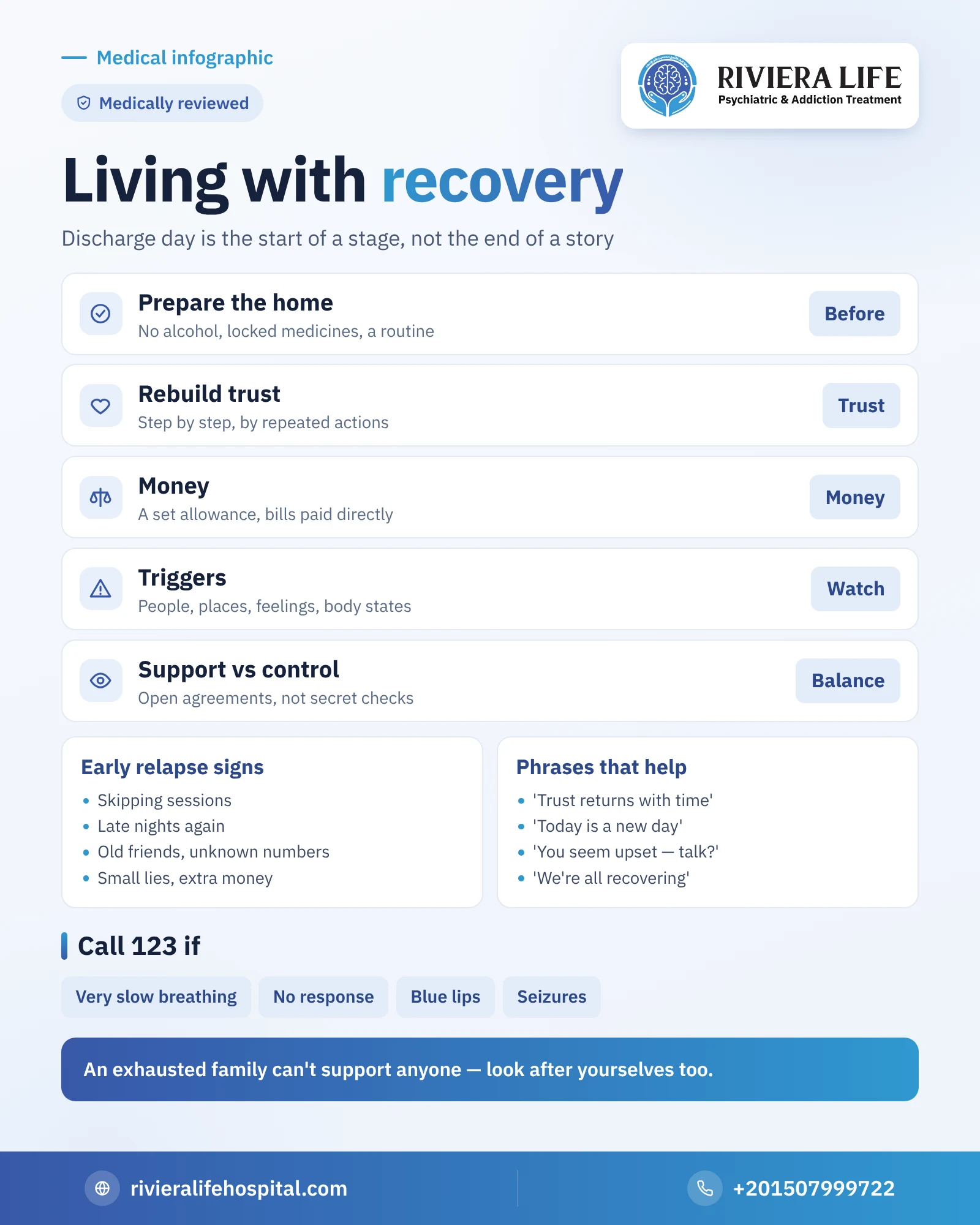
- Get rid of any alcohol or substances in the home, and any old tools for using.
- Lock the home medicine cabinet, and dispose of unused medicines, especially painkillers and sedatives.
- Agree with the treatment team on who keeps his prescribed medicines and how they are given.
- Prepare a clear daily routine starting from day one: times for sleep, meals, sessions and activity.
- Agree within the family on unified rules, so he doesn’t find a gap between a lenient father and a strict mother.
Rebuilding trust: step by step
It is natural not to trust him immediately after years of lying, and it is also natural for him to be hurt by this doubt. Trust isn’t given all at once or withheld forever; it returns through repeated actions. What has helped many families is agreeing with him on clear steps: he keeps to the sessions and is honest about his times, and in return his freedom widens gradually as time passes without problems.
And if the doctor has included periodic testing in the follow-up plan, let it be part of an open agreement that also protects him from suspicion, not a surprise tool for accusation.
Money: temporary, agreed arrangements
Cash in the first months may be a strong trigger, but depriving him of it completely humiliates him and makes him feel he is still a suspect. The middle ground is a temporary arrangement agreed clearly: a set allowance that covers his needs, paying large bills directly, and reviewing the arrangement every month or two. The more his commitment is proven, the more his financial responsibility increases until he returns to managing his money himself.
Triggers: friends, places and feelings
A trigger is anything that wakes the desire to use, some obvious and some hidden:
- People: using friends, or a dealer whose number he knows.
- Places and times: a particular café, a street, Thursday night, or payday.
- Feelings: anger, boredom, loneliness, a sense of injustice, and even intense joy.
- Body state: hunger, tiredness and lack of sleep raise vulnerability to relapse.
The family’s role isn’t to prevent life, but to help him avoid the big triggers at the start, and give him space to talk about his feelings without being met with a sermon. The aftercare program explains how the recovering person himself learns skills for dealing with sudden craving.
Support or control? How to avoid smothering surveillance
Fear of relapse pushes many families to search the room daily, call every hour, ban going out completely, and comment on every delay. This is understandable, but it sends one message: “You are still an addict in our eyes”, and may push him towards frustration or rebellion.
The difference between support and control is that support relies on an open agreement, clear limits and known consequences, while control relies on secret surveillance and sudden decisions. Ask yourselves before any action: is this part of what we agreed, or a reaction to my own fear?
How do you talk when dealing with a recovering addict?
| Phrases that hurt | Phrases that help |
|---|---|
| “We’ll never trust you again” | “Trust comes back with time, and we can see your effort” |
| “Remember when you did such-and-such?” | “Today is a new day, what do you need?” |
| “Looks like you’re back at it” | “I feel you’re upset, would you like to talk?” |
| “You destroyed the family” | “We were all hurt, and we’re all recovering together” |
Also avoid reminding him of the past in front of guests, comparing him with others, or exaggerated celebration that puts him under pressure never to make a mistake.
Early warning signs of relapse
Relapse usually begins days or weeks before use, and shows in behavior before it shows in a test:
- Leaving sessions or dodging them with repeated excuses.
- Returning to late nights and changed sleep times.
- Contact with old friends or unknown numbers.
- Lying about small things, and asking for extra money without a clear reason.
- Irritability and isolation, or repeated talk that “the treatment is exaggerated”.
If you notice two or more signs, don’t wait and don’t accuse him; talk with him calmly and contact the treatment team.
If a slip or relapse happens: what do you do?
A slip, meaning using once, isn’t necessarily a full relapse, but it is a warning that deserves action immediately. Avoid shouting and punishment, and focus on returning to the treatment team quickly to adjust the plan. And if the return recurs, the relapse treatment program page explains what happens next.
And beware of a real danger: someone who returns to opioids or sedatives after a period of abstinence has lower tolerance, so the amount he was used to before may cause an overdose.
Call an ambulance on 123 immediately if you see
Returning to use after a period of abstinence may cause an overdose, so don't leave him alone if you notice:
- Very slow or irregular breathing, or unusual snoring
- No response to calling or shaking
- Lips or limbs turning bluish
- Seizures or loss of consciousness
Family therapy: the family needs recovery too
Addiction changes the whole family: roles shift, anger builds up, siblings felt neglected, and a mother or wife is exhausted by worry. That is why it isn’t enough for the patient to recover alone while the family stays in its old patterns. Family therapy helps in learning to communicate again, setting healthy boundaries, and expressing old pain in a safe place, and it is provided in the family rehabilitation program for addiction treatment.
Look after yourselves
You can’t fully protect his recovery; in the end it is his responsibility. What you can do is be a supportive environment, and keep your own health, life and relationships outside this crisis. Sleep well, ask for support from someone you trust, and don’t give up your activities. An exhausted family can’t support anyone.
And don’t forget the siblings and children; they often feel all the attention has gone to the recovering person, so set aside time for them and listen to what they lived through in the years of crisis. And if any of you notices in themselves anxiety that won’t settle, insomnia or persistent sadness, asking for a psychological assessment for themselves is also a healthy step with no weakness in it. To understand what awaits him in the coming years, read does an addict return to normal after treatment?
How can Riviera Life help you?
We don’t leave the family alone after discharge day. Our team provides a written aftercare plan known to the recovering person and his family, family sessions that help you rebuild trust and set clear agreements, and follow-up from consultants in psychiatry and addiction treatment at any sign of danger, in complete confidentiality. The first consultation is free; contact us on +201507999722 at any time, and we are based in Sheikh Zayed, Giza.
Read also
- The aftercare program
- The stages of recovery from addiction
- Does an addict return to normal after treatment?
- The family rehabilitation program for addiction treatment
- Self-confidence after recovery from addiction: how is it rebuilt?
Questions many people ask
Follow-up is needed in the first months, but by open agreement with him and with clear limits, not by constant secret searching that destroys trust.
You can give a set allowance that covers his needs while paying large bills directly, then gradually increase his financial responsibility as his commitment is proven.
Talk to him calmly without accusing, contact the treatment team quickly, and don't leave him alone if signs of poisoning such as slow breathing appear.
Yes, at least in the first months, with the home medicine cabinet locked and his prescribed medicines handed to a person agreed with the treatment team.
Usually yes; family therapy helps repair communication, deal with old anger and support continued recovery.