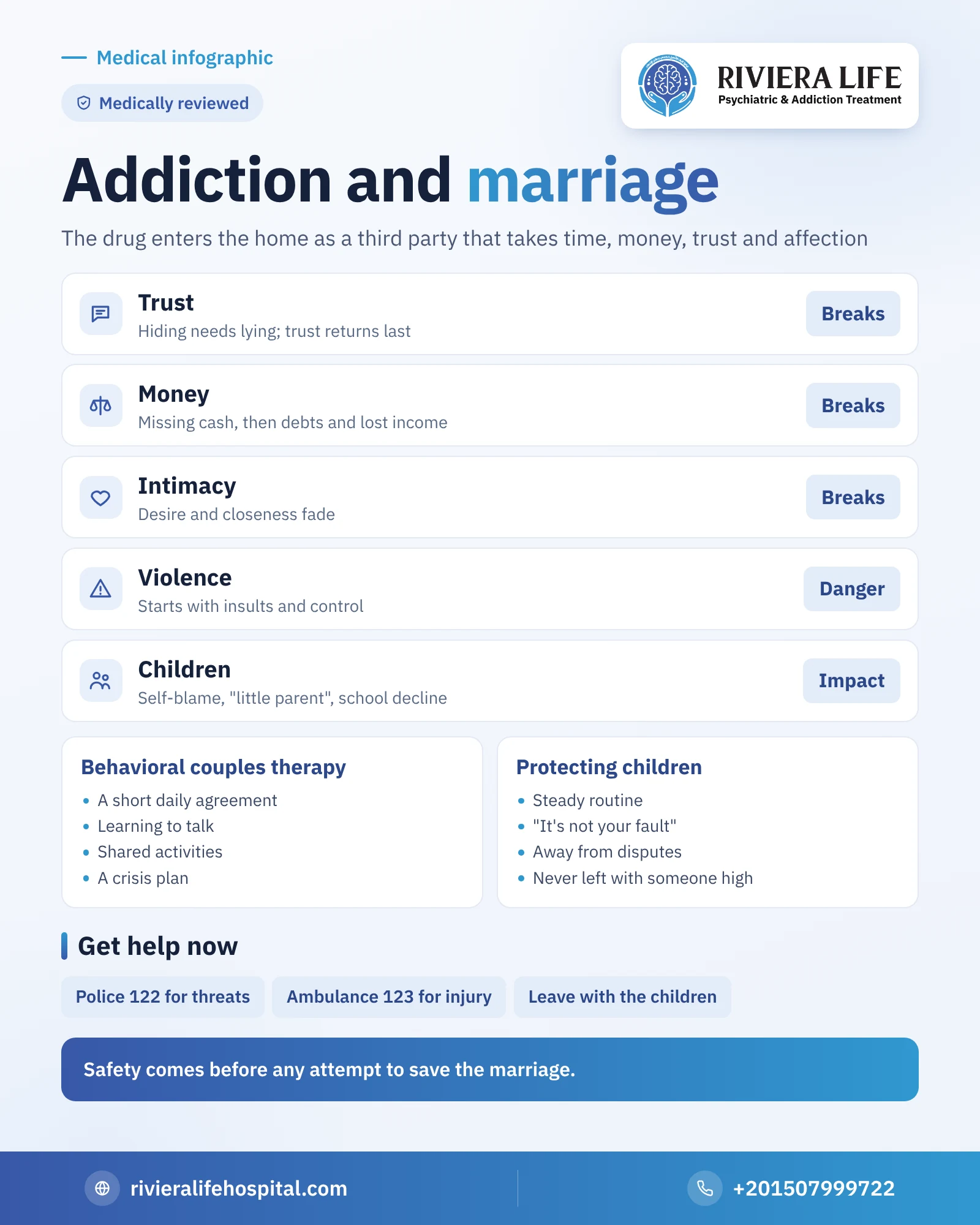
The effect of addiction on married life doesn’t stop at the person who uses; the drug enters the home as a third party that takes time, money, trust and affection, and rearranges the whole relationship around itself. The loss begins with small lies and unexplained late nights, then extends to debts, fading intimacy and disputes that may end in violence, and the children pay a price no one sees. But many couples get through this stage when the addiction is treated and the marriage is treated with it. Here we explain what specifically changes in the marriage, how it recovers, and when separation becomes a decision for safety, not a decision of failure.
The effect of addiction on married life: how does the shape of the marriage change?
A healthy marriage is built on partnership: shared decisions, known spending, time for the family, and frankness about big matters. Addiction quietly breaks this partnership. The using husband, or wife, comes to have a parallel world with its own appointments, friends and hidden budget, and the other party turns from a partner into an investigator, a nurse or a treasurer.
Over time the roles inside the home shift: one carries all the responsibilities, and the other withdraws from them. This imbalance is the core of the problem, and it is what sometimes makes treating the addiction alone insufficient to repair the marriage.
Trust: the first thing to break
Addiction needs hiding, and hiding needs lying. The user lies about where they are, about their money and about why they are tired, and usually doesn’t intend to hurt their partner so much as to protect the use. But the result is the same: the partner discovers that what they heard wasn’t true, so they begin to doubt everything.
Here a painful cycle appears: the partner monitors and searches, and the user feels besieged so hides more. Even after stopping, trust is the last thing to return, because it is built by repeated actions, not by a single promise however sincere.
Money: from household spending to debts
Drugs are expensive, and the cost rises as tolerance increases. It starts with small amounts disappearing from the household budget, then late rent or school fees, then loans or selling the wife’s gold or household appliances. In many cases income itself falls because of absence from work or losing it.
Money in the home isn’t just numbers; it is a feeling of security. And when this security is threatened, the partner lives in constant worry about tomorrow, and the children feel tension even if they don’t understand its cause.
Intimacy: fading or disturbed
Different substances affect sexual desire and performance in many ways; opioids and sedatives usually lower desire, some stimulants may raise it temporarily and then leave it collapsed, and with long-term use performance is disturbed in many people. We explain these medical effects in detail in our article on drugs and sex.
But the deeper side is emotional: it is hard for a partner to feel close to someone who lies to them, or who comes to bed under the influence. They may feel rejected or merely used, and some relationships may reach risky sexual behavior outside the marriage under the influence of the substance, with the infection and wounded dignity it carries. That is why repairing this area needs patience, and sometimes specialist sessions after recovery.
Disputes and violence: when does the home become unsafe?
Not all disputes in an addict’s home are violent, but addiction clearly raises the risk of violence. Alcohol, some stimulants and synthetic cannabis increase impulsiveness, suspicion and aggression, and withdrawal crises and financial pressure add fuel to disputes. Violence may begin with words, insults and control over money and going out, before reaching physical harm.
Violence isn’t a symptom to be tolerated until the patient recovers, nor is it excused by “he wasn’t in his right mind”. Safety comes before any attempt to save the marriage.
Seek help immediately if this happens
Call the police on 122 in case of threats or assault, and an ambulance on 123 in case of injury or health danger, and move with the children to a safe place.
- Physical assault or a threat with a weapon
- A threat to kill or to harm the children
- Suspicion and hallucinations that the partner acts on
- Talk of harming themselves or ending their life
The children: what they see and what they carry
Many parents think the children don’t know, but children pick up tension, shouting, absences and broken promises. Public health bodies count a substance problem in the home among the adverse childhood experiences that may leave a mark on mental health later.
- A child who blames themselves and thinks they are the cause of the problem.
- An older child who turns into a “little parent” caring for siblings and protecting their mother.
- Academic decline, withdrawal, or aggression at school.
- A higher risk of substance use in adolescence if they find no support.
The good news is that a steady routine, and one safe adult who calmly explains that the father or mother is ill and that the illness isn’t the child’s fault, greatly ease this effect.
Codependency: when the partner revolves around the addiction
Some husbands and wives gradually dissolve into the other party’s problem: they cover for them in front of the family, pay their debts, cancel their own lives, and measure their day by the other’s mood. This is what therapists call “codependency”, a description of a relationship pattern, not a medical diagnosis.
This pattern looks like love and sacrifice, but it protects the addiction from its consequences, and drains the partner until they too become ill with anxiety, insomnia and depression. Getting out of it doesn’t mean abandonment, but distinguishing between supporting the person and supporting the use, which our article on how to help someone addicted to drugs explains with practical steps.
When the wife is the one with the addiction, or both use
A wife’s addiction usually passes in greater silence, because the stigma is heavier and the fear of losing the children or divorce prevents her from seeking treatment, and it often begins with a medicine for sleep or pain. We cover this particular situation in our article on women and addiction.
When the couple use together, use becomes part of the bond between them, and it is hard for one to recover while the other continues beside them. In this case each needs their own treatment plan, and the relationship itself is looked at after both have stabilized.
Can the marriage be saved? Couples therapy during recovery
Yes in many cases, provided that treating the addiction is the foundation. One of the studied methods in this field is “behavioral couples therapy”, in which the partner takes part in structured sessions aimed at supporting abstinence and improving communication together, and studies have shown that it may achieve better results than treating the patient alone in couples suited to it.
- A short daily agreement: the person in recovery expresses their commitment to abstinence, and the partner expresses appreciation and support without searching or accusation.
- Learning dialogue: talking about feelings and needs instead of old accusations.
- Shared activities: recovering enjoyable time together that doesn’t revolve around the problem.
- A crisis plan: what each does if a strong craving or a slip appears.
This method doesn’t suit homes where there is current violence or fear of the partner; here safety and individual treatment come first.
What changes in the marriage after recovery?
Many expect the marriage to return to how it was as soon as the partner leaves hospital, but the first months are usually the hardest. The person in recovery is learning a life without the substance, and may be moody or busy with their sessions. And the partner carries old anger that hasn’t found time to be expressed, and fear of relapse.
This stage is normal, and passes more easily when both know what to expect. Our article on dealing with a recovering addict offers the family a guide for this period, while our article on the stages of addiction recovery explains what awaits the person in recovery themselves.
When is separation a decision for safety, not failure?
Not every marriage must continue at any price. Separation, temporary or final, becomes an understandable option when violence or threats recur, when the children are exposed to direct danger, when the partner refuses any treatment despite years of chances, or when the other party begins to lose their mental health completely.
A temporary separation is sometimes a clear message that pushes towards treatment, provided it isn’t used as a threat that isn’t carried out. This is a personal decision that no one has the right to impose, and it is better made after consulting a specialist, not in a moment of anger. And if you are a wife looking for practical steps for day-to-day handling, our article on how to deal with an addicted husband is written for you.
How can Riviera Life help you?
Our team doesn’t treat addiction in isolation from the home. Consultants in psychiatry and addiction treatment assess the patient, detox takes place under round-the-clock medical supervision, then the husband or wife takes part in the family program and aftercare to rebuild the partnership step by step, in complete confidentiality. The partner can start with a free consultation even before the other agrees to treatment. Contact us on +201507999722; we are based in Sheikh Zayed, Giza.
Read also
- How to deal with an addicted husband: a guide for wives
- How do I know if my husband is addicted?
- The family rehabilitation program for addiction treatment
- My husband gambles: what should I do?
- Marrying a recovered addict: frank questions and warning signs before deciding
- How mental health affects the marital relationship: how it changes and what helps
Questions many people ask
Yes, many marriages continue and improve when the addiction is treated first and then the couple works on repairing the relationship with a specialist's help, provided there is no violence or current danger.
The legal and personal assessment differs from case to case; it is best to consult a lawyer on the legal side and a mental health specialist on the decision itself, putting safety before any other consideration.
It is a pattern in which the partner revolves around the other's problem, covering for them, paying their debts and neglecting themselves, which protects the addiction from its consequences and drains the partner.
They usually need support and family sessions, because years of worry and fear leave a psychological mark, and because changing how they respond helps their partner recover.
With a steady daily routine, a simple explanation that the illness isn't their fault, keeping them away from disputes, and not leaving them in the care of the person while they are under the influence.