The short answer
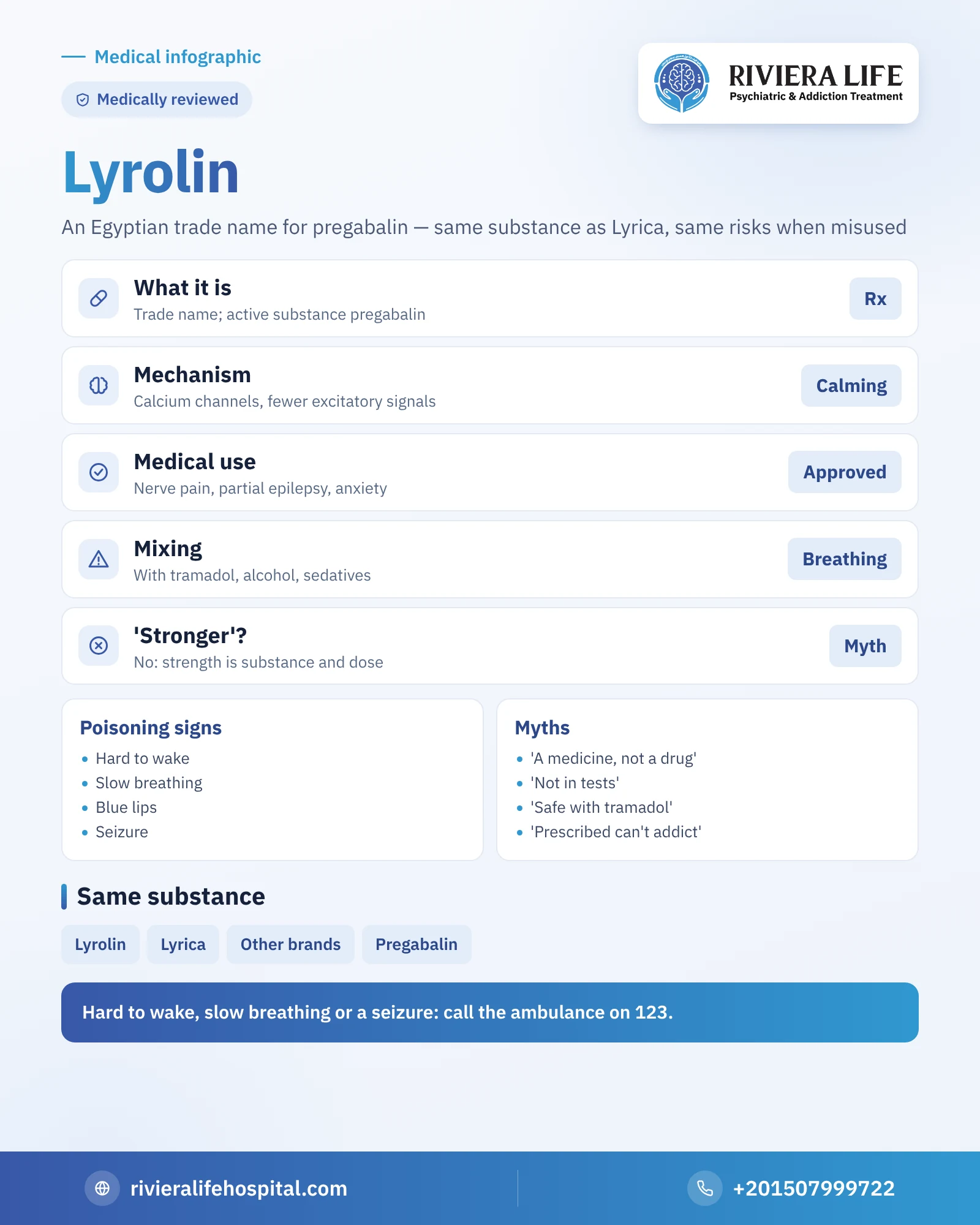
Lyrolin is an Egyptian trade name for a medicine whose active substance is pregabalin, the same substance found in “Lyrica” and other trade names. It is dispensed by medical prescription for nerve pain, some types of epilepsy and generalized anxiety disorder, but it is misused in large amounts in search of a high or mixed with tramadol, so it turns into an addiction that may be accompanied by difficult withdrawal. That is why everything concerning the symptoms of addiction to it, its withdrawal, its harms and its treatment is the same as for pregabalin.
- Active substancePregabalin
- Equivalent namesLyrica and others
- Is it stronger?No, strength is set by the substance and concentration
Because the substance is the same, the steps of Lyrolin and pregabalin addiction treatment are also the same, and we explain them in a separate article.
Lyrolin is a trade name for capsules containing the substance pregabalin, a medicine doctors prescribe for nerve pain, epilepsy and some anxiety disorders. That is, what is said medically about pregabalin applies to Lyrolin literally, as the difference is in the company name and the shape of the box, not in the substance. But the name itself has acquired a different reputation among some young people in recent years, so it has come to be asked for in pharmacies and on the tongues of users as “a pill that knocks you out” rather than a treatment. This page gathers what the family needs to understand Lyrolin: what it is, why it is misused, and the mixes that make it dangerous, followed by detailed links for every aspect from symptoms to treatment.
What is Lyrolin?
The active substance in Lyrolin is pregabalin, which belongs to a medicine group sometimes called “gabapentinoids”, the same group gabapentin belongs to. Pregabalin was originally designed to resemble in structure a calming neurotransmitter called gamma-aminobutyric acid, but in reality it doesn’t act on its receptors; rather, it affects the calcium channels inside nerve cells in a way that reduces the release of excitatory signals.
Because Lyrolin is one of several trade names for the same substance, the pregabalin page is the broader reference for everything related to the active substance. This page focuses on the name people actually search for, and on the way it circulates on the Egyptian street.
Lyrolin on the Egyptian street: the name and the reputation
Many young people don’t know the word “pregabalin” at all, and know the medicine by the name on the strip they see: Lyrolin, or Lyrica, the oldest trade name for the substance, or other trade names available in pharmacies. The capsule is sometimes referred to by its strength alone, so the strength number is said instead of the name. This multiplicity confuses parents, as a father may find a box with a name he doesn’t know and think it is vitamins or an ordinary painkiller.
More dangerous than the name is the image associated with it. Some users pass around ideas such as “it’s a nerve medicine, not a drug”, “it doesn’t show in the test” and “it calms the nerves without addiction”. These ideas make the start easy and delay asking for help, and all of them, as we will see, are incorrect.
Why does Lyrolin spread among young people in particular?
Most young people don’t start with Lyrolin looking for addiction, but looking for something else that seems innocent. The beginnings in many stories are similar:
- A student in an exam year who took a capsule from a friend “to calm down and sleep”, then came to need it every night.
- A young man who works long shifts and sees it as a cheap way to bear tiredness and distress.
- A group of friends who treat it as the start of the night out, taken before hashish or with a bottle of beer.
- A user of tramadol or heroin who uses it to strengthen the effect or to ease withdrawal symptoms.
One factor brings these stories together: the belief that what is sold in a pharmacy is less dangerous than what is sold on the street. Added to that, the young person sees Lyrolin in the home of a relative who takes it for nerve pain, so the medicine loses any respect in his eyes. The details of these motives and risk factors are in the article on the causes of Lyrolin addiction.
Forms of Lyrolin and ways of using it
Lyrolin comes as capsules in more than one strength, taken by mouth. Therapeutic use differs clearly from the pattern of misuse:
- Medical use: a dose set by the doctor, raised gradually and reviewed regularly, with a specific therapeutic aim.
- Misuse: amounts exceeding what is usually prescribed, taken all at once in search of a high or a “knockout”, usually without any prescription.
- Mixing: taking it with tramadol, hashish, alcohol, sedatives or strox to strengthen the effect, the most dangerous pattern of all.
What does Lyrolin do in the brain and body?
At therapeutic doses pregabalin calms excessive nerve signals, so nerve pain eases and anxiety decreases in those who need it. But at large amounts another face appears:
- A feeling of looseness, elation and social boldness that some describe as resembling the effect of alcohol.
- Dizziness, unsteady walking and slurred speech.
- Drowsiness, slow responses and blurred vision.
- A decline in concentration and short-term memory.
- With other depressant substances: deep drowsiness and slowed breathing that may reach loss of consciousness.
Pregabalin leaves the body through the kidneys almost as it entered, without being converted in the liver, and its half-life is about six hours. That is why someone who misuses it needs repeated doses during the day, and with repetition the nervous system adapts, so tolerance appears, then dependence, and the nerves become “tense” if the capsule is late.
The legitimate medical use of the substance
Lyrolin has real medical uses, including nerve pain linked to diabetes, shingles or spinal cord injuries, some types of partial epileptic seizures as an add-on treatment, and generalized anxiety disorder in some countries. Many patients use it safely under medical supervision and then stop it gradually without a problem. The existence of this legitimate use doesn’t contradict the risk of addiction; rather, it is what makes the medicine available and easy to reach for those who misuse it.
Why is Lyrolin dangerous when misused?
- A misleading reputation: the belief that it is “just a medicine” makes a young person take amounts they wouldn’t dare with a known drug.
- Mixing: it multiplies the risk of respiratory depression when combined with opioids such as tramadol, and with alcohol and sedatives, and international drug authorities have warned of this specific risk.
- Troublesome withdrawal: stopping suddenly after long use may cause insomnia, anxiety, headache and nausea, and seizures in some patients.
- Effect on driving and work: dizziness and poor balance raise the risk of accidents and injuries.
- Psychological effect: it may increase depression, and drug leaflets warn of the possibility of suicidal thoughts appearing in a few users.
Lyrolin within its medicine family
Lyrolin isn’t an independent medicine in itself, but one of a group of trade names sharing pregabalin. Close to it in the same group is gabapentin, and the two can be compared in the article on pregabalin and gabapentin. It is often confused with tramadol in young people’s talk because the two are taken together, even though tramadol is an opioid and pregabalin isn’t, and the differences are explained in the article on the difference between pregabalin and tramadol.
Lyrolin and the law in Egypt
In recent years the health authorities in Egypt have tightened control over the dispensing of pregabalin under its various trade names after its misuse spread, and its dispensing has become restricted to a medical prescription, and the law punishes circulating and trafficking it outside legitimate channels. On the other hand, no criminal case is brought against someone who comes forward of their own accord to seek treatment for addiction. For inquiries about a specific case it is preferable to ask a specialized lawyer, and the Fund for Drug Control and Treatment of Addiction also provides a free hotline on 16023.
Lyrolin and pregabalin in a table
| Point of comparison | Lyrolin | Pregabalin |
|---|---|---|
| What is it? | A trade name for a medicinal preparation | The name of the active substance (the scientific name) |
| Active substance | Pregabalin | Pregabalin |
| Mechanism of action | Binds to calcium channels in the nerves | The same mechanism |
| Medical use | Nerve pain, add-on for epilepsy, generalized anxiety and others | The same uses |
| What differs | The company, name, packaging, excipients and price | There are other brands of it, such as Lyrica |
| Risk of dependence and misuse | Present | Present to the same degree |
| Is either one stronger? | No, strength is set by the substance and its concentration | No |
Why is it said that Lyrolin is “stronger”?
The idea is widespread among those who misuse the medicine, and it comes from non-pharmacological reasons. The first is brand reputation: someone who tried a brand and felt a stronger effect may attribute that to the name, while the cause may be a larger amount, an empty stomach or mixing with other substances. The second is the existence of counterfeit or unknown-source capsules carrying a famous name. The third is a limited difference in the speed of dissolution and absorption between preparations, which doesn’t turn one medicine into another. The name on the box doesn’t determine the strength; the substance, concentration, amount and state of the body do.
Can Lyrolin be swapped for Lyrica or vice versa?
The pharmacist may offer an equivalent with the same active substance, but it is better that the doctor decides or agrees, especially in epilepsy, older adults and kidney patients. And it isn’t right to change the brand thinking the other is “stronger” or “lighter”, or to combine two brands, because that doubles the amount without the person noticing.
The Lyrolin guide: each aspect in a separate article
We have dedicated an article to each question people ask about Lyrolin that answers it alone:
Lyrolin addiction symptoms
The signs the family sees, from heavy speech to empty strips, and how they develop from occasional use to dependence.
Lyrolin withdrawal symptoms
A timeline of what happens after the last capsule, and why stopping suddenly after long use isn’t right.
Lyrolin addiction treatment
The medical steps of treatment, the truth behind talk of a “recovery rate”, and how to choose a hospital.
Causes of Lyrolin addiction
How a nerve medicine turns into an addiction, and who is most at risk of that.
The harms of Lyrolin
What long use and mixing leave on the nerves, breathing, weight, mood and daily life.
How long Lyrolin stays in the body
When it shows in urine, blood and hair, and why the usual rapid tests don’t detect it.
Common myths about Lyrolin
The myth: Lyrolin is a medicine, not a drug, so it doesn’t cause addiction. The truth is that being a medicine doesn’t prevent dependence on it, and medical references and official leaflets recognize the possibility of misusing it and becoming addicted to it.
The myth: Lyrolin doesn’t show up in testing. The truth is that the common rapid tests usually don’t look for it, but laboratories can detect it with a dedicated test when it is requested.
The myth: mixing it with tramadol “sets the head right” safely. The truth is that this particular mix is among what most worries doctors, because it multiplies the risk of deep drowsiness and breathing stopping.
The myth: someone who takes it on prescription can’t become addicted. The truth is that sticking to the prescription greatly reduces the risk, but raising the dose oneself or continuing without review may open the door to dependence.
Found a strip of Lyrolin with your son? Start here
Don’t jump to conclusions or to punishment. First ask calmly: is there a prescription? Who wrote it? And why? The medicine may actually be prescribed for pain or anxiety. If there is no prescription, or the amount is larger than reasonable, watch for changes without constant searching, and record what you notice in drowsiness, stammering or repeated requests for money.
And talk with him when he is sober, about your fear for him, not about your shock at him. Ask for a medical consultation for the family itself even if he refuses at first; early guidance changes the course of many cases. And if use has already begun, the article on Lyrolin addiction symptoms helps you estimate the stage.
Signs of poisoning with Lyrolin and its mixes
Call the ambulance on 123 immediately if any of these appear
Lyrolin's danger multiplies when it is mixed with tramadol, alcohol or sedatives, and consciousness and breathing may deteriorate within a short time.
- Deep drowsiness and difficulty waking the person
- Slow, shallow or irregular breathing
- Bluish lips or severe pallor
- A seizure
- Severe confusion or incomprehensible speech with unsteadiness
Until the ambulance arrives, put the person on their side if they are unconscious and breathing, don’t leave them alone, and don’t try to wake them with cold water or by giving them anything by mouth. And keep the empty strips or any substance you found, as knowing what they took and what they mixed it with saves the medical team precious time.
When should you ask for help?
If Lyrolin is being taken without a prescription, in amounts beyond what is prescribed, or with other substances, or if the person has become irritable and agitated when the capsule is late, this is the time for a medical assessment, not for waiting. The Riviera Life team of consultants in psychiatry and addiction treatment assesses the case in complete confidentiality, and puts in place a safe gradual tapering plan that takes the accompanying mixes into account, and the first consultation is free.
Medical sources and referencesThe information in this article is based on reliable scientific sources
1StatPearls — Pregabalin: uses, mechanism and side effectsncbi.nlm.nih.gov2MedlinePlus — Pregabalin drug informationmedlineplus.gov3NHS — Pregabalin medicine guidenhs.uk4NHS — Common questions about pregabalin (addiction, stopping and alcohol)nhs.uk5MedlinePlus — Drug use and addictionmedlineplus.gov