The side effects of pregabalin range from unpleasant effects most people who have tried it know, such as dizziness, drowsiness and weight gain, to rare but serious ones — most importantly depressed breathing when it is mixed with opioids or sedatives, allergic swelling of the face and throat, and suicidal thoughts. The higher the amount above what the doctor prescribes, or the longer the overuse, the wider the circle of harm, from the body to memory, work and relationships. This article sets out what pregabalin does to the brain, heart, breathing, eyes and weight, the harms that call for the emergency department, the groups most at risk, and what improves after stopping.
These side effects apply to pregabalin capsules under all their brand names, including “Lyrica” and “Lyrolin”, because the active substance is the same.
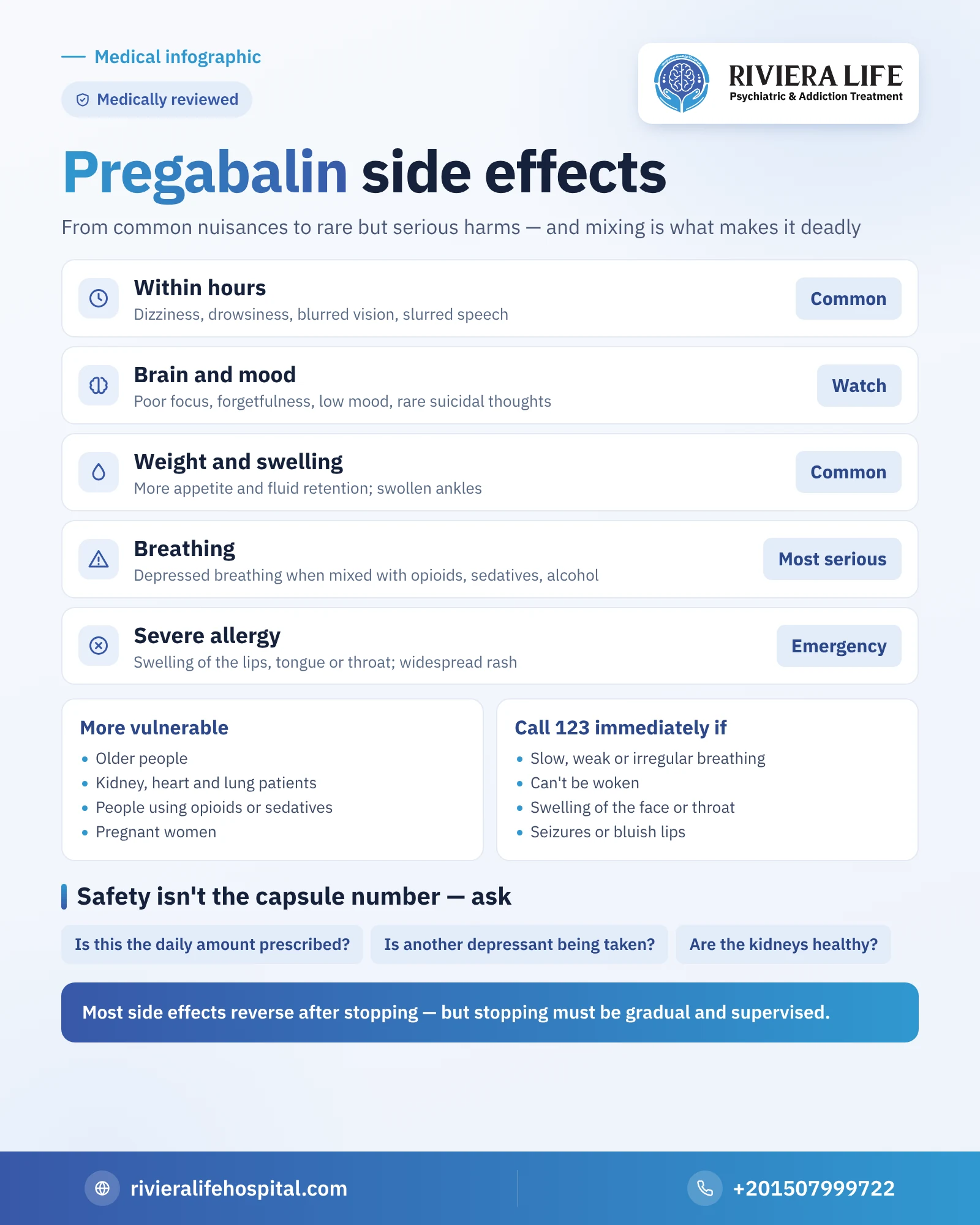
Immediate side effects after taking it
These are the effects that appear within hours, and become more severe as the amount increases:
- Dizziness and a feeling that the ground is tilting, with unsteadiness that can end in a fall.
- Drowsiness and slow reactions that make driving and operating machinery a real danger.
- Blurred or double vision.
- Dry mouth and sometimes nausea.
- Slurred speech and difficulty finding words.
- A feeling of elation or detachment — exactly what drives some people to repeat the dose.
The effects of pregabalin on the brain and mood
Excessive and prolonged use leaves a clear mark on mental functions: poor concentration, forgetting recent events, and slow thinking that colleagues notice before the family does. In terms of mood, depression, mood swings or irritability may appear, especially in the hours when the medicine wears off.
Medicines regulators warn that epilepsy medicines in general, including pregabalin, have been linked to a rare increase in suicidal thoughts, which calls for attention to any talk of hopelessness or self-harm. In large amounts, confusion or hallucinations may occur. Add to this the dependence itself, which is a harm in its own right that changes a person’s relationship with sleep and stress; you will find its signs in our article on pregabalin addiction symptoms.
Weight gain and swollen limbs
Weight gain is one of the most common complaints, caused by increased appetite and fluid retention together. Many people notice swelling of the feet and ankles that gets worse by the end of the day. This may seem cosmetic, but in people with diabetes or heart disease it deserves follow-up, because fluid retention adds a burden to a heart that is already tired. And weight gain itself may push some young people to stop the medicine suddenly without advice — a decision with its own risks.
The heart and blood pressure
Pregabalin isn’t considered harmful to the heart in most healthy people, but it can worsen heart failure because of fluid retention, so these patients need special follow-up when it is prescribed. Some users may notice a change in heart rate, or dizziness on standing up suddenly. Its relationship with high or low blood pressure specifically is covered in a separate article, pregabalin and blood pressure.
Breathing: the most serious harm when mixed
Pregabalin alone rarely stops breathing in healthy people, but the picture changes completely when it is combined with substances that depress the nervous system. Opioids such as tramadol, heroin and methadone, sedatives from the benzodiazepine group, and alcohol all slow breathing, and pregabalin multiplies this effect. The risk is higher still in older people, those with chronic lung disease, and anyone whose tolerance has fallen after a break. That is why many deaths attributed to pregabalin are linked to mixing rather than the medicine alone. The details of this risk with alcohol are in our article on pregabalin and alcohol.
The eyes and vision
Blurred and double vision are known side effects and usually go away after stopping. But any sudden change in the field or sharpness of vision deserves a visit to the doctor, especially for people who drive or work at heights, because poor vision combined with dizziness doubles the risk of accidents. Some users also complain of difficulty focusing their eyes when reading or using a phone for long periods — an annoying effect that usually improves with a lower amount or gradual stopping.
The digestive system, muscles and kidneys
Pregabalin causes constipation and bloating in some people, and constipation can become severe when it is mixed with opioids. Among the rare effects is unexplained muscle pain or weakness, especially with a fever, which calls for a medical examination. As for the kidneys, the medicine doesn’t usually damage them, but they are the only route for getting rid of it, so if they are weak it builds up and its harms appear at lower amounts, as our article on how long pregabalin stays in your system explains.
Severe allergy
In rare cases pregabalin causes a severe allergic reaction, appearing as swelling of the lips, tongue or throat, difficulty swallowing and breathing, or a widespread rash. This is an emergency that can’t wait: stop the medicine and go to the emergency department immediately.
Side effects of pregabalin 75, 150 and 300 mg capsules: does the harm differ by strength?
Pregabalin is dispensed in capsules of different strengths, the best known in Egyptian pharmacies being 75 and 150 mg, and some markets have other strengths, including 25, 50 and 300 mg. The number on the pack shows the amount of substance in a single capsule, which is why many people ask about the harms of each strength separately.
The medical rule is that most of pregabalin’s side effects increase with the amount entering the body per day, not with the capsule number alone. Dizziness, drowsiness, blurred vision and unsteadiness are clearer with higher daily amounts, as are weight gain and swollen feet. Two capsules of a small strength have the same effect as one capsule carrying the same amount.
The real danger begins when someone exceeds what the doctor wrote, combines pregabalin with tramadol, sedatives or alcohol, or takes it with weak kidneys. The kidneys are what clear it from the body, and if they are weak the medicine builds up even at the usual dose. In these situations the chances of poisoning and depressed breathing rise, and higher strengths reach danger faster.
So safety isn’t measured by the number on the capsule, but by three questions: is the daily amount the one the doctor set? Is another depressant being taken with it? And is kidney function healthy? If you find yourself increasing the amount to get the same feeling, that is a sign of dependence worth stopping to look at; you will find the details in pregabalin addiction symptoms.
Large doses and poisoning
When the amount goes far beyond medical use, or is mixed with other substances, a person can reach a state of poisoning that begins with severe drowsiness, confusion and agitation, and may progress to seizures or coma. There is no specific antidote that reverses pregabalin’s effect the way naloxone does with opioids, so emergency treatment relies on supporting breathing and circulation and monitoring consciousness until the body clears the medicine, and a kidney patient may need dialysis to speed this up.
Call an ambulance immediately (123 in Egypt) if you see
Especially if the person has mixed pregabalin with tramadol, sedatives or alcohol.
- Slow, weak or irregular breathing
- Severe drowsiness that makes it hard to wake the person
- Swelling of the face, lips or throat with difficulty breathing
- Seizures, severe confusion or hallucinations
- Bluish lips or limbs
Harms beyond the body
The harm of pregabalin overuse doesn’t stop at the organs. Drowsiness and slow reactions raise the risk of road accidents and workplace injuries. Poor concentration shows in study and work. Sexual interest may decline, or performance weaken in some men. The family is affected by growing spending on strips, by repeated lies and by mood swings. And there are legal risks from buying or possessing it outside a prescription, given the restrictions on dispensing it in Egypt.
In teenagers and young people
Pregabalin reaches many young people through a friend who presents it as “something light from the pharmacy” that helps them have fun or sleep. The problem is that at this age, the brain’s areas for self-control and decision-making haven’t fully matured, so the move from trying it to dependence is faster, and the gamble of mixing is greater. The harm usually shows in studies first: sleeping in lectures, forgetfulness and falling grades, then in relationships with the family. And because the medicine has no smell and needs no equipment, a long time may pass before parents notice what is happening.
Groups more vulnerable to harm
- Older people: more prone to dizziness, falls, confusion and build-up of the medicine.
- Kidney, heart and lung patients: they need smaller amounts and closer follow-up.
- People using opioids, sedatives or alcohol: the greatest risk to breathing.
- Pregnant women: the medicine’s effect on the baby has special considerations, explained in our article on pregabalin and pregnancy.
- Anyone with a history of depression or thoughts of self-harm.
Do pregabalin’s side effects go away after stopping?
The reassuring news is that most of pregabalin’s harms are reversible. Dizziness, blurred vision and drowsiness usually go within days of the medicine running out, weight and swelling return to normal gradually within weeks to months, and concentration and memory improve with abstinence and regular sleep. What may leave a lasting mark are the results of accidents or lack of oxygen in severe poisoning — an extra reason not to put off treatment. Stopping itself must be gradual and under medical supervision, as our article on pregabalin addiction treatment explains.
Pregabalin and hashish: does one soften the effect of the other?
Some young people think hashish softens the effect of pregabalin or prolongs the feeling of relaxation. In reality, both slow the nervous system and weaken attention, so the effects pile up rather than cancel out. Anyone who combines them bears the harms of both at the same time.
- Worse drowsiness and dizziness: standing up suddenly, walking down stairs or driving becomes a real risk.
- Disturbed memory and concentration: forgetfulness and slow understanding double, and study and work are affected quickly.
- Anxiety, suspicion and hallucinations: hashish can trigger panic or paranoia in people who are psychologically predisposed, and pregabalin adds confusion and disorientation. Our hashish guide explains how use turns into a mental disorder.
- Road accidents: slow reactions combined with misjudged distances.
The risk of breathing stopping is lower here than when pregabalin is mixed with opioids, but it doesn’t disappear if the amounts rise or alcohol or a third sedative comes into play. You will find the full picture of this risk in our article on pregabalin and alcohol.
The bigger long-term danger is that each becomes self-treatment for the symptoms of the other: the user sleeps with hashish when pregabalin withdrawal makes them anxious, and goes back to pregabalin when hashish anxiety bothers them. If you notice this pattern in yourself or a relative, ask for a medical assessment and a pregabalin addiction treatment plan with gradual withdrawal instead of a sudden stop.
Pregabalin with energy drinks: why do some young people mix them?
“Lyrica with Red Bull” is a frequently asked question, because some young people mix pregabalin capsules with energy drinks or soft drinks, thinking the caffeine prevents drowsiness and strengthens the feeling. What actually happens is that caffeine hides part of the sleepiness, without reducing pregabalin’s effect on attention, balance and reaction speed. So the person thinks they are in better shape than they are, and may drive or increase the amount.
- Palpitations and a racing heart, especially with a lot of caffeine.
- Dizziness, blurred vision and difficulty keeping balance.
- Insomnia, anxiety and irritability when the caffeine wears off.
- The mix turning into a ritual tied to craving, so it becomes hard to stop.
There is no “safe” mix of this kind, and anyone who needs pregabalin as treatment takes it only as the doctor prescribed. If the mixing has become a habit, that is a sign worth a medical assessment; the details are in pregabalin addiction treatment.
More from our pregabalin guide
- Pregabalin: the complete guide
- Pregabalin withdrawal symptoms and how long they last
- Pregabalin and alcohol: the risks of combining them
- The causes of pregabalin addiction
- Pregabalin and sex: the truth about delayed ejaculation and its effect on desire and erections
- Alternatives to pregabalin: medical options by the reason for the prescription, and the risks of switching
- Lyrolin vs pregabalin: one brand name, one active substance
Questions many people ask
The most serious are depressed breathing when it is mixed with opioids, sedatives or alcohol, an allergic reaction causing swelling of the throat, and rare suicidal thoughts. All of these need urgent medical attention.
Yes. Weight gain is a common side effect because of increased appetite and fluid retention, and it usually reverses gradually after stopping. The medicine shouldn't be stopped suddenly for this reason without asking the doctor.
It can cause poor concentration and forgetting recent events, especially in large amounts. This usually improves after gradual stopping and regular sleep.
It doesn't usually damage the kidneys, but it leaves the body through them, so if they are weak it builds up and its side effects appear at lower amounts. That is why the doctor adjusts the amount for kidney patients.
Most do: dizziness and blurred vision disappear within days, weight and swelling within weeks to months, and concentration improves over time. But stopping must be gradual and under medical supervision.