Fentanyl is an opioid made entirely in laboratories, and one of the strongest painkillers used in medicine; its strength is estimated at roughly fifty to one hundred times that of morphine. In hospitals it is used in anesthesia and in treating severe cancer pain with skin patches, under close monitoring. But in recent years it has also become the most dangerous name in the world of drugs, after illicit fentanyl spread in North America and began to be mixed into other drugs without the knowledge of those using them. This article explains the difference between medical and illicit fentanyl, why its overdose is so fast, and the role of naloxone in saving the person affected.
What is fentanyl?
Fentanyl is a synthetic opioid, meaning it isn’t extracted from the poppy plant like morphine and codeine, but made chemically. It binds strongly to the “mu” opioid receptors in the brain and spinal cord, stopping the sensation of pain and causing drowsiness and calm, and it slows the breathing center in the brainstem. Because it dissolves quickly in fat, it reaches the brain very fast, which is what makes it useful in operating rooms and very dangerous outside them.
Fentanyl has many chemical “relatives” known as fentanyl analogues, some of them much stronger than it, and some appear in the illicit market. For its place among the other opioid painkillers see our article on types of opioid painkillers.
Medical fentanyl: injections and patches
Fentanyl is used in medicine in several forms, all on prescription and under supervision:
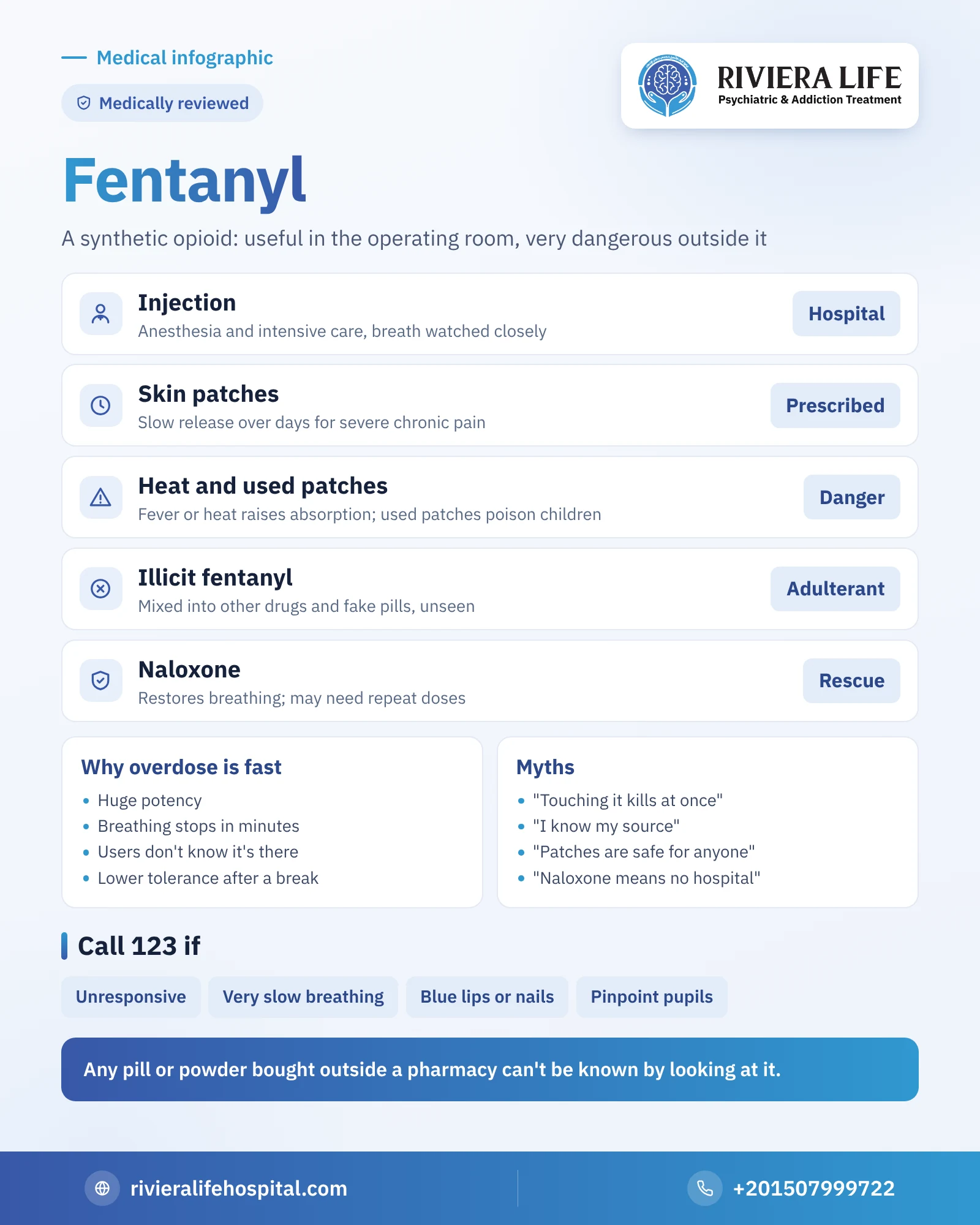
- Intravenous injection: in anesthesia during operations, and in intensive care, where the medical team monitors breathing and vital signs moment by moment.
- Skin patches: they release the medicine slowly over days for patients with severe chronic pain, especially cancer pain, and are only given to those whose bodies are already used to opioids.
- Fast-acting forms: absorbed through the mouth or nose in some countries, for sudden bouts of pain in cancer patients used to opioids.
Patches have risks the family must know: heat, such as fever, a heating pad or a hot bath, may suddenly increase absorption of the medicine. A used patch still contains an amount of the medicine, and serious poisoning cases have been recorded in children who touched one or put it in their mouths. That is why patches are kept away from children, used ones are disposed of in the way the pharmacist explains, and a patch isn’t cut or used for another person.
Illicit fentanyl and adulterated drugs
Most fentanyl deaths in the world aren’t linked to medical patches, but to fentanyl made in illegal laboratories and sold as powder or counterfeit pills. Data from the US Centers for Disease Control indicate that synthetic opioids, mostly illicit fentanyl, have become responsible for a large proportion of overdose deaths there.
The biggest danger is adulteration. Fentanyl is added to heroin, cocaine and methamphetamine, and pressed into pills that resemble well-known medicines such as painkillers or sedatives. It can’t be seen, tasted or smelled, and because the lethal amount is very small, one pill may contain several times what another pill from the same batch contains. The result is that someone who thinks they are taking a sedative or stimulant is exposed to a lethal opioid dose without knowing.
Is fentanyl present in Egypt?
Medical fentanyl is present in Egyptian hospitals for anesthesia and pain treatment, and is subject to strict control like other narcotic medicines. As for illicit fentanyl, we don’t have reliable published data proving its wide spread in Egypt as is the case in North America, and the picture may change at any time. But the lesson that matters to us remains true: any pill or powder bought outside a pharmacy can’t be known in content, and may contain a strong opioid or another substance the buyer didn’t intend.
How does fentanyl affect the body?
Its effects are the familiar effects of opioids but faster and more intense: pain relief and a short high, then drowsiness and relaxation, pinpoint pupils, nausea and constipation. One of its distinctive effects when given rapidly into a vein is stiffening of the chest muscles, something anesthesiologists know and manage, but it increases breathing difficulty in someone exposed to it outside hospital. And because the effect of an injection is relatively short, those who misuse it repeat it more, exposing themselves to repeated risk within a single day. With long use the familiar effects of opioids appear: chronic constipation, hormonal disturbance, lethargy, and decline in work and relationships.
Why is a fentanyl overdose so fast and deadly?
Three reasons come together. The first is the great potency: the difference between the amount that causes an effect and the amount that stops breathing is very small. The second is speed: breathing may stop within minutes, not hours, so there is no long time to call for help. The third is not knowing: someone using an adulterated substance doesn’t know they took fentanyl at all, and their body isn’t used to an opioid this strong.
The risk increases when it is mixed with alcohol, benzodiazepines or pregabalin, and in someone who stopped for a while and then returned, because their tolerance has fallen. To learn the long-term harms of the whole opioid family see our article on opioid harms.
Call an ambulance on 123 immediately if you see
When you suspect someone has been exposed to fentanyl or any strong opioid, even if they believe they took a different substance.
- No response or great difficulty waking
- Very slow, irregular or stopped breathing
- An unusual snoring or gurgling sound
- Blue lips or nails
- Very small pupils
- Cold, clammy skin
Naloxone: how does it save someone from a fentanyl overdose?
Naloxone is a medicine that quickly pushes opioids off their receptors and restores breathing, and it is the basic emergency medicine for opioid overdoses. But with fentanyl there are two notes: the person may need more than one dose of naloxone because of fentanyl’s strength, and the effect of naloxone may wear off before the effect of the opioid, so drowsiness and slow breathing return. That is why the person must be taken to the emergency department and monitored even if they regain consciousness. How naloxone works, its forms and what the rescuer does are in our article on naloxone.
Does fentanyl cause addiction?
Yes, and quickly. Repeated use causes tolerance and physical dependence, then harsh withdrawal on stopping: bone and muscle pain, diarrhea and vomiting, chills, severe insomnia and intense craving. Even a patient who used patches for a long time to treat real pain may become physically dependent on them; this doesn’t necessarily mean they are addicted, but it means that stopping them must be done gradually with the doctor who prescribed them, not on their own.
Fentanyl addiction treatment in brief
Fentanyl addiction is treatable, but it needs specialist medical supervision from day one, because starting some treatment medicines in someone used to fentanyl has special considerations. Treatment includes medically managed withdrawal, medicines the doctor chooses, psychological rehabilitation, and a clear plan to prevent overdose after discharge. All these steps are explained in our article on fentanyl addiction treatment.
Common myths about fentanyl
- “Touching fentanyl kills instantly”: brief skin contact usually doesn’t cause an overdose; the real danger is in swallowing, inhaling or injecting it. Even so, care must be taken with used patches around children.
- “I know my source so there’s no risk”: no one can know the content of an illicit pill or powder by looking at it.
- “A medical patch is safe for anyone”: it is safe only for the patient it was prescribed for and in the way the doctor set.
- “Naloxone is enough and there’s no need for hospital”: its effect may end before fentanyl’s, so medical monitoring is necessary.
How can Riviera Life help you?
If a member of your family is using a strong opioid painkiller outside their doctor’s supervision, or you fear what they are using is adulterated, don’t wait for the first overdose. Riviera Life’s consultants provide a confidential assessment and a treatment plan with medical supervision around the clock, and the first consultation is free on +201507999722.
More from our opioids guide
- Opioids: the complete guide
- Fentanyl addiction treatment
- Naloxone and saving an overdose
- Types of opioid painkillers
Questions many people ask
Health agencies estimate its strength at roughly fifty to one hundred times that of morphine. That is why its medical use needs precise calculations and continuous monitoring.
Yes. A used patch still contains an amount of the medicine that may cause serious poisoning in a child who touches it or puts it in their mouth. Keep it out of their reach and dispose of it as your pharmacist directs.
Not by looking, taste or smell, as fentanyl doesn't change how the substance looks. That is why any pill or powder from outside a pharmacy may carry an unexpected risk.
Naloxone may save their life, but the person may need more than one dose, and slow breathing may return after its effect wears off. So always call an ambulance on 123 and take them to hospital.
Long use causes physical dependence in most patients, and may develop into addiction in some. That is why they are used at the dose the doctor sets, and are stopped or adjusted only with him.