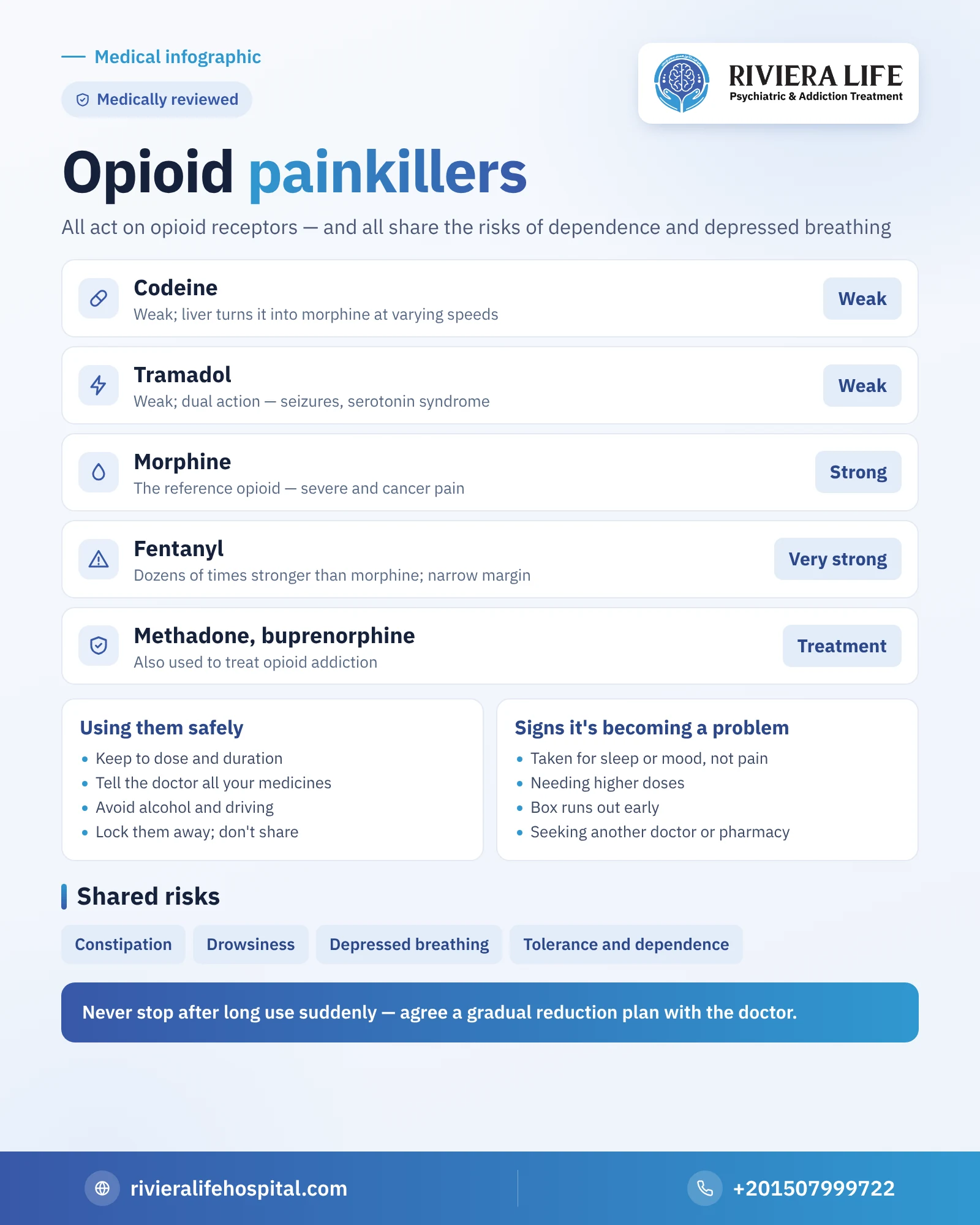
There are many types of opioid painkillers, but all of them are medicines that act on opioid receptors to relieve moderate and severe pain. The best known are codeine, tramadol, morphine, oxycodone, fentanyl and pethidine, as well as methadone and buprenorphine, which are also used to treat addiction. Doctors divide them into weak and strong opioids, and they differ in how quickly they work, how long they last and how they are dispensed. All of them, however mild they seem, share the risk of dependence and depressed breathing, and are only used on prescription and under follow-up. In this article we set out their names, their medical uses, and the risks particular to each.
What is meant by opioid painkillers?
Painkillers in general fall into two types. The first is non-opioid, such as paracetamol and non-steroidal anti-inflammatories like ibuprofen, which treat most everyday pain. The second is opioid, acting on the same receptors morphine acts on in the brain and spinal cord, changing the way the nervous system senses pain. The doctor turns to it when the first type isn’t enough, or when the pain is severe from the start, as after major surgery. Our opioids page explains the whole family, including non-medicinal substances such as heroin.
Why are opioid painkillers dispensed under special restrictions?
In Egypt, as in most countries, opioid painkillers aren’t treated like any medicine on the pharmacy shelf. Dispensing them requires a medical prescription, and several fall under the narcotic medicines system, which sets who can write them, how they are recorded and how much is dispensed at a time.
These procedures may seem burdensome to a patient in pain, but they exist for a clear reason: the same medicine that eases a cancer patient’s pain can, in someone else’s hands, become the start of an addiction or a cause of death. Buying these medicines outside pharmacies or without a prescription doesn’t just break the law; it deprives the person of the most important elements of safety: knowing the real dose, and medical follow-up.
Classifying opioid painkillers by strength
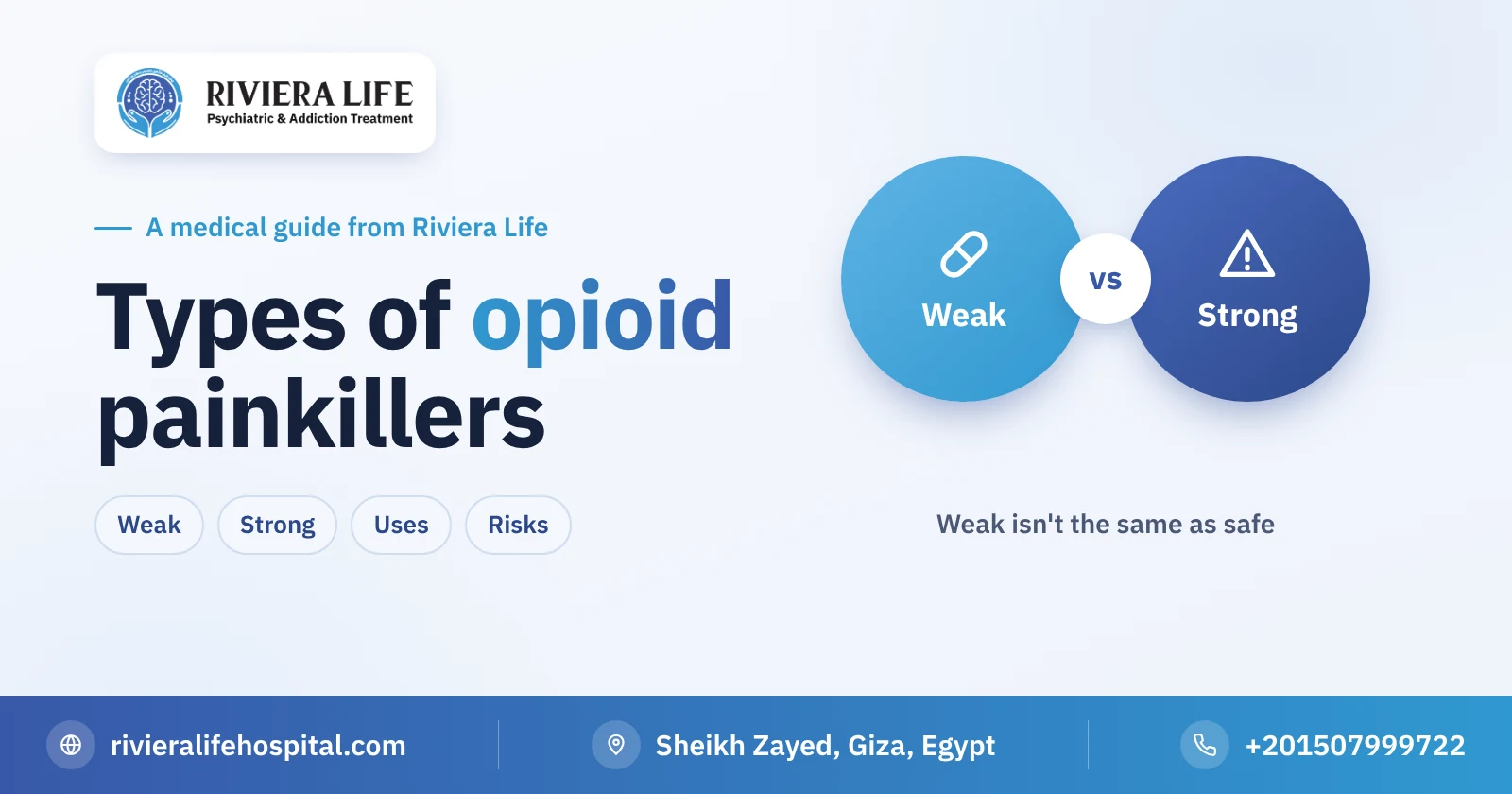
For decades the World Health Organization has used a stepped approach to treating pain known as the analgesic ladder: it starts with non-opioid painkillers, then adds a weak opioid if the pain continues, then moves to a strong opioid for severe pain. On this basis, opioid painkillers are divided into:
- Weak opioids: codeine, tramadol and dihydrocodeine.
- Strong opioids: morphine, oxycodone, hydromorphone, fentanyl, methadone and pethidine.
The word “weak” here describes the strength of pain relief, not a certificate of safety. Tramadol is classed as weak and yet causes dependence and seizures.
The names of opioid painkillers and their best-known medicines
The following table brings together the most used opioid painkillers by their scientific names, with the group each medicine belongs to, its main medical use, and the risk that most deserves attention.
| Scientific name | Group | Main medical use | A risk worth noting |
|---|---|---|---|
| Codeine | Weak, natural | Mild to moderate pain, and some cough medicines | Its conversion to morphine varies genetically |
| Tramadol | Weak, synthetic | Moderate pain | Seizures and serotonin syndrome |
| Morphine | Strong, natural | Severe pain and cancer pain | Depressed breathing |
| Oxycodone | Strong, semi-synthetic | Severe pain | High misuse |
| Fentanyl | Very strong, synthetic | Anesthesia, and cancer pain as patches | A very narrow safety margin |
| Pethidine | Strong, synthetic | Short-term acute pain | A breakdown product that can cause seizures |
| Methadone | Strong, synthetic | Treating addiction and some chronic pain | Builds up in the body and affects heart rhythm |
| Buprenorphine | Partial effect | Treating addiction and some pain | Causes withdrawal if started too early |
Weak opioid painkillers
Codeine
A natural substance from the poppy, usually found with paracetamol in painkiller tablets or in cough syrups. It works mainly after the liver converts part of it into morphine, and this process differs between people: in some it is weak, so they feel little relief, and in others it is very fast, so they suffer symptoms of poisoning at normal doses — which is why health authorities restrict its use in children.
Tramadol
A synthetic painkiller that works in two ways: a moderate opioid effect, and an effect on serotonin and noradrenaline. This dual effect gives it risks unlike other opioids, the most important being seizures, especially at high doses or with medicines that lower the seizure threshold. It is the most widespread in Egypt, and has its own guide on our tramadol page.
Strong opioid painkillers
Morphine
The reference substance against which the strength of other opioids is measured. It is given by injection or as rapid- or extended-release tablets, and its main place is severe pain after surgery, in tumors and in palliative care. Its details are on our morphine page.
Oxycodone and hydromorphone
Two semi-synthetic opioids stronger than morphine when the same weight is compared, used for severe pain. Oxycodone has been linked worldwide to a broad wave of misuse of prescription painkillers.
Fentanyl
A synthetic opioid dozens of times stronger than morphine. It is used in operating theaters, and as patches for chronic cancer pain in patients used to opioids. Any small error in the amount can stop breathing, which is why it is only used under close supervision.
Pethidine
An old painkiller also known as meperidine, whose use has declined in many countries because one of its breakdown products builds up with repetition and can cause tremor and seizures.
Opioids used to treat addiction
One of the ironies is that medicines from the same family are among the most important treatments for addiction to it. Methadone is a long-acting opioid that prevents withdrawal and craving with a fixed daily dose, and buprenorphine partially activates the receptors, easing craving with greater safety for breathing. Their use in this context takes place within an integrated treatment program, explained in our article on opioid addiction treatment.
Mixed-action painkillers
There are medicines that activate some opioid receptors and oppose others, such as nalbuphine, pentazocine and butorphanol. They were thought to be further from addiction, but reality has proven they can be misused and depended on, and cases of dependence on nalbuphine injections have been described in Egypt and elsewhere. They can also cause withdrawal in someone dependent on another opioid.
Forms of dispensing and the risks linked to them
- Rapid-release tablets: relief within a short time, with the effect wearing off within hours.
- Extended-release tablets: release the medicine over a long period, and tampering with them releases the whole amount at once.
- Syrups: mostly codeine cough medicines.
- Injections: for use in hospital and emergencies.
- Skin patches: absorption may rise with heat, such as a fever or a heating pad.
- Combinations with paracetamol: raising the dose also raises the paracetamol and threatens the liver.
Risks shared by opioid painkillers
Whatever their names, these medicines share constipation, drowsiness, dizziness and nausea, and depressed breathing with high doses or when mixed with sedatives, pregabalin and alcohol. With long use, tolerance and physical dependence appear, and it may develop into addiction, as well as hormone disturbance and weaker bones. You will find these harms in detail in our article on the harmful effects of opioid painkillers.
How do you use a prescribed opioid painkiller safely?
- Keep to the dose and duration as the doctor wrote them, and don’t raise it yourself even if the pain continues.
- Tell the doctor about any previous history of addiction, and all the medicines you take, especially sleeping pills and sedatives.
- Avoid alcohol and driving in the first days or when you feel drowsy.
- Keep the medicine locked away from children, teenagers and visitors.
- Don’t give the medicine to anyone else, even if their complaint is similar.
- Dispose of leftover medicine after treatment ends, in coordination with the pharmacist.
- Don’t stop the medicine suddenly after long use; agree a gradual reduction plan with the doctor.
When does a prescribed painkiller become a problem?
The first sign is usually that the medicine is no longer linked to pain: it is taken for sleep, to lift mood, or to face a tiring day. Then comes the need for higher doses, the box running out before it should, and looking for another doctor or another pharmacy. If you notice this in yourself or someone close, see our article on opioid addiction symptoms, and talk to a specialist before the dependence deepens. At Riviera Life the case can be assessed confidentially, taking into account the original pain where the story began.
More from our opioids guide
- Opioids: the complete guide
- The harmful effects of opioids
- Opioid addiction symptoms
- How long opioids stay in your system
- Codeine: its uses, conversion to morphine and the risks of addiction and overdose
- Nalbuphine: is it really safe? Medical use, addiction and the risks of injecting
- Opium: what it is, how it affects the body and why it causes addiction
- Fentanyl: from pain patches to the most dangerous counterfeit drug and the risk of overdose
- Pethidine: its uses, why its use has declined and the risks of addiction
- Oxycodone: its uses, the opioid crisis, counterfeit pills and treatment
- Hydrocodone: its uses, combinations, paracetamol risks and dependence
- Tapentadol: how it works, how it differs from tramadol, its risks and addiction
- How long nalbuphine stays in your system: does it show in a test, and for how many days?
Questions many people ask
Among the weak ones, codeine and tramadol; among the strong ones, morphine, oxycodone, hydromorphone, fentanyl and pethidine, as well as methadone and buprenorphine, which are also used to treat addiction.
Yes. It is a synthetic opioid painkiller classed among the weak opioids in terms of pain relief, but it causes dependence and carries the risk of seizures and serotonin syndrome.
One of the strongest painkillers used medically is fentanyl, dozens of times stronger than morphine, which is why it is only used in hospital or as patches for patients used to opioids, under close supervision.
“Weak” describes the strength of pain relief, not safety: codeine and tramadol can cause dependence and poisoning, especially at high doses or mixed with sedatives.
No. They are dispensed on prescription, and several fall under the narcotic medicines system; buying them outside this framework is illegal and deprives the person of a known dose and follow-up.