Fentanyl addiction treatment is possible, but it is more sensitive than the treatment of most other opioids. Fentanyl’s strength and the way it is stored in the body mean that starting treatment medicines needs precise timing, and the biggest danger after stopping isn’t withdrawal but overdose if the person suddenly goes back. That is why the plan rests on medically managed withdrawal in an equipped place, then a long-term medicine chosen by the doctor, psychological rehabilitation, and training the family to handle emergencies. The path differs slightly between a patient who became dependent on patches prescribed for real pain, and someone who used illicit fentanyl or drugs adulterated with it.
Why does fentanyl treatment differ from treatment of other opioids?
The general lines are the same for the whole opioid family, and we explained them in the article on opioid addiction treatment. But fentanyl adds special challenges:
- Its great strength means high tolerance, so withdrawal is severe and craving strong.
- It dissolves in fat and is stored in body tissues, so its clearance may be delayed in someone who used it for a long time, and this affects the timing of some medicines.
- The patient has often been exposed to other substances mixed with it without knowing, such as stimulants or sedatives.
- The risk of death after relapse is very high compared with weaker opioids.
As for fentanyl itself, its medical uses, illicit sources and risks, they are explained in the article on fentanyl.
Two different patients: a prescribed patch or illicit fentanyl?
The first patient may be a man in his fifties with severe chronic pain who was prescribed fentanyl patches, then came to need a larger amount or use them differently from what the doctor set. This patient needs coordination between the addiction doctor and the pain doctor, a calm gradual reduction, and an alternative plan to treat the pain. Not everyone whose body became dependent on the patch is addicted; physical dependence alone is treated by tapering with the doctor.
The second patient may be a young man using illicit substances, or tablets he bought as a sedative or stimulant that turned out to be adulterated with fentanyl. This needs a wider assessment of other substances, treatment of addiction in its full sense, and intensive protection against overdose.
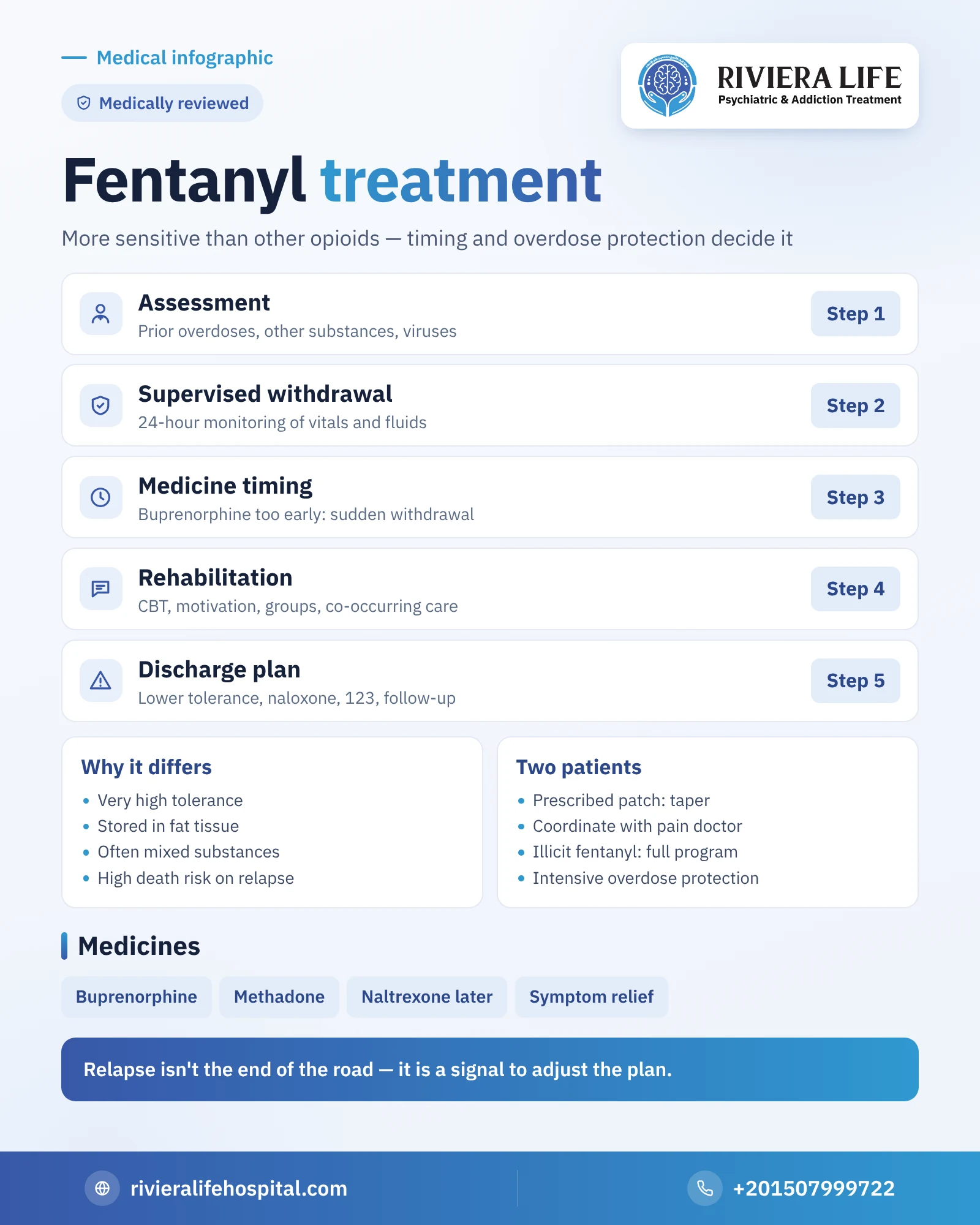
The stages of fentanyl addiction treatment
- A quick, comprehensive medical and psychological assessment, with tests for other substances.
- Medically managed withdrawal in a place equipped with round-the-clock monitoring.
- Starting a long-term medicine at a time the doctor determines.
- Psychological and behavioral rehabilitation and treatment of co-occurring conditions.
- A discharge plan that includes overdose prevention and extended follow-up.
The first assessment: what does the doctor look for?
The doctor asks about the form of fentanyl, the length of use and the method of use, and about any previous overdose, because someone who survived an overdose once is at risk of another. They request tests that include other substances, because illicit fentanyl is often mixed with stimulants or sedatives. In those who inject, they examine the skin and veins and request tests for hepatitis viruses and HIV. And they assess the psychological state, especially depression, anxiety and any thoughts of self-harm, as these need early attention.
Medically managed withdrawal: why not at home?
Fentanyl withdrawal can be harsh: chills and sweating, severe bone pain, vomiting and diarrhea that may cause dehydration, insomnia, anxiety and strong craving. Trying to stop at home often ends with going back on the hardest days, sometimes with a larger amount to make up for the suffering, and this is an extremely dangerous moment because tolerance has started to fall. That is why it is preferable for withdrawal to take place in a medical setting that follows vital signs and fluids and treats each symptom appropriately. The details of the withdrawal stages are in the article on opioid withdrawal symptoms.
Medicines: why does timing matter with fentanyl?
Medicines to treat opioid dependence are among the most important things that protect a fentanyl patient from relapse and death, and the doctor chooses between them depending on the case:
- Buprenorphine: effective at reducing craving and withdrawal, but starting it after fentanyl may cause sudden withdrawal if the timing isn’t right, so the doctor determines when and how to start it, and may use special methods for this. Details are in the article on buprenorphine.
- Methadone: an important option for severe dependence, and needs close follow-up in the first weeks. See the article on methadone.
- Naltrexone: is only started after the body is completely free of opioids, and with fentanyl this may take longer.
- Medicines for symptoms: for vomiting, diarrhea, pain and insomnia during withdrawal.
None of these medicines should ever be tried without supervision; a mistake in timing can turn a difficult day into a dangerous one.
Psychological rehabilitation and treating what accompanies addiction
After the body stabilizes, the longer work begins: understanding craving situations, building an organized day, and learning skills to refuse offers and handle stress. Cognitive behavioral therapy, motivational interviewing and group sessions are used. At the same time, the team treats any depression, anxiety, sleep disorder or psychological trauma, because leaving them untreated pushes towards going back. With a chronic pain patient, physiotherapy and non-opioid means of relieving pain determined by the doctor are added.
Preventing overdose after discharge
This is the most important section of the article. After days or weeks of stopping, the body’s tolerance falls, so if the person returns to the amount they used before treatment, their breathing may stop. That is why the discharge plan includes:
- A clear explanation to the patient and family about the fall in tolerance and its danger.
- Training the family on the signs of overdose and to call the ambulance on 123 immediately.
- Introducing the medicine naloxone and its role, and that the affected person needs hospital even after waking, as the article on naloxone explains.
- Continuing the prescribed medicine and follow-up sessions, as stopping them early raises the risk of relapse.
The family’s role
The family needs a balance between firmness and support: no cash that can turn into drugs, and no threats or scandals that push towards running away. Family sessions help agree on house rules, and on what to do if signs of relapse appear. It helps for the family to keep the treating doctor’s number and the ambulance number in a visible place, and for everyone to agree in advance on who calls and when, instead of confusion in the moment of danger.
The family itself also benefits from psychological support, as constant worry about a fentanyl patient is exhausting and needs space to talk. And it is important for the family to know that relapse, if it happens, isn’t the end of the road but a signal to adjust the plan, and a quick return to the doctor is better than silence.
The right hospital for fentanyl addiction treatment: how to choose
The right hospital for fentanyl addiction treatment is the one that has what this patient specifically needs: continuous medical monitoring, experience in timing treatment medicines with a strong opioid, and a serious plan to prevent overdose. Ask before you decide:
- Is withdrawal done under round-the-clock medical supervision?
- Does the team have experience starting dependence medicines after strong opioids without sudden withdrawal?
- Does it test for other substances and for viruses in those who inject?
- Does it coordinate with the pain doctor if the dependence began with prescribed patches?
- Does it train the family on the signs of overdose and how to act?
- Does it offer long follow-up after discharge?
And don’t be convinced by any promise of a guaranteed cure or treatment that ends in days.
How Riviera Life meets these standards in fentanyl addiction treatment
Here is how these criteria are met at Riviera Life:
- Official license: a hospital licensed by the Ministry of Health.
- Fourteen years of experience: in treating opioid addiction, with thousands of recovered cases.
- Consultants in psychiatry and addiction treatment: who time medicines precisely with strong opioids.
- Round-the-clock medical supervision: continuous monitoring during withdrawal and the first days of medicine.
- Complete confidentiality: full protection of the data of the patient and their family.
- A family program: training on danger signs and support that protects against relapse.
- Aftercare: extended follow-up after discharge, the most dangerous period.
The first consultation is free; to get in touch around the clock call +201507999722; we are based in Sheikh Zayed, Giza.
More from the opioids guide
Questions many people ask
It usually needs more caution, because of fentanyl's strength, its storage in body tissues and the higher risk of overdose after relapse. But treatment results are good with medical supervision, the right medicine and follow-up.
Because starting it early in someone used to fentanyl may cause sudden, severe withdrawal. So the doctor determines the right timing or uses special methods to start the medicine.
If the dependence is only physical because of pain treatment, the reduction may be done gradually outside hospital with a plan the doctor sets and follows. Stopping suddenly without a doctor is unsafe.
The first weeks and months after discharge, because the body's tolerance falls, and returning to the old amount may stop breathing. Continuing the medicine and follow-up greatly reduces this risk.
Look for round-the-clock supervised withdrawal, experience timing dependence medicines after strong opioids, tests for other substances and viruses, family training on overdose signs and long follow-up. Riviera Life in Sheikh Zayed, Giza meets these criteria.