There is no single medicine that is “the best” for depression and anxiety for everyone. The best medication for depression and anxiety is the one the doctor chooses specifically for you after learning your symptoms, medical history, other medicines and the side effects you can tolerate. The plan usually starts with one of two classes: selective serotonin reuptake inhibitors, or serotonin-noradrenaline reuptake inhibitors, with other alternatives for particular cases. In this article we explain how the doctor thinks when choosing, the classes available, what to expect in the first weeks, and why taking medicine without a prescription is a real risk. You won’t find favorite brand names or doses here, as that is an individual medical decision.
Why is there no single medicine that is best for everyone?
Studies show that differences in effectiveness between most modern antidepressants are small at the level of large groups, while differences are large at the level of the individual. One person may improve on a particular medicine while their brother doesn’t benefit from it, and one person may tolerate side effects another completely rejects. So a good doctor asks “what is most suitable for this patient?”, not “what is strongest?”. And what is posted on forums about “the strongest depression medicine” reflects the writer’s experience and nothing more.
Why do the same medicines treat depression and anxiety?
Depression and anxiety share similar brain circuits and neurotransmitters, and they occur together in a large proportion of patients. That is why many antidepressants, led by selective serotonin reuptake inhibitors, are also used as first-line treatment for various anxiety disorders, such as generalized anxiety, panic and social phobia. But there are medicines that help anxiety and don’t treat depression, and vice versa, and this is where accurate diagnosis matters. You will find a broader picture of anxiety treatment in our article on anxiety treatment.
The classes of medicine the doctor chooses from
Selective serotonin reuptake inhibitors (SSRIs)
The most commonly used first choice for depression and anxiety together, because they are easy to use and relatively safe. Their common early effects include nausea and disturbed sleep, and they may affect sexual function.
Serotonin-noradrenaline reuptake inhibitors (SNRIs)
These work on two neurotransmitters, and are used in depression and generalized anxiety, and may help when depression is accompanied by chronic physical pain. Blood pressure needs monitoring in some patients.
Medicines with other mechanisms
These include medicines that help with sleep and increase appetite, suiting those with insomnia and weight loss, and others that are relatively activating and usually don’t affect sexual function, but aren’t usually considered an option for anxiety disorders.
Tricyclic antidepressants
An older, effective generation, but with more side effects, and more dangerous in overdose, so it is reserved for specific cases. One example is clomipramine, whose two brand names we explain in our article on the difference between Supranil and Anafranil.
Anxiety-specific medicines
Such as buspirone for generalized anxiety, pregabalin, which is approved for generalized anxiety in some countries, and benzodiazepines, which calm quickly but are used only for short periods because of the risk of dependence.
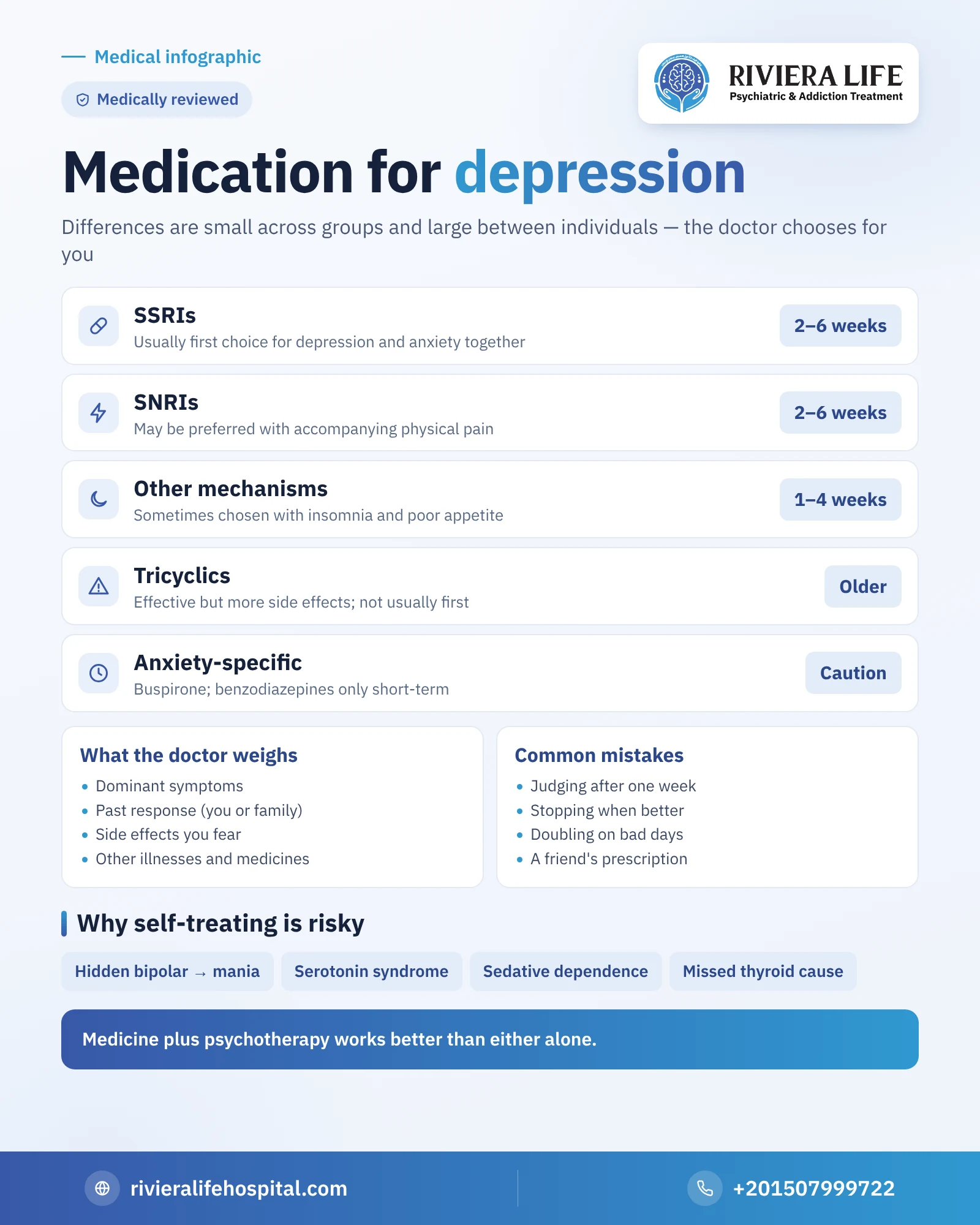
A quick comparison of depression and anxiety medicine classes
| Class | Common examples (generic name) | When improvement usually appears | Note |
|---|---|---|---|
| Selective serotonin reuptake inhibitors | Sertraline, escitalopram, fluoxetine, paroxetine | Two to six weeks | Usually the first choice for depression and anxiety together |
| Serotonin-noradrenaline reuptake inhibitors | Venlafaxine, duloxetine | Two to six weeks | May be preferred when there is accompanying physical pain |
| Medicines with other mechanisms | Mirtazapine | One to four weeks | Sometimes chosen with insomnia and loss of appetite |
| Tricyclic antidepressants | Amitriptyline, clomipramine | Two to six weeks | More side effects, so usually not the starting point |
| Anxiety-specific medicines | Buspirone, and benzodiazepines for a short period | Benzodiazepines within hours, buspirone within weeks | Benzodiazepines carry a dependence risk, so aren’t used long-term |
The table is for information only and isn’t suitable for choosing a medicine yourself; the dose and type are set by the doctor after assessment.
How does the doctor choose the right medicine for you?
The doctor gathers several pieces of information before writing the prescription:
- The dominant symptoms: insomnia or excessive sleep, loss or increase of appetite, accompanying anxiety or lethargy.
- Previous experience: a medicine that worked for the patient before, or for a first-degree relative.
- The side effects the patient fears, such as weight gain, effects on sexual function, or drowsiness.
- Other illnesses, such as heart disease, liver disease, epilepsy and glaucoma.
- Current medicines and the risk of interaction with them.
- Pregnancy or planning for it, and breastfeeding.
- Age, alcohol or substance use, and the possibility of bipolar disorder.
Then the doctor explains to the patient why they chose this particular medicine, what effects may appear, when improvement is expected, and when to call them before the appointment. This conversation isn’t a luxury; a patient who understands their plan sticks to it more, and doesn’t stop at the first side effect. And you have the right to ask about anything that worries you, including the medicine’s effect on driving, work and married life.
What should you expect in the first weeks?
Antidepressants aren’t a painkiller that works within an hour. Improvement usually begins after two to four weeks, appearing first in sleep and energy before mood, and the full effect develops over a longer period. Mild side effects may appear in the first days and then settle, and anxiety may increase slightly at first for some, which the doctor manages. Guidelines recommend closer follow-up for teenagers and young adults at the start of treatment, to watch for any increase in suicidal thoughts and contact the doctor immediately if it happens.
Do depression medicines cause addiction?
Antidepressants don’t cause a high, an intense craving to increase the amount, or drug-seeking, the signs that characterize addiction. But stopping them suddenly may cause “discontinuation symptoms” such as dizziness, irritability, disturbed sleep and electric-shock-like sensations, which is why they are reduced gradually under the doctor’s supervision. Benzodiazepines and pregabalin are different, however, as they can cause real dependence and misuse, which we see a lot in Egypt. We cover this on our page on benzodiazepines and in our article on pregabalin and anxiety.
Why is self-treatment a risk?
In Egypt it is easy to get many psychiatric medicines from the pharmacy or from a relative’s prescription. This route is full of real risks:
- Depression may be part of bipolar disorder, so an antidepressant alone pushes the patient into a manic episode.
- The medicine may interact with other medicines, such as tramadol or migraine medicines, causing dangerous serotonin syndrome.
- Sedatives taken without supervision may turn into a dependence that is hard to get rid of.
- The medicine may mask a physical cause that needs different treatment, such as a thyroid imbalance.
- Without follow-up, no one will notice the condition worsening or thoughts of self-harm appearing.
Medicine alone or with psychotherapy?
In mild depression, doctors often start with psychotherapy without medicine. In moderate and severe cases, combining medicine and psychotherapy achieves better results than either alone, and reduces the chance of relapse after the medicine is stopped. The medicine eases the severity of symptoms, and psychotherapy teaches the patient skills that stay with them after the prescription ends.
The same applies to anxiety: medicine may calm the physical symptoms and constant tension, but cognitive behavioral therapy is what teaches the patient to face the situations they avoid instead of escaping them, so their reliance on medicine decreases over time.
When does the doctor change the medicine or add another?
If enough time passes without clear improvement despite adherence, or intolerable side effects appear, the doctor reviews the plan. They may adjust the dose, switch to a medicine from the same class or another class, or add an augmenting medicine. Every switch is done with a clear plan, because some switches between medicines need a gap to avoid interaction. The details of advanced options are in our article on depression treatment.
Common mistakes with depression and anxiety medicines
- Judging the medicine after one week and leaving it.
- Stopping it as soon as you feel better, the best-known cause of relapse.
- Doubling the amount on your own on hard days.
- Combining it with alcohol, sedatives or painkillers without the doctor’s knowledge.
- Using a friend’s prescription because their symptoms “resemble” yours.
Antihistamines for anxiety: do they work?
Some antihistamines are indeed used for anxiety, the best known being hydroxyzine. They aren’t from the benzodiazepine class, don’t cause dependence in the same way, and the doctor sometimes prescribes them for short-term anxiety or when anxiety comes with insomnia and itching. But they aren’t the first choice for chronic anxiety.
Antihistamines sold for allergies and known for causing drowsiness, however, aren’t considered a treatment for anxiety. Their light sleep may give an illusion of improvement, but their sedating effect weakens with repetition.
- Their common side effects include drowsiness, dry mouth, dizziness and poor concentration.
- Hydroxyzine may affect heart rhythm in some patients, so caution is needed for those with heart disease or taking interacting medicines.
- The risk increases with alcohol or other sedatives.
- Older people are more sensitive to them, and they may cause confusion.
And if anxiety doesn’t improve after using them, or the patient needs them every night to calm down, this is a sign that the matter needs a broader treatment plan, not a doubled dose. That is why none of them is used without the doctor’s assessment. The full picture of anxiety options is in anxiety treatment, and accompanying sleep problems in sleep disorders.
How can Riviera Life help you?
If you are taking a medicine without a prescription, or have tried more than one medicine without improvement, you can start with a free first consultation with a consultant psychiatrist at Riviera Life. We review what you have tried with you, assess the whole condition, then set a clear medication and psychological plan with regular follow-up, in complete confidentiality.
More from our depression guide
- Depression: the complete guide
- Depression treatment and the steps to recovery
- The difference between Supranil and Anafranil
- Anxiety: the complete guide
- Psychiatric medicines: their types, what each family treats and how the doctor chooses
- Antidepressants: their types, how they work and when they start working
- Sertraline (Lustral): uses, side effects and warnings
- Escitalopram (Cipralex): uses, side effects and the heart warning
Questions many people ask
There is no medicine that is strongest for everyone; differences between modern medicines are small across groups and large between individuals. The most suitable is the one your doctor chooses based on your symptoms and history.
Yes, many modern antidepressants are used as first-line treatment for both conditions, but some anxiety medicines don't treat depression, so an accurate diagnosis matters.
They don't cause a high or intense craving, but stopping them suddenly may cause unpleasant discontinuation symptoms, so they are reduced gradually. Sedatives and pregabalin are the ones that carry a risk of dependence.
Because the effect of antidepressants usually begins after two to four weeks. Talk to your doctor before any change, and don't stop the medicine on your own.
No, it may be unsuitable for your condition, interact with your medicines, or trigger a manic episode if you have a predisposition to bipolar disorder. A medical assessment is needed first.