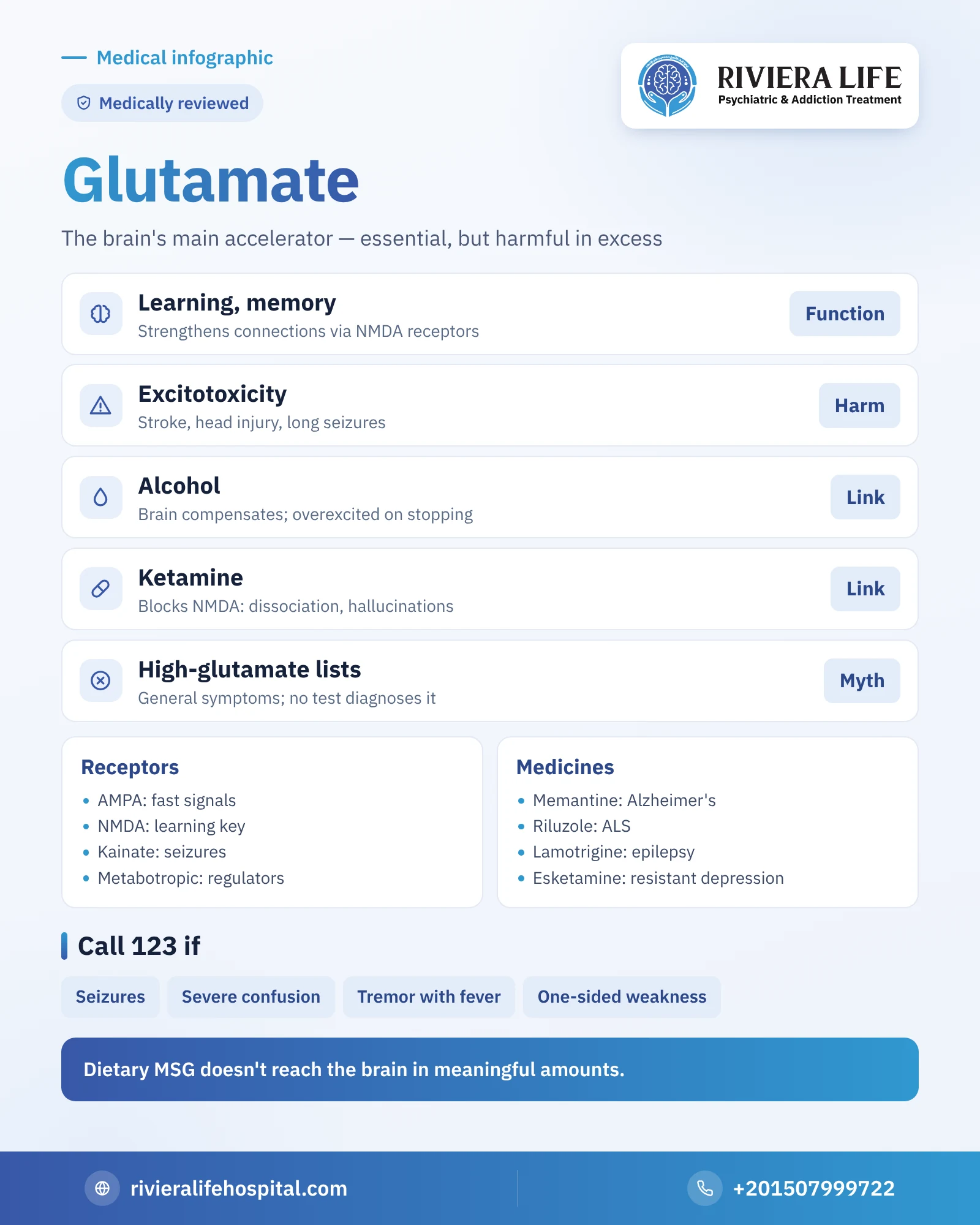
Glutamate is the most important excitatory neurotransmitter in the brain, and takes part in most of what you do in thinking, learning and remembering. It is entirely necessary, but its excess in the wrong place harms nerve cells and may be linked to seizures and stroke, and disturbances in its signaling are linked to schizophrenia, depression and OCD. In addiction it has a distinct role: alcohol calms the brain, so the brain responds by increasing glutamate, and ketamine blocks one of its receptors. This article explains what glutamate is, what it does and when it becomes a problem, and answers frankly the question of “high glutamate symptoms” that is searched for so often.
What is glutamate?
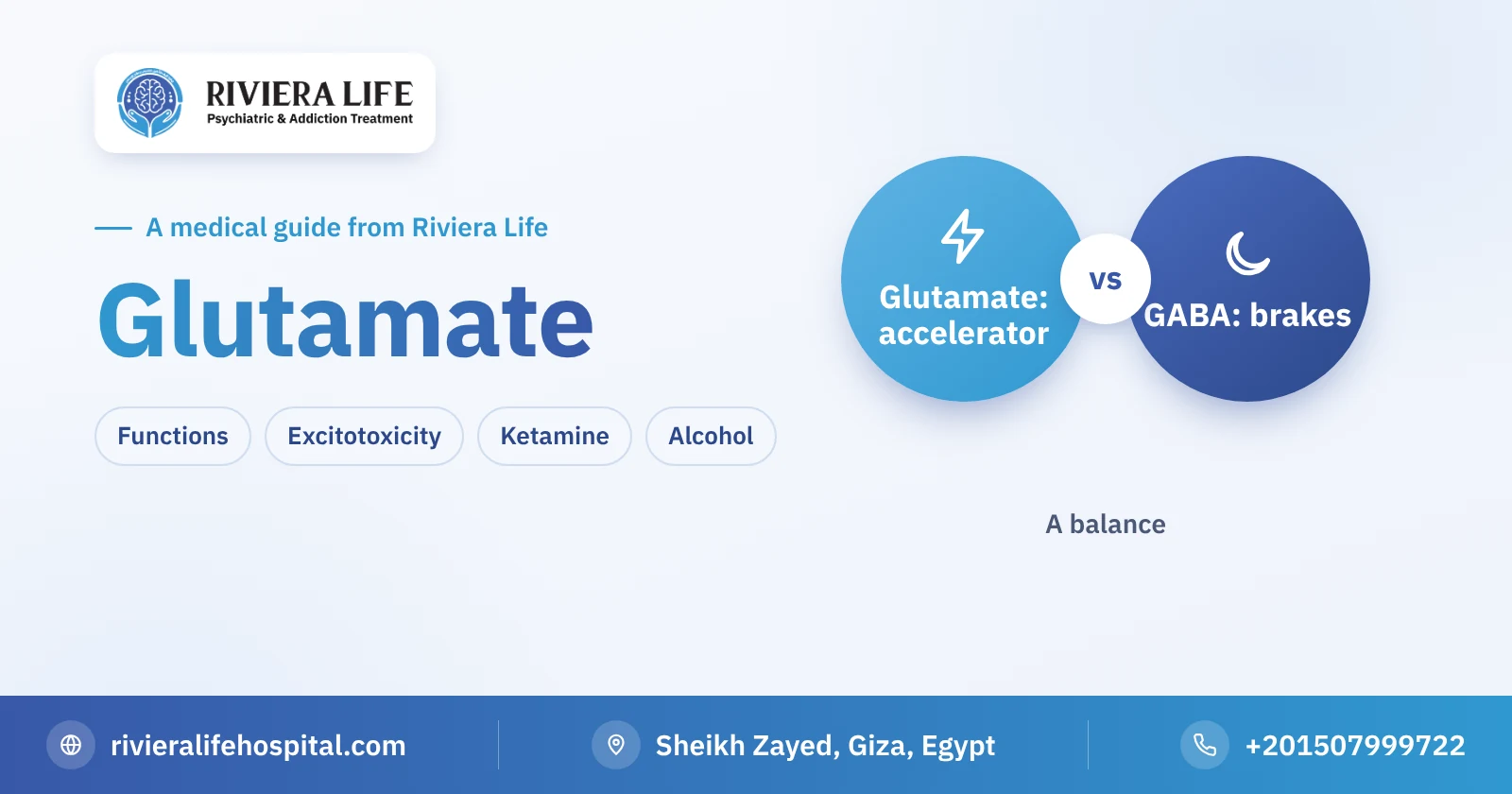
Glutamate is an amino acid the body makes, used in the brain as a signal telling the receiving cell: activate. Almost every nerve cell in the cerebral cortex receives signals from it. It is formed inside nerve endings from glutamine, then released at the synapse, and after doing its job it is quickly taken up by support cells called astrocytes, because staying long in the space between cells exposes them to toxicity. At the same time it is a raw material for making GABA, the inhibitory neurotransmitter that balances it: the brain makes its brakes from the same fuel it uses for the accelerator pedal, as detailed in the GABA guide.
Its receptors: why does it matter?
Glutamate has several receptors, and knowing them explains most of what follows in this article:
- AMPA: fast, carrying most moment-to-moment signals.
- NMDA: slower and more conditional; they only open if glutamate comes together with the cell’s activity, which is why they are the key to learning and strengthening connections.
- Kainate: less studied, with a role in seizures.
- Metabotropic receptors: act as quiet regulators of the network, and their sensitivity changes.
Most medicines and substances linked to glutamate act through the NMDA receptor, including ketamine, memantine and the effect of alcohol.
What does glutamate do?
Its most prominent functions are learning and memory. When a piece of information repeats, the connections carrying it strengthen, a phenomenon called long-term potentiation, which needs NMDA receptors. It also takes part in sensory perception, movement, planning and pain regulation. And it partners other neurotransmitters such as dopamine in reward circuits, which is why it appears in addiction research. Its excitatory power means the brain needs to keep it under constant control.
When it goes too far: excitotoxicity
This term describes what happens when nerve cells are overexcited because of excess glutamate, so calcium enters the cell in harmful amounts and it begins to be damaged. This happens in stroke after blood supply is cut off, in head injuries, and in some long seizures. These are medical emergencies with another underlying cause; excess glutamate is a link in the chain of damage, not a separate cause treated with a test. In amyotrophic lateral sclerosis, glutamate is believed to play a role in the death of motor cells, which is why there is a medicine that reduces its release, riluzole, decided by the neurologist, which slows the disease somewhat but doesn’t cure it.
High glutamate symptoms: what is the truth?
There is no recognized medical condition called “high glutamate” that can be diagnosed with a blood test or a list of symptoms. What is measured in blood doesn’t reflect what is happening inside the synapses in the brain, and the spectroscopic imaging that estimates its level is used in research. So the lists spread on websites, including anxiety, insomnia, headache, tension and distraction, gather general symptoms that appear in dozens of other conditions.
The known conditions in which the glutamate system is overactive are seizures, severe withdrawal from alcohol and sedatives, and some acute injuries. If you suffer from anxiety and insomnia, go to anxiety symptoms and see a specialist, instead of trying to lower a substance you can’t measure.
Glutamate and alcohol
Alcohol weakens NMDA receptors and strengthens GABA, so the drinker feels relaxed. With continued use, the brain tries to compensate by increasing the number and activity of glutamate receptors. If the person stops suddenly, the brain stays in a state of overexcitation, which explains the tremor, sweating, anxiety, seizures and hallucinations, and in severe cases delirium tremens. That is why stopping alcohol after long dependence must be done under medical supervision. Acamprosate, used to prevent relapse, is believed to adjust this system partially. You will find details of the substance and its withdrawal in the alcohol guide.
Glutamate and ketamine
Ketamine blocks NMDA receptors, causing a state of detachment from the body and surroundings, euphoria and hallucinations, and the user loses the sense of pain and danger. It is used medically as an anesthetic under doctors’ supervision. Esketamine, which is close to it, is being studied in treatment-resistant depression under strict medical supervision because it may ease symptoms quickly in some cases, but it isn’t a magic solution and isn’t used for self-experimentation. Use outside medicine is linked to confusion, memory disturbance, bladder problems and the risk of addiction, which are detailed in the ketamine guide.
Glutamate and psychiatric illnesses
- Schizophrenia: one theory suggests that weak NMDA receptor function contributes to the symptoms, because substances such as phencyclidine and ketamine mimic some of them. It is still a theory and hasn’t turned into a ready treatment. See the schizophrenia guide.
- Depression: studies point to changes in glutamate signaling, which is the basis of interest in medicines such as ketamine. For details, the depression guide.
- OCD: the circuits between the frontal cortex and basal ganglia are linked to excess glutamate activity in some studies, and medicines in this direction are being tried but haven’t become standard.
- Anxiety and insomnia: brain overexcitation may be linked to both, but the practical evidence for direct treatment is weak.
Glutamate in food: the myth of monosodium glutamate
The glutamate in food, in cheese, tomatoes, meat and in the Chinese salt known as Ajinomoto, is mostly used in the intestine as fuel for its cells, and doesn’t cross into the brain in meaningful amounts because of the blood-brain barrier. Controlled trials haven’t proven that a person consistently develops the so-called Chinese restaurant syndrome, although some have reported temporary headache and flushing after large amounts on an empty stomach. Food authorities such as the US Food and Drug Administration consider it generally safe. So there is no need to avoid it out of fear for the brain, and no diet is presented as lowering glutamate in the brain.
Medicines that affect glutamate
- Memantine: blocks the NMDA receptor mildly, and is used in moderate to severe Alzheimer’s.
- Riluzole: reduces glutamate release and is used in amyotrophic lateral sclerosis.
- Lamotrigine and some anti-epileptic medicines: reduce glutamate release among their mechanisms.
- Esketamine: a nasal spray given in approved clinics and under monitoring for resistant depression.
There is no medicine taken on one’s own initiative to lower glutamate, and these medicines are only started or stopped with the doctor.
What protects glutamate balance?
There is no recipe that regulates it directly, but what protects the brain in general supports its balance: enough sleep, treating blood pressure and diabetes, avoiding alcohol, smoking and head injuries, and treating epilepsy regularly if present. Relying on products carrying a “lower glutamate” label means paying for a claim without basis.
Call an ambulance on 123 immediately if you see
After suddenly stopping alcohol or sedatives, or at any time:
- A seizure or epileptic fit
- Severe confusion, hallucinations or delirium
- Strong tremor with sweating, fever and a racing pulse
- Sudden weakness on one side of the body or difficulty speaking
When should you see the doctor?
Don’t go to the doctor to ask about glutamate, but to tell them what you are suffering from. Mention seizures if they have happened, how much you drink or take of substances, the medicines you use, and any family history of epilepsy or injuries. The doctor decides the appropriate tests, from blood tests to a brain tracing and imaging when needed. And if your dependence on alcohol or sedatives is stopping you from quitting for fear of withdrawal symptoms, Riviera Life offers round-the-clock medical supervision and complete confidentiality, and the first consultation is free on +201507999722.
More from the brain guide
- GABA: the complete guide
- GABA and addiction
- Acetylcholine
- Brain chemistry: the complete introduction
Questions many people ask
There is no recognized condition by this name diagnosed with a test. Excess glutamate activity is linked to known conditions such as seizures and severe alcohol withdrawal, while general symptom lists online diagnose nothing.
Dietary glutamate doesn't cross into the brain in meaningful amounts, controlled trials haven't proven consistent harm in moderate users, and food authorities consider it generally safe. Some complain of passing symptoms with large amounts.
Ketamine blocks the NMDA receptor that receives glutamate, causing dissociation and hallucinations. It is used medically as an anesthetic, and esketamine is studied in treatment-resistant depression under medical supervision.
After long dependence the brain compensates for alcohol's effect by increasing glutamate activity, so if alcohol stops suddenly the brain stays overexcited. That is why stopping must be done under medical supervision.
There is no proven method and it can't practically be measured. General brain care, with sleep, control of blood pressure and sugar, and avoiding alcohol, is the most useful.