Acetylcholine is the first neurotransmitter discovered in the history of science, and it is the messenger that moves your muscles, slows your heartbeat and helps your brain pay attention, learn and consolidate memories. Because it works throughout the body, not only in the brain, any disturbance in its system may show up as muscle weakness, forgetfulness, dry mouth or insecticide poisoning. This article explains where acetylcholine is made, what it does and when it goes wrong, its link to Alzheimer’s, nicotine and medicines often prescribed in Egypt, and the truth about supplements sold to boost memory.
What is acetylcholine and how is it made?
This transmitter is formed inside nerve endings from the substance choline and the acetyl group supplied by sugar metabolism, with the help of an enzyme called choline acetyltransferase. When the signal reaches the end of the nerve, the transmitter is released into the small gap between cells, binds to receptors on the neighboring cell and passes on the message, then a fast enzyme called acetylcholinesterase breaks the transmitter down within fractions of a second. This speed is what allows precise, finely controlled movement; if the transmitter stayed longer, the muscle would remain contracted. Choline itself is obtained by the body from food, which also makes a small amount of it.
Two systems of receptors
Acetylcholine has two main types of receptors with familiar names. Nicotinic receptors are so called because nicotine also binds to them, and they are found in skeletal muscles, in nerve ganglia and in some brain areas. Muscarinic receptors, named after a substance extracted from a poisonous mushroom, are spread through the heart, intestines, glands and the brain, and are the ones affected by many medicines. Knowing this distinction explains why one medicine’s effect differs from another’s even though the transmitter is the same.
What does it do in the body?
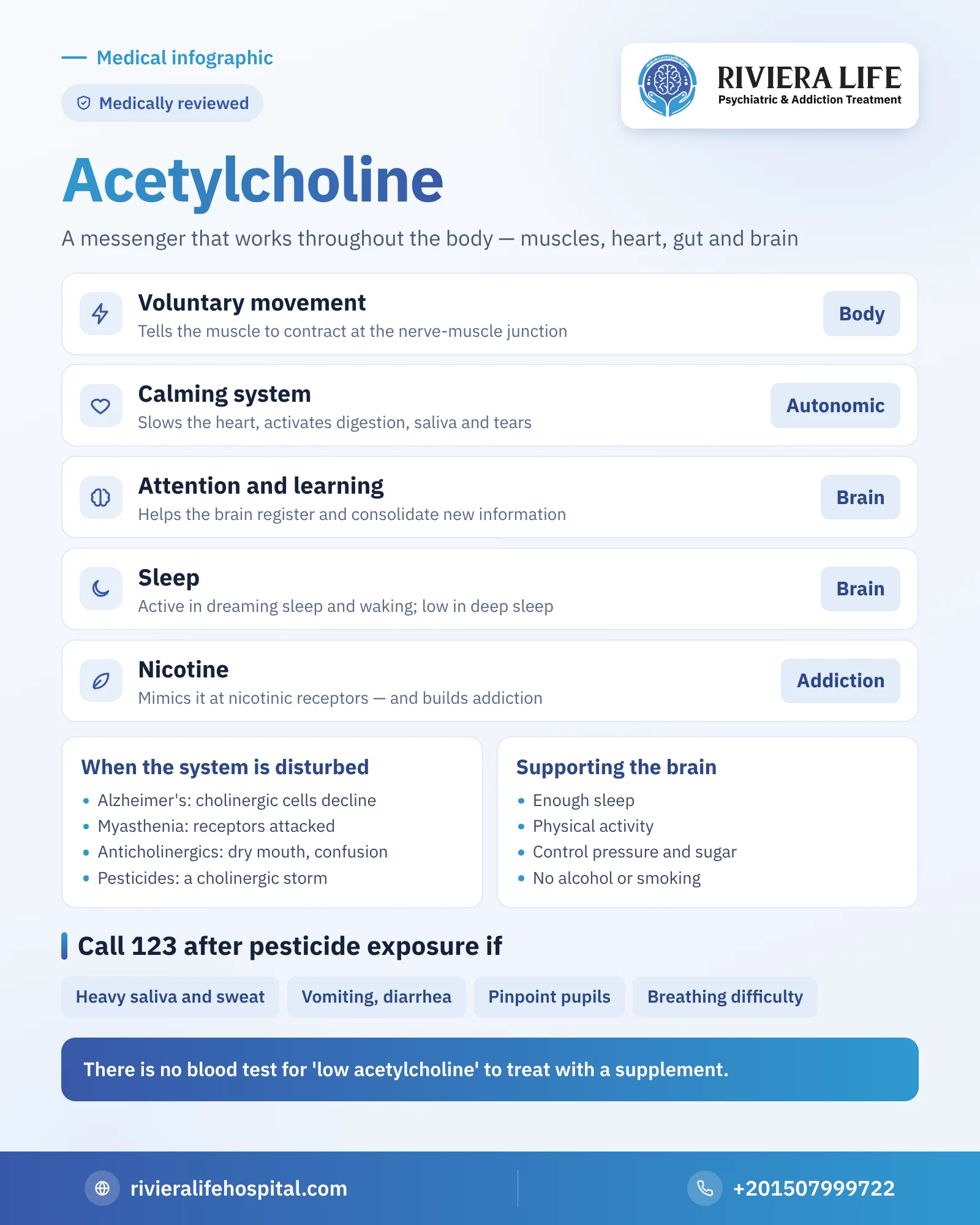
- Voluntary movement: at the junction between nerve and muscle, this transmitter orders the muscle to contract, so there is no voluntary movement without it.
- The autonomic nervous system: it is the main transmitter of the parasympathetic branch, which calms the body: it slows the heart, activates digestion, saliva and tears, narrows the pupil and stimulates bladder emptying.
- Attention and learning: cells at the base of the forebrain send fibers to the cortex and hippocampus, increasing the brain’s sensitivity to new information and helping to consolidate it.
- Sleep: its activity rises during dreaming sleep and wakefulness, and falls in deep sleep.
Acetylcholine, memory and attention
Experiments that temporarily block this transmitter show it is essential for forming new memories, so the person can remember what happened minutes ago but can’t retain anything new. This doesn’t mean increasing the transmitter raises memory in healthy people; it is more like a system that works well at a certain level, and changing it in either direction may disrupt performance. It is also linked to selective attention, your ability to choose what to pay attention to. Other transmitters share this role with it, such as dopamine and noradrenaline. And if your problem is distraction rather than forgetfulness, our article on the causes of poor concentration may help.
Alzheimer’s and dementia
In Alzheimer’s disease, the cholinergic cells at the base of the forebrain gradually die, so its level falls in the cortex and hippocampus. On this basis, medicines were made that prevent its breakdown, called cholinesterase inhibitors, used in mild and moderate and sometimes advanced cases. Their benefit is limited: they may slow the decline of symptoms or stabilize them for a time in some patients, but they don’t stop the disease or restore the cells.
They may cause nausea, diarrhea and a slow pulse in some, which is why they are prescribed and monitored by the doctor. Anticholinergic medicines, however, may increase confusion in older people, so doctors take care to review their medicine lists. General information about the disease is on the NHS dementia page.
Myasthenia gravis
In this autoimmune disease, the body attacks the receptors this transmitter binds to at the nerve-muscle junction, so the signal weakens. Symptoms appear as a drooping eyelid, double vision, difficulty chewing and swallowing, and weakness that increases with effort and eases with rest. Treatment is based on medicines that prevent the transmitter’s breakdown, immune suppressants and sometimes surgery on the thymus gland, decided by the neurologist. Sudden shortness of breath in this condition is an emergency.
Nicotine and smoking addiction
Nicotine mimics acetylcholine at nicotinic receptors, raising attention and alertness for minutes, and also stimulates dopamine, which is what creates addiction. With repetition the number of receptors increases and the brain adapts, so the absence of nicotine becomes a source of tension and distraction. You will find the details of withdrawal and quitting in our article on nicotine addiction.
Medicines that reduce acetylcholine
These medicines are called anticholinergics, and include some older antihistamines, some bladder and stomach medicines, some older antidepressants and some antipsychotics. Medicines such as trihexyphenidyl are also used to treat the tremor caused by antipsychotics, explained in our Parkinol guide. The known effects of this class: dry mouth, blurred vision, constipation, urinary retention and a fast pulse, and in older people confusion and forgetfulness that may be mistaken for dementia. The risk varies with the medicine, dose and age, and only the doctor changes any of this.
Cholinergic poisoning
Organophosphate insecticides and nerve agents block the breakdown enzyme, so the transmitter accumulates and the signal turns into a storm. In an agricultural country like Egypt, pesticide poisoning incidents happen accidentally or deliberately, and it is a life-threatening condition that needs immediate treatment in hospital.
Call an ambulance on 123 immediately if you see
After exposure to an insecticide, spraying it, or swallowing it:
- Heavy saliva, tears and severe sweating
- Nausea, vomiting, diarrhea and abdominal cramps
- Very small pupils and difficulty breathing
- Muscle weakness or twitching, seizures or fainting
While waiting for the ambulance, move the person away from the source of exposure, remove their contaminated clothes and wash their skin with soap and water, without trying to give them anything by mouth.
Symptoms of acetylcholine imbalance: why is there no single list?
Many people search for “symptoms of low acetylcholine” the way they search for iron deficiency, but there is no medical syndrome by that name. The imbalance shows according to the site affected: weak movement at the muscle junction, forgetfulness when brain circuits are disturbed, dry mouth, constipation and urinary retention when autonomic signals are weakened, or saliva, diarrhea and a slow heart when they are increased. So internet lists that put all of this under one heading aren’t a diagnosis, and it is more useful to describe to your doctor the symptom that bothers you so they can look for its real cause, which may be a medicine, a nerve disease or something else.
Do supplements raise acetylcholine?
Choline is an essential nutrient found in eggs, liver, fish, meat, soy and legumes, and most people who eat a varied diet get what they need. As for supplements marketed to improve memory, such as choline, alpha-GPC or huperzine, the evidence for their benefit in healthy people is weak or insufficient, as with medicines circulated to strengthen memory such as Lucidril, and some may interact with medicines or cause digestive and heart effects.
And there is no evidence that low acetylcholine can be detected by a blood test to be treated with a supplement. What is more useful for supporting the brain is what you already know: enough sleep, physical activity, controlling blood pressure and sugar, learning new things, and avoiding alcohol and smoking. For comparison with another transmitter that affects mood and sleep, see our serotonin guide.
When should you see a doctor?
- Increasing forgetfulness noticed by those around you or that disrupts your work and independence.
- Muscle weakness that increases with effort, a drooping eyelid or difficulty swallowing.
- Confusion or forgetfulness that began after a new medicine, especially in older people.
- Severe dry mouth, urinary retention or persistent constipation with a medicine you are taking.
More from our brain and neurochemistry guide
Questions many people ask
It moves voluntary muscles, regulates the heart, digestion and saliva through the autonomic nervous system, and takes part in attention, learning, memory and stages of sleep.
The evidence for choline or other supplements in healthy people is weak, and they may interact with medicines. Varied food, sleep and physical activity are more useful.
Cholinergic cells in the brain decline in the disease, which is why there are medicines that inhibit its breakdown and help symptoms in some patients without stopping the disease.
Heavy saliva, sweating, nausea, diarrhea, pinpoint pupils, difficulty breathing and muscle weakness; it may happen after exposure to insecticides. It calls for an immediate call to an ambulance on 123.
Medicines that block the action of acetylcholine, causing dry mouth, constipation, urinary retention and confusion in older people. Only the doctor changes a medicine.