The hashish addict and suspicion come together in many homes, and suspicion is one of the most exhausting things for families. It begins as passing anxiety under the influence, such as thinking the neighbors are watching him or that someone will discover him, then in some regular users it may turn into constant suspicion of the wife, family or friends, and sometimes into true psychosis in which the person loses touch with reality.
Not every suspicion is psychosis, but suspicion that continues after the effect wears off, or comes with hearing voices or aggression, is a sign that calls for a psychiatrist. This article explains why suspicion happens, when it is a passing symptom and when it is dangerous, how the family should act, and what the treatment is.
Why does hashish cause suspicion and paranoia?
The active substance in hashish affects the brain areas that assess danger and interpret other people’s intentions. At small doses the person may feel relaxed, but with a larger amount or stronger hashish it may flip into anxiety and apprehension, so an ordinary sound in the street or a passing glance seems like a threat. The risk increases when a person uses daily for long periods, or when the hashish is adulterated or mixed with much stronger synthetic substances, such as strox, whose danger is explained in our strox guide.
Passing suspicion or persistent suspicion?
| Passing suspicion under the influence | Suspicion that calls for assessment |
|---|---|
| Appears while smoking and disappears within hours | Lasts days, even after the effect wears off |
| The person later knows he was exaggerating | Completely convinced and accepts no contrary evidence |
| General anxiety about being found out | Specific ideas about a conspiracy, infidelity or poisoning |
| Doesn’t change his behavior much | Searches, watches, accuses, closes windows and changes locks |
| No voices or hallucinations | Hears voices or sees things others don’t |
Common forms of suspicion in hashish users
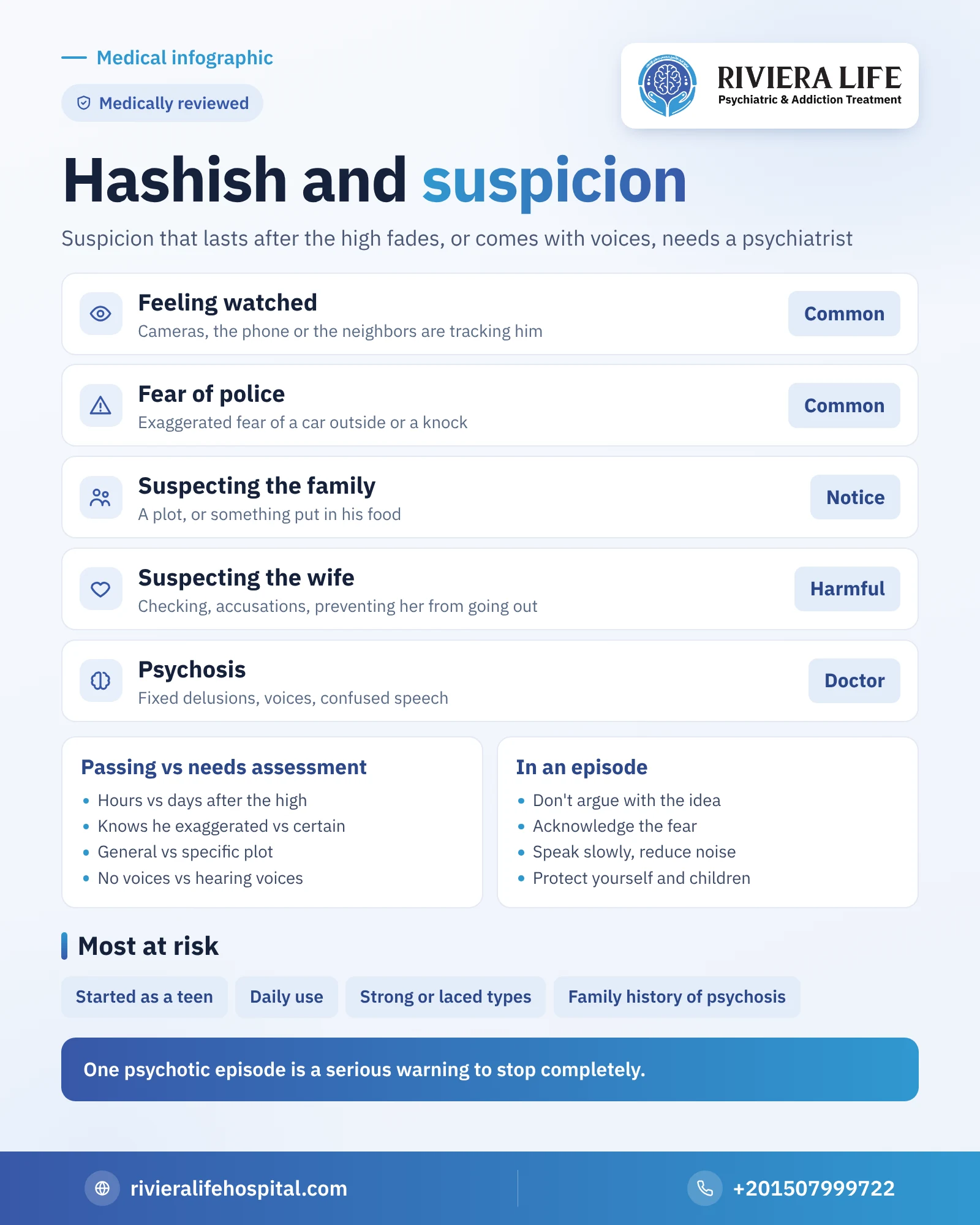
- The feeling of being watched: that cameras, the phone or the neighbors are tracking him.
- Fear of the police: exaggerated anxiety about a car stopping outside the house or a knock on the door.
- Suspecting the family: that they are plotting against him or putting something in his food.
- Suspecting friends: that they are talking about him or planning to harm him.
- Suspecting the wife: the most painful and destructive for the home, to which we devote a separate section.
The hashish addict and suspicion of his wife
Many wives describe a gradual change: the husband starts with questions about her delay in answering the phone, then searches her messages, then interprets any small action as evidence of infidelity, and may go as far as preventing her from going out or threatening her.
Part of this may be anxiety and tension that drug use increases, but when the idea becomes fixed and unshakable despite the absence of any evidence, it is what doctors call pathological jealousy, and it may be part of a psychotic disorder. Here swearing oaths and presenting evidence don’t help, because the idea isn’t based on logic in the first place. What helps is a psychiatric assessment, and protecting the wife and children if any threat or violence appears.
What should the wife do?
Stay calm and don’t get into a daily chain of defending yourself, as it drains you and doesn’t change his conviction. Tell someone you trust in your family what is happening, and keep your phone, keys and the ambulance number within reach. If the threats are repeated, your safety and your children’s safety come before any other consideration, and you can ask for a psychiatric consultation for yourself even before he accepts treatment.
What is hashish-induced psychosis?
Psychosis is a state in which a person loses the ability to distinguish between what is real and what is in their head. Hashish may cause a psychotic episode in which delusions appear, that is, firm false beliefs such as believing one is persecuted, along with auditory or visual hallucinations, confused speech and strange behavior. Some of these episodes are short and pass within days after stopping, and some last weeks and need medication. Much of this picture differs from the usual hashish addiction symptoms, because it is an independent psychiatric disorder with its own treatment.
Who is most at risk?
- Those who began using in adolescence, when the brain is still developing.
- Those who use daily or more than once a day.
- Those who use high-concentration types or types mixed with synthetic substances.
- Those with a first-degree relative with schizophrenia or a psychotic disorder.
- Those who have had a previous episode of suspicion or hallucinations with drug use.
Does suspicion turn into schizophrenia?
The relationship between hashish and schizophrenia is one of the most studied by researchers. What is established is that regular use, especially at an early age and in high concentrations, is linked to a higher risk of developing schizophrenia, and may bring its onset earlier in those with a genetic predisposition. Long-term follow-ups indicate that a significant proportion of those who go through hashish-related psychosis are later diagnosed with schizophrenia or a chronic psychotic disorder. This doesn’t mean every user will develop it, but it does mean that a single psychotic episode is a serious warning to stop completely and to follow up. You will find hashish’s other effects on the brain in our article on the harms of hashish.
When is it an emergency?
Call an ambulance on 123 immediately if you see
Don't argue with him or try to control him by force; move the children and sharp tools away, and stay somewhere safe until help arrives.
- Threats to harm himself or talk of suicide
- Threats to harm the wife or a family member, or carrying a weapon or sharp tool
- Voices he hears ordering him to do something
- Severe agitation or aggression that can’t be calmed
- Refusing food and drink for fear of poisoning
- Confusion and not knowing the place or people
How do you deal with him during an episode of suspicion?
- Don’t argue with the idea: trying to prove it wrong increases his conviction that you are part of the conspiracy.
- Acknowledge his feelings, not the idea: “I can see you’re very afraid, and I’m here with you”, without confirming what he says.
- Speak calmly and slowly: and reduce the noise and number of people around him.
- Give him space: don’t corner him in a room or stand between him and the door.
- Protect yourself and the children: the family’s safety comes before anything else.
And after the episode calms down, don’t postpone the medical assessment even if he seems completely normal again. You will find the steps for persuading him into treatment in our article on how to deal with a hashish addict.
How are suspicion and hashish-induced psychosis treated?
Treatment begins with a careful psychiatric assessment that distinguishes between a substance-related episode and a primary psychotic disorder that appeared with drug use. In acute cases the patient may need a short hospital stay under continuous medical supervision, especially if there is a danger to himself or others. The psychiatrist prescribes antipsychotic medicines when needed for a period set according to the response, along with treatment of the accompanying insomnia and anxiety. But the cornerstone is stopping hashish completely, because returning to it is one of the strongest causes of repeated episodes. Then come cognitive behavioral therapy, the family program and relapse prevention, stages explained in our article on hashish addiction treatment.
Does suspicion go away after stopping?
In many cases suspicion eases gradually within days to weeks of stopping, especially if it was linked to the direct effect of the substance. But if it continues for more than about a month after stopping, or the episodes recur, this may point to an independent psychiatric disorder that needs longer follow-up. What matters is that the family doesn’t treat calm after a few days of abstinence as the end of the story; regular follow-up is what prevents the next episode.
The drug addict and suspicion: is paranoia limited to hashish?
Hashish isn’t the only substance that plants suspicion in its user’s head. When we talk about drug addicts and suspicion in general, stimulants are at the top of the list: shabu, captagon and cocaine may, after long sleeplessness, lead the user to hear footsteps behind the door or become convinced that someone is following him.
Other substances follow, each in its own way:
- Strox and spice: a strong and unpredictable effect on mood, which may bring sudden episodes of fear and hallucinations, detailed in the harms of strox.
- Alcohol: long-term addiction may generate pathological jealousy and suspicion of the partner, the subject of pathological jealousy.
- Sedatives and alcohol when stopped suddenly: paranoia and hallucinations may appear as part of a dangerous withdrawal that needs medical supervision.
- Mixing two or more substances: this multiplies the likelihood of psychosis and makes the cause harder to pin down.
And it isn’t limited to the user himself; the family notices that the suspicion shifts with the substance, the state of sleep and the most recent doses, and these observations help the doctor identify the cause.
The practical rule is the same whatever the substance: if suspicion continues after the effect wears off, or comes with voices or threats, what is needed is a psychiatric assessment, not a discussion. You will find the broader picture in our article on drug-induced psychosis.
How can Riviera Life help you?
Riviera Life’s team of psychiatrists and addiction consultants handles cases of suspicion and hashish-related psychosis in a safe environment under round-the-clock medical supervision, in complete confidentiality, with a program that supports the wife and family. The first consultation is free, and you can get in touch at any time: +201507999722, Sheikh Zayed, Giza.
More from our hashish guide
- Hashish: the complete guide
- The behavior of hashish users
- Hashish and sex
- Hashish withdrawal symptoms
- Paranoia: from passing suspicion to persecutory delusion, and treatment
- Psychosis: the complete guide
- Pathological jealousy: when does fear for a partner become suspicion that threatens the relationship?
- How does a drug and hashish addict think?
Questions many people ask
No, but suspicion and anxiety under the influence are common with large amounts and strong types, and the risk rises with daily use and starting at a young age.
Drug use may increase anxiety and tension, and in some users the suspicions turn into a fixed idea that accepts no evidence, which may be part of a psychotic disorder that needs assessment.
Regular use, especially at an early age and in high concentrations, is linked to a higher risk of schizophrenia, and may bring its onset earlier in those with a genetic predisposition.
No, arguing increases his conviction that you are part of the conspiracy. It is better to reassure him calmly, protect the family and ask for a psychiatric assessment.
It usually eases within days to weeks, but if it lasts more than about a month or recurs, it may point to an independent psychiatric disorder that needs follow-up.