How to deal with someone with bipolar disorder depends on the phase they are going through: what helps them in a manic episode may hurt them in a depressive episode, and what the family does in stable periods often determines whether the next episode comes early or late. This is a practical guide for family, partners and friends, divided by the three phases, with steps for financial and physical safety during mania, early signs of relapse, and how to protect yourself from burnout. It doesn’t replace the psychiatrist, who remains the reference for diagnosis and treatment.
Start with understanding: the illness isn’t the personality
The first step in dealing with someone with bipolar disorder is to separate the person from their episodes. The brother who bought a car on installments in a manic episode, or the wife who didn’t leave her bed for two weeks in a depressive episode, didn’t do it out of stubbornness or lack of responsibility. Bipolar disorder is an illness that changes the chemistry of mood, energy, sleep and judgment. If you want to know what the episodes look like in detail, see the symptoms of bipolar disorder; here we focus on what you do.
Dealing with the patient in a manic episode
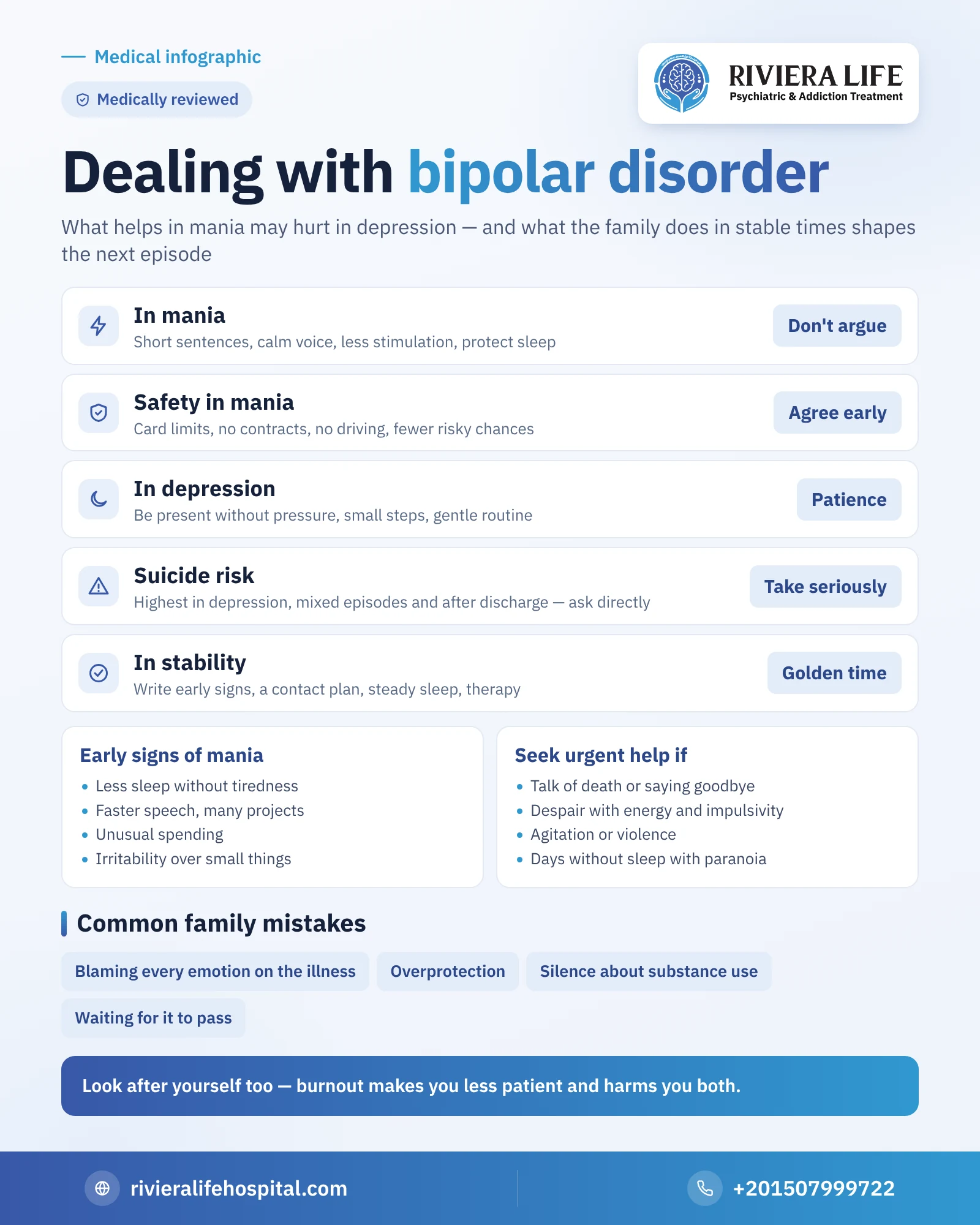
In mania the patient feels they are at their best, which is why they usually reject any suggestion that they are ill. Direct argument increases agitation, and mockery ignites anger. What helps more:
- Speak in short sentences with a calm voice, and avoid arguing about their big ideas or plans.
- Reduce stimulation at home: less noise, fewer visits, and calm lighting at night.
- Encourage sleep in any acceptable way; lack of sleep feeds mania, and mania prevents sleep.
- Don’t take their hurtful words personally; impulsivity and irritability are part of the episode.
- Contact their doctor early, as some manic episodes need an urgent change in treatment or hospital admission.
Safety during mania: money, driving and risky behavior
This part in particular is what changes the fate of many families. A single manic episode may leave debts for years or an unforgettable accident. That is why it is better to agree on these steps during stability, with the patient’s consent:
Money
- Setting a cap on bank cards, or handing them to a trusted person during an episode.
- Agreeing not to sign contracts or checks or sell property during periods of instability.
- Disabling any quick-loan or betting apps.
Driving
Speed, recklessness and lack of sleep are a dangerous mix. It is wise to agree on not driving during an episode, and to hold on to the car keys if necessary.
Risky behavior
Mania may include reckless relationships, substance use, sudden travel or quitting a job. The family can’t prevent everything, but it can reduce the opportunities, and ask for medical intervention when things go beyond what it can handle.
If they refuse treatment during an episode
In severe mania, insight is often absent, so the patient refuses both the doctor and the medicine. Don’t enter a long battle of persuasion. Call on someone they trust, or ask the treating doctor to contact them directly, and hold on to what you agreed during stability. If it reaches a clear danger to their life or the life of others, Egypt’s Mental Health Care Law regulates treatment admission in such cases under medical supervision, and the doctor is the one who assesses whether it applies. Hospital admission here isn’t a punishment, but temporary protection until sound judgment returns.
Dealing with the patient in a depressive episode
In depression the scene flips: the same person who didn’t sleep for a week may sleep all day and lose interest in everything. Here phrases such as “snap out of it” or “may God guide you” hurt more than they help.
- Be present without pressure: sit beside them, and offer specific help such as a meal or a short outing.
- Break tasks into small steps, and celebrate every step.
- Don’t compare their activity now with their activity during mania, as that increases their guilt.
- Gently keep an eye on eating, sleep and medicine.
- Pay attention to any talk of despair or wanting to die, and always take it seriously.
Awareness of suicide risk
Bipolar disorder is among the disorders linked to a higher risk of suicide, especially in depressive episodes, in mixed episodes where the energy of mania combines with the despair of depression, and right after leaving hospital. Asking directly about suicidal thoughts doesn’t plant the idea as some think; it opens the door to talking. If they answer yes, don’t leave them alone, remove extra medicines and dangerous tools, and seek help immediately.
Seek urgent help immediately if you see
Call an ambulance on 123 or the mental health hotline on 16328, or go to the nearest emergency department, if there is:
- Talk of death, ending life or saying goodbye to people
- Severe despair together with energy and impulsivity
- Agitation or violence threatening their safety or that of those around them
- No sleep for several nights with unrealistic thoughts or severe suspicion
- Reckless driving or behavior that puts their life at risk
Stable periods: the golden time for work
Many families breathe a sigh of relief when an episode ends, then forget about it until the next one. But stability is the best time to build a plan:
- Sit together and write down their particular early signs of mania and depression.
- Agree on who calls the doctor, and when, and what the financial safety steps are.
- Keep a regular sleep routine as far as possible, as disturbed sleep is one of the strongest triggers of episodes.
- Encourage psychotherapy and psychoeducation, as both reduce relapse.
- Treat them as a whole person, not as a patient under constant watch.
Supporting adherence to medicine without conflict
Stopping mood stabilizers is one of the best-known causes of relapse. It usually happens because the patient feels cured, misses the energy of mania, or is bothered by a side effect. Instead of surveillance and threats, ask them what bothers them about the medicine, and encourage them to discuss it with the doctor. Remember that adjusting the dose or stopping is the doctor’s decision alone, and that some medicines need regular blood tests. The available treatment options are explained in bipolar disorder treatment.
Early signs of relapse
Before mania
- Less sleep without feeling tired.
- Faster speech and many new projects.
- Unusual spending or irritability over small things.
Before depression
- Withdrawing from people and sleeping longer.
- Losing interest in what they used to love.
- Pessimism and talk of things being pointless.
Each patient has their own signs, and the people who know them best are the patient themselves and those closest to them. General triggers of episodes are explained in our article on the causes of bipolar disorder.
Common mistakes families make with good intentions
- Explaining every emotion as the illness: saying “you must be going into an episode” at every ordinary anger makes the patient feel their feelings are no longer their own. Not every sadness is depression and not every joy is mania.
- Overprotection: stopping them from working, traveling or making decisions in stable periods weakens their self-confidence and increases isolation.
- Silence about substance use: hashish, alcohol and stimulants are known triggers of episodes, and ignoring them makes every other treatment weaker. It may need a dual diagnosis assessment.
- Hiding the illness from the doctor or close relatives: complete secrecy deprives the family of support and delays seeking help.
- Waiting for them to “come to their senses on their own”: a severe manic episode rarely calms down with advice, and delay may cost a lot.
Look after yourself too
Whoever cares for someone with bipolar disorder lives on edge, waiting for the next episode. Burnout makes you less patient and more reactive, which harms both of you. Set aside time for yourself, share responsibility with another family member, and talk with a professional or a support group if possible. Seeking help for yourself isn’t selfish; it is part of caring for them. For more on organizing family life with any mental illness, see how the family can deal with a person with mental illness.
How can Riviera Life help you?
At Riviera Life in Sheikh Zayed we admit people with bipolar disorder in severe manic or depressive episodes under round-the-clock medical supervision, and work with the family on the safety plan and relapse prevention through the family program and aftercare. The first consultation is free and confidential, and you can reach us at any time on +201507999722.
More from our bipolar disorder guide
- Bipolar disorder: the complete guide
- The symptoms of bipolar disorder
- Bipolar disorder treatment
- Bipolar disorder vs borderline personality disorder
- Bipolar disorder and marriage: disclosure, pregnancy and the partner’s role
- The types of bipolar disorder: type I, type II and cyclothymia
Questions many people ask
It isn't advised. Arguing increases agitation; it is better to speak calmly and briefly, reduce stimulation and contact the doctor.
No. Asking directly and calmly opens the door to talking and helps in seeking help at the right time.
By agreeing with the patient during stability on a cap for cards, handing them to a trusted person during an episode, and avoiding signing contracts.
Ask calmly about the reason and encourage them to see the doctor, as stopping is one of the best-known causes of relapse; adjusting treatment is the doctor's decision alone.
Not always, but severe episodes, or those accompanied by danger to the patient or others, may need a short stay under supervision until they stabilize.