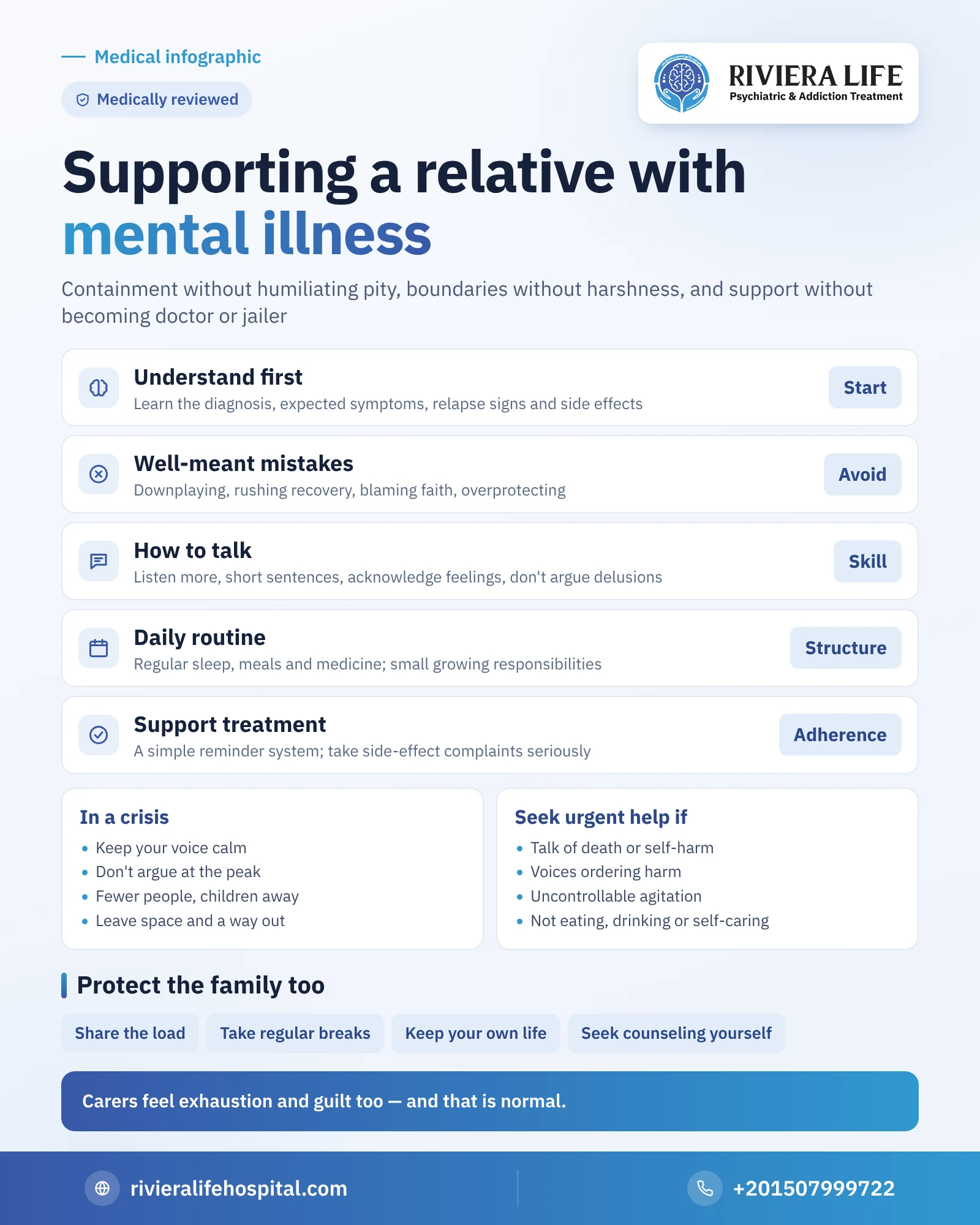
How can the family deal with a person with mental illness in the best way? When it understands that what it sees is an illness with treatment, not stubbornness or weak faith. Three balanced things are needed: containment without humiliating pity, clear boundaries without harshness, and support for treatment without the family turning into a doctor or a jailer. This guide explains how to talk with them, how to organize the home, what to do during a crisis or when treatment is refused, and when urgent intervention becomes necessary. It also explains how the family can protect itself from burnout, because those who care need care too.
Why does the way the family deals with it make a real difference?
The patient spends many times more time at home than in the doctor’s clinic, and the atmosphere they live in affects the course of their illness. Many studies have noticed that constant criticism, hostility and over-involvement within the family are linked to a higher risk of relapse, especially in schizophrenia and mood disorders. That is why medical guidelines recommend involving the family in treatment, and teaching it how to communicate and solve problems calmly.
This doesn’t mean the family is the cause of the illness. Mental illness has intertwined biological, psychological and social roots, but the family holds an influential tool in the speed and stability of improvement.
Start with understanding: illness isn’t weak willpower
Before any advice, learn about the diagnosis itself. Ask the treating doctor: what is the disorder called? What symptoms are expected? What are the signs of relapse? What are the medicine’s side effects? Dealing with depression differs from dealing with schizophrenia or bipolar disorder. Someone with depression who doesn’t get out of bed isn’t lazy, and someone with schizophrenia who believes someone is watching them isn’t lying to you; they are actually living what they say.
Mistakes families make with good intentions
- Downplaying: “We all have stress, pull yourself together.” The phrase sounds encouraging but makes them feel their suffering isn’t understood.
- Rushing recovery: asking every day “are you still tired?” adds pressure and makes them hide their symptoms.
- Linking the illness to lack of faith: spiritual support may comfort, but it doesn’t replace medical treatment.
- Overprotection: taking all responsibilities away from them weakens their confidence and delays their return to life.
- Talking about them in front of them: as if they aren’t there or can’t understand.
- Home diagnosis: describing their condition to acquaintances and relatives and suggesting medicines others have tried.
How do you talk with a person with mental illness?
Listening matters more than advice. Choose a calm time, sit close rather than in sharp confrontation, and speak in short sentences. Acknowledge their feeling even if you don’t understand its cause, and don’t argue about unrealistic ideas: neither agree with them nor mock them, but talk about the feeling they cause.
| Instead of saying | Try saying |
|---|---|
| You’re exaggerating | It’s clear this really bothers you |
| No one is watching you, stop imagining things | I don’t see what you see, but I believe you’re afraid |
| You have to snap out of this | Would you like us to take a quarter-hour walk together? |
| Why don’t you take your medicine? | What bothers you about the medicine? Let’s ask the doctor about it |
How do you organize daily life at home?
A fixed routine eases inner chaos. Help them keep regular times for sleep, meals and medicine, because sleep disturbance in particular may be the first sign of relapse in some disorders. Give them small responsibilities that suit their condition, then increase them gradually, such as buying bread or tidying their room. Keep medicines in a safe place under the supervision of a family member if the doctor sees fit, and reduce tension at home as far as possible: less loud noise, fewer surprise visits, fewer sharp arguments.
How do you act during an outburst of anger or a breakdown?
- Keep your voice and body calm, as agitation is contagious in both directions.
- Don’t try to persuade with logic at the peak of the crisis; postpone the discussion to later.
- Reduce the number of people in the room, and calmly move the children away.
- Leave them space and a way out, and don’t corner them in a room.
- Once things calm down, talk together about what set off the crisis and how you will act next time.
If a real threat to their safety or others’ appears, everyone’s safety comes first: move away and ask for help.
How do you support commitment to treatment without becoming a guard?
Commitment to medicine and appointments is one of the strongest reasons relapse is prevented, but close surveillance breeds stubbornness. Agree together on a simple reminder method, such as a weekly pill box or a phone alarm, instead of repeated questions in front of others. Go with them to appointments if they wish, and write down beforehand your observations on their sleep, appetite and mood, as this information helps the doctor a lot. If they complain of side effects such as weight gain or sleepiness, take their complaint seriously and pass it to the doctor; these effects are among the most common reasons patients secretly stop their medicine.
And celebrate small progress: a week in which their sleep was regular, or a day they went out with a friend. Encouraging a specific step has a stronger effect than general praise.
What do you do if they refuse treatment or stop their medicine?
Refusal isn’t always stubbornness. Some disorders weaken the patient’s ability to realize they are ill, and some fear stigma or side effects. Start from their complaint, not the diagnosis: “I notice you’re not sleeping well — what do you think about asking a doctor about sleep?” And offer one consultation, not “long treatment”. If they stop their medicine, don’t hide it in their food; ask for an urgent appointment with their doctor to discuss the reason, as changing the medicine may be the solution.
In cases where there is serious danger, Egypt’s Mental Health Care Law regulates admission without the patient’s consent according to specific conditions and procedures decided by the psychiatrist after assessment.
Signs that call for urgent intervention
Seek urgent help immediately if you see
Call an ambulance on 123 or go to the nearest emergency department, and don't leave the patient alone.
- Talk of death or harming themselves, or an unusual farewell
- Voices ordering them to harm themselves or others
- Severe agitation or aggression that can’t be calmed
- Complete refusal to eat and drink, or inability to care for themselves
- Severe confusion or loss of contact with reality
When is hospital admission the most suitable option?
Treatment at home with clinic follow-up suits many cases, but it isn’t enough when there is danger to self or others, when a careful adjustment of medicines under continuous monitoring is needed, or when outpatient attempts fail time after time. A temporary stay here isn’t a punishment or “confinement”, but a safe environment for regaining stability. To learn what determines the cost of this step, see our article on psychiatric hospital prices in Egypt.
Dealing with someone with depression: what does the family do?
Someone with depression needs a calm, steady presence more than words of encouragement. The slowness of their movement and speech and their extinguished energy aren’t negligence on their part, and phrases such as “count your blessings” or “get up and you’ll feel better” increase their guilt without lifting their mood.
- Offer specific help: “Shall I bring you lunch?” or “Shall we go to the doctor tomorrow?” is easier for them than a general question about what they want.
- Suggest small steps: a ten-minute walk or sitting by the window, without insisting or comparing with what they used to do.
- Ask frankly: if you notice talk of despair or death, ask them directly whether they are thinking of harming themselves; a clear question doesn’t plant the idea.
- Support treatment: remind them of appointments and medicine, and remember that antidepressants usually need weeks to work, so don’t judge them by the first days.
- Remove means of danger: if there is a risk to their life, keep medicines and dangerous tools out of their reach.
If they say they want to die or have made a plan to harm themselves, don’t leave them alone, and call an ambulance on 123 or take them to the nearest emergency department. You will find in our guide to suicidal thoughts what to say and what to avoid at that moment, and in signs of depression relapse what to watch for after improvement.
What if mental illness and addiction come together?
Patients often turn to drugs or pills to calm their symptoms, and their condition gets worse. Treating one side and leaving the other opens the door to relapse, which is why a single plan that treats both together is needed, as in the dual diagnosis program. The family has an organized role at this stage, explained by the family rehabilitation program.
How can the family protect its own mental health?
Exhaustion, anger and guilt are natural feelings in those who care for someone with mental illness, and admitting them doesn’t mean you don’t love them. Share tasks among family members instead of one person carrying everything, and take regular breaks without feeling negligent. Keep up your sleep, work and friendships, and don’t hesitate to seek psychological consultation for yourself if you feel you are breaking down.
How can Riviera Life help you?
The family can contact Riviera Life before the patient themselves is convinced, to learn the best way to talk with them and the most suitable level of care. The hospital is licensed by the Ministry of Health in Sheikh Zayed, with fourteen years of experience, and consultant psychiatrists follow patients around the clock, with a family program and care after discharge. The first consultation is free and completely confidential: +201507999722.
Read also
- Schizophrenia treatment and the relapse prevention plan
- Bipolar disorder treatment
- The symptoms of depression and when to worry
- Cognitive behavioral therapy: the complete guide
- Admitting a psychiatric patient to hospital without their consent in Egypt
Questions many people ask
No. Mental illness results from an interaction of biological, psychological and social factors. But the way the family deals with it affects the speed of improvement and the likelihood of relapse.
This is a decision made with the patient as far as possible; it is usually enough to tell those whose role in support is needed, respecting his privacy and avoiding turning his condition into family gossip.
It isn't advised, because it destroys trust and may be dangerous. It is better to discuss the reason they refuse the medicine with the doctor, as changing the medicine or dose may solve the problem.
Common early signs include changes in sleep, isolation, stopping medicine, and the return of thoughts or behaviors that preceded the last episode. It helps to agree a list of signs specific to the case with the doctor in advance.
It may: long-term caring strains the nerves. Family counseling sessions or individual consultation help ease guilt and exhaustion and improve how the family copes.