How to deal with someone with schizophrenia starts from one idea: what they say and do during symptoms isn’t stubbornness or rudeness, but an illness that changes how they perceive reality. Don’t argue about what they hear or see, don’t mock them, and don’t leave them alone without treatment. Listen calmly, speak in short, clear sentences, encourage medicine and follow-up, and know when a situation becomes an emergency. This article gives practical steps for the family, with examples of what to say and what not to say, and how to protect yourself from burnout while you care for them.
Understand what is happening before you act
Schizophrenia is an illness that affects thinking, perception and emotions. The patient may hear voices others don’t, hold fixed beliefs that no evidence changes, speak in a disjointed way that is hard to follow, or withdraw, fall silent and neglect themselves. These symptoms aren’t a choice. When you understand this, your anger eases, and arguments at home decrease.
If you want the details of the signs themselves, they are in our article on the symptoms of schizophrenia. Here we focus on what you do as a family member.
How do you talk with them during an episode of symptoms?
Talking during symptoms has simple rules, but they change the course of the whole situation.
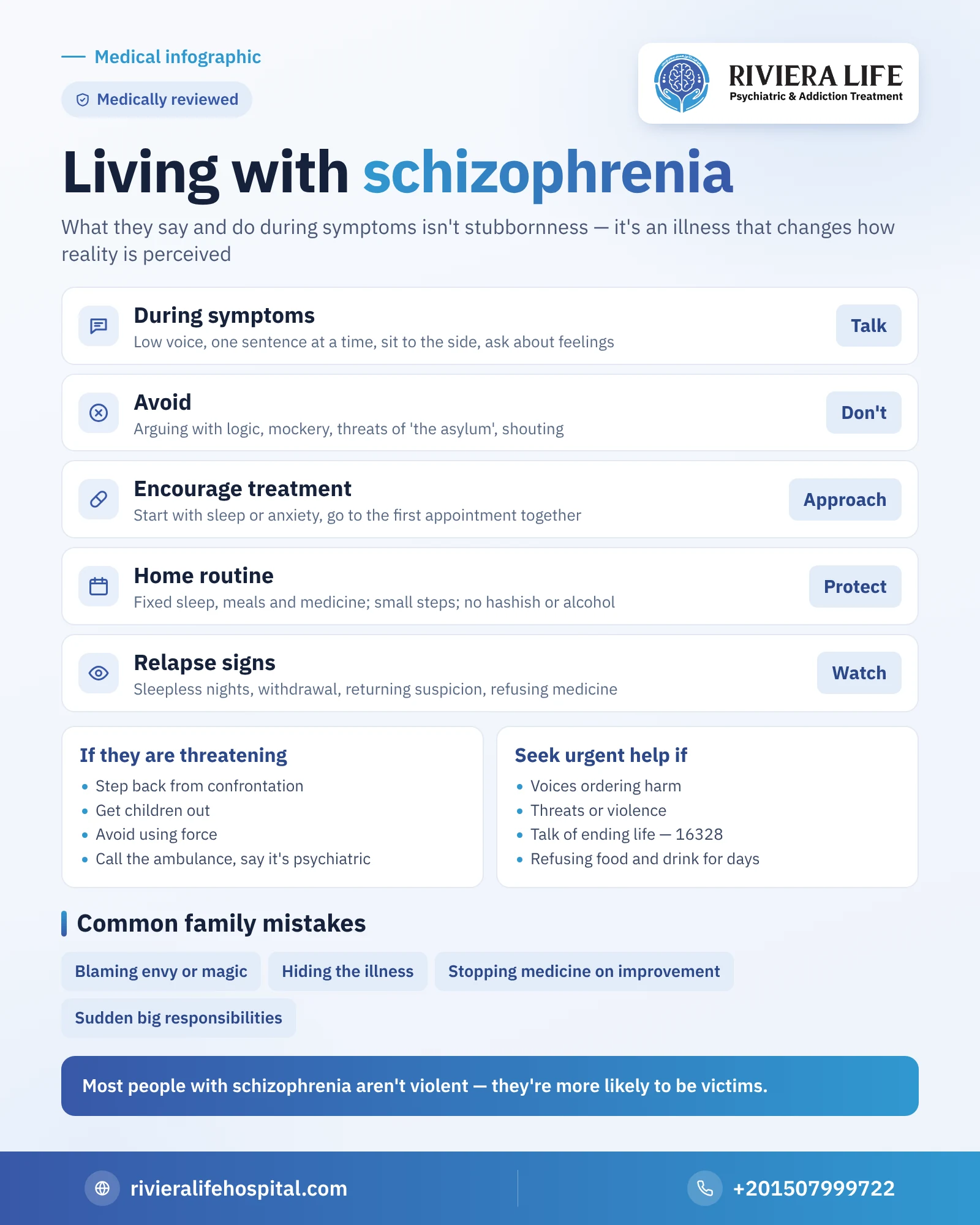
- Lower your voice and slow your speech, and use one sentence at a time.
- Sit beside them or at an angle, not directly facing them, as facing makes a troubled person feel threatened.
- Ask about their feelings instead of discussing the content: “You seem frightened — can I help you?”
- Acknowledge their experience without endorsing the delusion: “I believe you hear this and it frightens you; I don’t hear it, but I’m with you.”
- Give them space and small choices: “Would you rather sit here or in your room?”
- Reduce stimulation: turn off the TV, and move away crowds and strong lights.
What must not be said or done?
Some reactions seem natural but make things worse:
| What usually happens | Why it harms | The better alternative |
|---|---|---|
| “It’s all in your head, there’s no one there” | They feel you don’t believe them, so they pull away and cling more | “You really hear it; I don’t, so let’s calm down together” |
| Arguing with evidence and logic | A delusion doesn’t change through argument and tension may rise | Gently changing the subject to something concrete |
| Mocking or laughing at what they say | It hurts them and costs you their trust | Listening seriously without endorsing |
| Threatening them with “the asylum” | It increases their fear and makes them hide symptoms | Explaining that treatment is a way for them to feel better |
| Shouting or blaming them for shortcomings | High emotion at home is linked to more relapse | A calm request with thanks for any effort |
| Secretly hiding medicine in food | If discovered, trust collapses completely | Frank discussion with the doctor about alternatives |
How do you encourage them into treatment?
The hardest thing families face is that some patients don’t realize they are ill; this is part of the illness, not deliberate denial. Don’t start by demanding they admit they are ill, as that may close the door. Start with what they actually feel: insomnia, anxiety, tiredness, and their distress at the voices if they acknowledge them. Say, for example: “You haven’t been able to sleep for weeks — let’s ask a doctor about something to ease it.”
Go with them to the first appointment, and tell the doctor privately before or after the session what you have noticed, as the patient may deny things in front of the doctor. Then follow commitment to medicine calmly, without monitoring that makes them feel humiliated: organizing tablets in a weekly box, or linking them to a fixed time such as breakfast. The medicine should only be adjusted or stopped by the doctor’s decision, as stopping suddenly is one of the main causes of relapse. The full treatment steps are in our article on schizophrenia treatment.
A home routine that protects against relapse
A calm, regular environment is part of treatment. Try to fix times for sleep, meals and medicine, and encourage a simple daily activity such as walking or helping you with a household task. Break big tasks into small steps, as a patient overcome by negative symptoms finds it hard to start, and this isn’t laziness. And praise effort however small.
Staying away from hashish, alcohol and stimulants is an essential condition, as these substances bring back or increase symptoms; we explained this in our article on schizophrenia and addiction.
Relapse signs worth watching for
Each patient has a particular “signature” for the start of relapse, and family members are the first to notice it. Write these signs down with the doctor in a written plan. Among the best known:
- Disturbed sleep or staying up several nights in a row.
- Sudden withdrawal and neglect of hygiene or eating.
- The return of suspicion or talk of voices after a quiet period.
- A change in speech that becomes incoherent.
- Refusing or hiding the medicine.
If two or more signs appear, call the doctor within days, and don’t wait until the condition worsens. Withdrawal and lethargy in particular have more severe forms that may reach freezing, which you will find in our article on catatonia.
Seek urgent help immediately if you see
Call an ambulance on 123 or go to the nearest emergency department if the patient shows:
- Commands from voices pushing them to harm themselves or others
- Threats or violence toward a family member
- Talk of ending their life; you can also call the mental health hotline on 16328
- Refusing to eat and drink for days, or prolonged freezing
How do you act if they are violent or threatening?
Most people with schizophrenia aren’t violent; they are more likely to be victims of violence or neglect. But intense tension may arise amid fear of voices or persecutory delusions, so the patient acts in self-defense as they imagine it. At that moment:
- Step back from confrontation and take the children out of the room.
- Don’t try to control them by force if you can avoid it.
- Move away anything that could be used to harm, without provoking them.
- Call an ambulance, and tell them the case is psychiatric so they come prepared to handle it appropriately.
If the patient completely refuses treatment and the danger is clear, urgent medical intervention is justified, and is done through the doctor and the legal procedures for compulsory treatment regulated in Egypt. It is better for the doctor to explain to the patient calmly afterwards what happened, so their trust isn’t broken.
Look after yourself too
Caring for someone with schizophrenia is long and exhausting, and a family neglecting itself leads to burnout, anger and guilt. So don’t carry the burden alone:
- Share roles among family members, so one person isn’t the permanent nurse.
- Take regular breaks without feeling negligent.
- Talk with someone who understands you; family support groups are useful in many countries and some hospitals.
- Watch your own sleep and mood, and if signs of depression or severe anxiety appear, seek help for yourself.
Family education reduces relapse and improves communication; it is one of the basics of modern treatment, so don’t consider it a luxury.
Common mistakes in Egyptian families
- Believing the cause is “envy” or “magic” and leaving medical treatment for months or years.
- Hiding the illness for fear of what people will say, so treatment is delayed and the condition worsens.
- Stopping the medicine at the first improvement.
- Suddenly loading the patient with big responsibilities after they come out of an episode.
- Treating drugs as a “solution” to calm them, which increases the symptoms.
To understand the difference between common labels and what medicine says, you can read our article on the difference between mental and psychological illness.
Dealing with children and siblings at home
Having someone with schizophrenia at home affects everyone, and the youngest family members are the most confused. Explain to children in simple words suited to their age: “Your uncle is ill; his brain sees and hears different things, it’s no one’s fault, and he’s being treated.” Don’t leave them guessing, as guessing frightens them more than the truth. Give them a safe place to go if the atmosphere becomes tense, listen to their feelings, and don’t impose the role of watchman on them.
Adult siblings often feel anger, shame or guilt at the same time. This is natural, and talking about it among family members or with a professional eases the pressure. Avoid turning the patient into a permanent “topic” at the dinner table; the person behind the illness still loves what they used to love and needs to be treated as one of the family.
Work, study and responsibilities
Many patients can gradually return to work, study or a useful activity after symptoms stabilize. The rule is that the return should be in small steps: fewer hours, then more, with the doctor’s follow-up. Sudden heavy pressure may bring back symptoms, and complete withdrawal from any activity may deepen the withdrawal. Look with the doctor for rehabilitation programs or organized activities, and distinguish between encouragement and nagging. If an attempt fails, don’t count it a defeat, but a step to be reviewed and adjusted.
How can Riviera Life help you?
At Riviera Life in Sheikh Zayed, Giza, a consultant psychiatrist assesses the patient’s condition in complete confidentiality, and explains to the family how to deal with them. If the case needs intensive supervision, there is round-the-clock medical follow-up, a family program and aftercare. The first consultation is free on +201507999722.
More from our schizophrenia guide
- Schizophrenia: the complete guide
- The symptoms of schizophrenia and when to seek help
- Schizophrenia treatment and the relapse prevention plan
- Schizophrenia and marriage
Questions many people ask
Believe that they hear them and that they frighten them, without agreeing with their content. This keeps them close to you and calms them more than arguing.
Don't force them or hide the medicine secretly. Talk with them about the insomnia or anxiety they feel, and tell the doctor about their refusal so the plan can be adjusted or alternatives suggested.
The overwhelming majority aren't violent, and they are more likely to be victims. The risk rises with intense fear from persecutory delusions or with drug use.
When there is danger to themselves or others, refusal to eat and drink, or severe deterioration that home follow-up can't handle. The decision belongs to the psychiatrist.
Share tasks across the family, take regular rest, talk with someone who understands, and see a doctor if severe anxiety or depression appears in you.