The difference between psychological and mental illness is a question that recurs in the Arab world: for many, the first is depression, anxiety and obsessions, a “nervous strain” that can affect anyone, and the second is schizophrenia and psychosis, the “madness” a household is ashamed of. But modern medicine doesn’t recognize this sharp separation; both are psychiatric disorders studied and treated by psychiatry itself, and the difference between them lies in the type and severity of symptoms, not in “the type of patient”. This article explains where the popular division came from, what doctors actually say, and why this division harms patients and their families.
What do people mean by psychological illness and mental illness?
In everyday talk, many draw the line like this:
- “Psychological illness”: a condition in which the person remains aware of what is happening to them, knows they are sad or anxious, and can usually work and deal with people. Such as depression, anxiety, panic attacks and obsessive-compulsive disorder.
- “Mental illness”: a condition in which the person seems detached from reality, hears voices or believes things that aren’t true, or behaves strangely. Such as schizophrenia and severe manic episodes.
This description captures something real, which is that some disorders touch a person’s contact with reality and some don’t. But it goes wrong when it makes this a difference in essence, and when it links one with acceptance and the other with shame.
What does medicine say? They are all psychiatric disorders
In the internationally adopted classification systems, such as the Diagnostic and Statistical Manual of Mental Disorders and the International Classification of Diseases, there is one broad category called mental disorders. Within it sit depression, anxiety, schizophrenia, bipolar disorder, addiction and personality disorders side by side.
In English, the word some translate as “mental illness” is the same one that simply means “psychiatric disorder”. In other words, what we think of as a scientific distinction is mostly a difference in translation that has, over time, become a social difference. All these conditions are treated by the psychiatrist, with the psychologist working alongside them in therapy sessions.
Psychosis and neurosis: the roots of the old division
The popular division has a root in the history of psychiatry itself. For many decades doctors used two terms:
| Aspect | Neurosis | Psychosis |
|---|---|---|
| Contact with reality | Preserved | Disturbed during the episode |
| The person’s awareness of their condition | Usually knows they have a problem | May not realize they are ill |
| Old examples | Anxiety, fears, obsessions and mild depression | Schizophrenia, severe mania and psychotic depression |
| Its status today | No longer an official category in the American manual | Still a description of specific symptoms, not the name of one illness |
The American manual abandoned the term neurosis decades ago, because it was broad, vague and built on theories that weren’t proven. Psychosis remained, but as a group of symptoms, such as hallucinations and delusions, that may appear in many conditions: schizophrenia, bipolar disorder, severe depression, drug use, or even a physical illness.
The spectrum of severity: better than two boxes
Instead of two separate boxes, doctors see psychiatric disorders on a spectrum of severity, and the spectrum runs within a single disorder itself:
- Mild depression: sadness and fatigue that affect performance, but life goes on.
- Severe depression: inability to work and eat, and thoughts of death may appear.
- Psychotic depression: delusions of guilt or illness with severe depression, which our article on psychotic depression explains.
This example alone demolishes the popular division: “psychological” depression may reach “mental” symptoms. Conversely, many people with schizophrenia live stably with treatment, working and marrying, while severe obsessive-compulsive disorder may be more disabling to life.
The difference between psychological and mental illness at its core
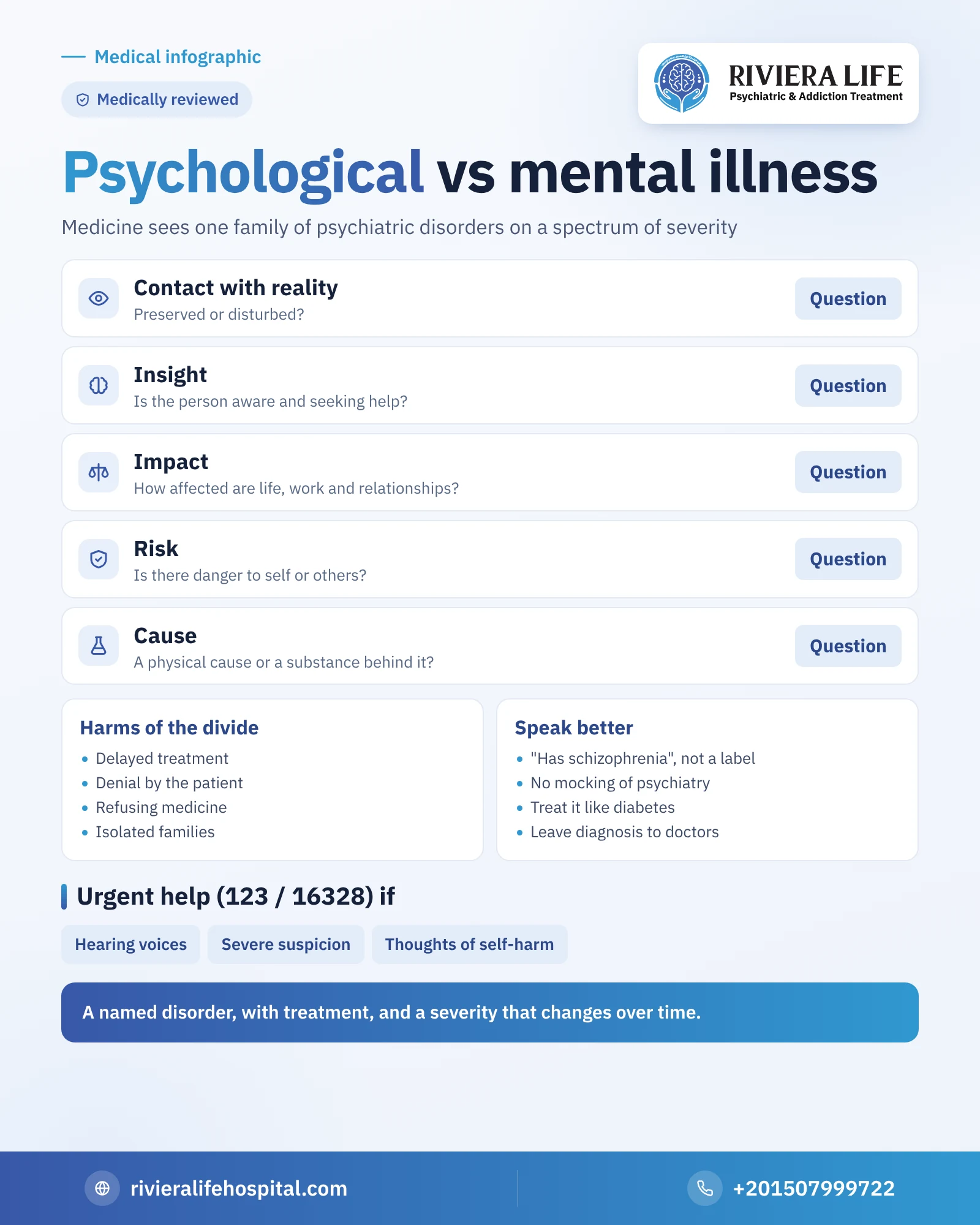
The differences that matter to the doctor aren’t “psychological or mental”, but practical questions:
- Is contact with reality preserved or disturbed?
- Is the person aware of their condition and seeking help?
- How much are their life, work and relationships affected?
- Is there a danger to them or to others?
- Is there a physical cause or a drug behind the symptoms?
These questions are what determine the type and place of treatment, not the popular label.
Can a “psychological illness” turn into a “mental illness”?
This is one of the questions clinics most often hear from frightened families: “Will my son’s depression develop into madness?”. The accurate answer is that a disorder doesn’t “turn” into another type so simply, but some conditions may develop psychotic symptoms if they intensify and go untreated, such as severe depression or a manic episode. Use of some drugs, such as cannabis in large amounts or stimulants, may also trigger psychotic symptoms in those predisposed.
The practical message here is reassuring: early and regular treatment greatly reduces the chances of symptoms intensifying. Fear of the label, on the other hand, delays treatment, and that is what really raises the risk.
Where does each disorder sit? Quick examples
- Anxiety and panic attacks: contact with reality is preserved, yet the suffering may be very severe.
- Obsessive-compulsive disorder: the person usually realizes their thoughts are exaggerated, but can’t stop them.
- Depression: ranges from mild to severe, and may be accompanied by psychotic symptoms in its most severe forms.
- Bipolar disorder: episodes of depression and mania, and the patient may lose contact with reality during severe mania, then regain it.
- Schizophrenia: affects perception and thinking, and many patients become stable with regular treatment.
- Addiction: also a psychiatric disorder, and often combined with others in what is called dual diagnosis.
Does treatment differ?
Treatment differs with the disorder and its severity, not with the division. Psychotherapy, such as cognitive behavioral therapy, is essential in anxiety and depression, and also useful in psychosis and schizophrenia. Medicines are used in both directions: antidepressants may be used in anxiety, and antipsychotics may be used in bipolar disorder and severe depression. Any patient, whatever their disorder, may need a short hospital stay if their condition becomes severe.
How does this division feed stigma?
When “mental illness” becomes a synonym for madness, real harm happens:
- Delayed treatment: a family hides their son with psychosis for years for fear of gossip, while early treatment greatly improves outcomes.
- Denial by the patient: a person with depression refuses to see a psychiatrist because they are “not crazy”, as if the clinic were only for the insane.
- Refusing medicine: “medicine for the insane” is said of medicines used every day for anxiety and depression.
- Isolating the family: the family of someone with schizophrenia is treated as if it carries a disgrace, so it withdraws and loses the support it needs.
- Silencing suffering: someone who sees themselves as “only psychologically ill” may underestimate serious symptoms such as suicidal thoughts.
It is more accurate and more compassionate to say: a psychiatric disorder, with a name, with treatment, and with a severity that changes over time and with treatment.
How can we talk in a better way?
- Say “has schizophrenia” instead of “schizophrenic” or “crazy”; the person is bigger than their diagnosis.
- Avoid mocking the psychiatrist or visiting a psychiatric hospital.
- Treat a psychiatric disorder as you treat diabetes or blood pressure: a medical condition that needs follow-up.
- Don’t diagnose anyone yourself; diagnosis is for the psychiatrist alone.
To understand what lies behind these disorders in general, our article on the causes of mental illness explains the role of genetics, the brain, trauma and stress.
When should you ask for help?
Don’t wait to decide first whether the condition is “psychological” or “mental”. Ask for an assessment if symptoms continue for weeks and affect sleep, work or relationships, or if symptoms appear such as hearing voices, severe suspicion or thoughts of self-harm. In urgent cases call an ambulance on 123 or the mental health hotline on 16328.
How can Riviera Life help you?
At Riviera Life, psychiatric consultants work with all psychiatric disorders, from anxiety and depression to psychosis, schizophrenia and addiction, without judgment and without hurtful labels. We begin with a confidential assessment, set a plan that suits the case, and involve the family in understanding it. The first consultation is free.
Read also
- Mental illnesses: symptoms, types and treatment
- The causes of mental illness
- The behavior of a person with a psychiatric illness
- Psychosis: the complete guide
- Neurosis vs psychosis: insight, reality and modern terms
Questions many people ask
Medically it is a psychiatric disorder treated by a psychiatrist, marked by psychotic symptoms. The division into psychological and mental is popular, not scientific.
Psychiatric disorders are all treated by a psychiatrist, while a neurologist treats diseases of the nervous system such as epilepsy and stroke.
In most disorders yes, but in episodes of psychosis or severe mania a person's awareness of their condition may weaken temporarily, then improve with treatment.
An old term that described disorders in which contact with reality is preserved, such as anxiety; modern classifications dropped it because it was vague.
No, psychiatric medicines are used in common conditions such as anxiety, depression and insomnia, and the doctor decides on them case by case.