Happiness hormones is a popular name for four chemicals linked to our feeling of satisfaction, pleasure and comfort: dopamine, serotonin, endorphins and oxytocin. Not all of them are hormones in the strict sense, and none of them makes happiness alone, but knowing what moves them in your ordinary day is genuinely useful. This is a practical guide that explains each substance in simple language, the daily activities that support it in a healthy way, how drugs hijack them and leave their user less able to feel joy, and then corrects common myths about them.
Where did the term “happiness hormones” come from?
The term is the child of press articles and social media posts, not medical books. Dopamine and serotonin work in the brain as neurotransmitters carrying the signal from one cell to another, endorphins are opioid-like peptides made by the body, and oxytocin is the only one of them that works both as a hormone in the blood and as a transmitter in the brain. Even so, the name has stuck because it is easy and points to an idea that is partly true: that our feelings have a biological basis affected by what we do.
If you want the full scientific picture of brain chemistry with all nine of its substances, our page on brain chemistry sets it out in detail. Here we stay with the four best known and with a practical question: what do I do with this information?
The four at a glance
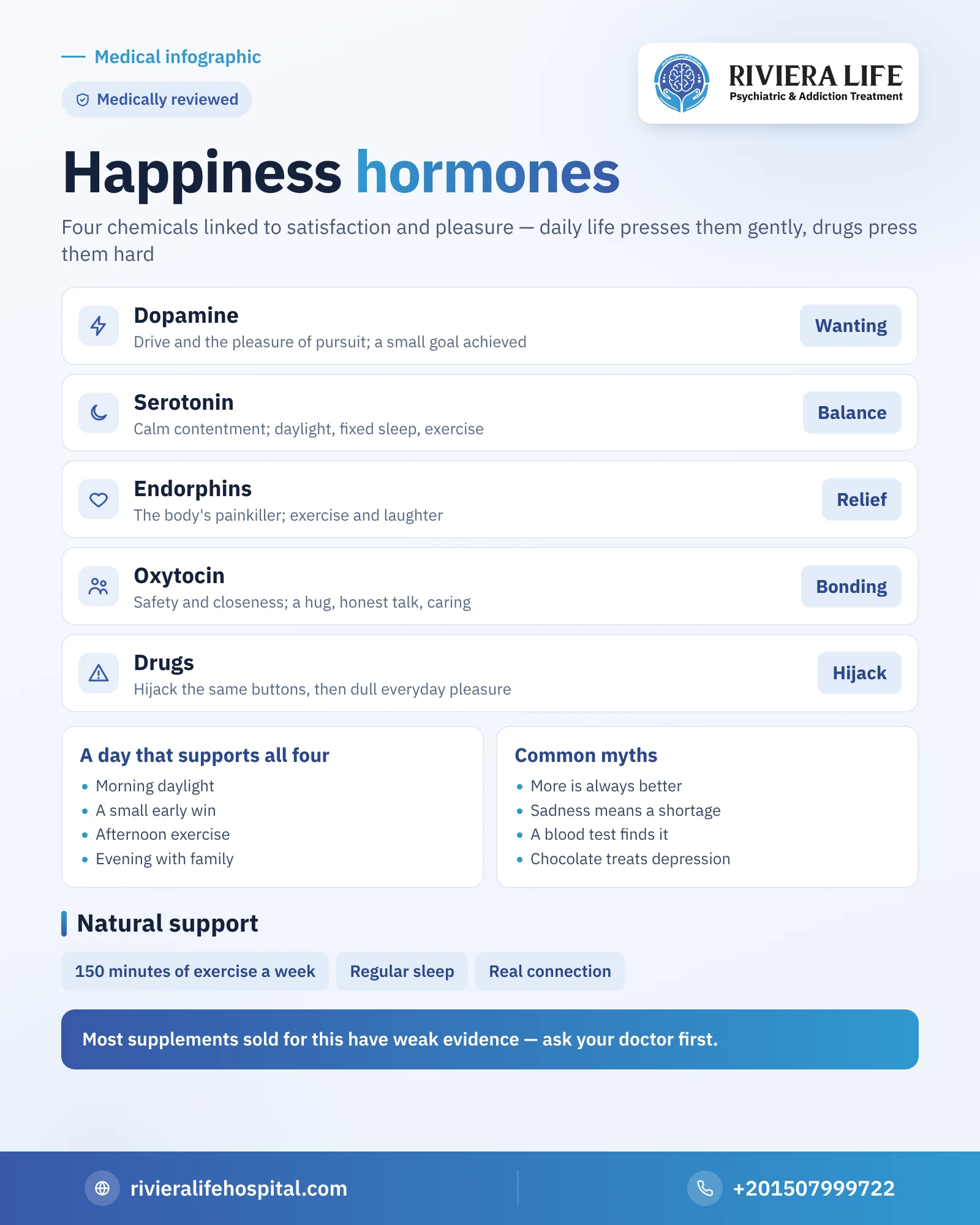
| Substance | The feeling linked to it | What moves it naturally | What hijacks it |
|---|---|---|---|
| Dopamine | Enthusiasm, and the pleasure of pursuit and achievement | A small goal achieved, learning a skill, movement | Stimulants, cocaine, gambling |
| Serotonin | Contentment, balance and calm | Sunlight, regular sleep, exercise | Ecstasy |
| Endorphins | Pain relief and relief after effort | Moderate to vigorous exercise, laughter | Heroin, tramadol, opioids |
| Oxytocin | Safety, trust and closeness | A hug, honest conversation, caring for others | Ecstasy, and alcohol partly |
Dopamine: the pleasure of the road to the goal
Dopamine doesn’t so much reward you for having something as drive you to pursue it. It is what you feel before opening a gift, when you get close to finishing a long task, and when you discover a better way of doing something. That is why small daily lists work: each item you cross off gives a modest boost that encourages you toward the next. You will find its scientific explanation in our dopamine guide.
Serotonin: the calm of someone who feels things are fine
If dopamine is the voice of “I want more”, serotonin is closer to “I’m fine now”. It is linked to stable mood, fullness, sleep and the ability to be patient. It is affected more by regularity of life than by surprises: morning light, fixed sleep times, physical activity, and a feeling of belonging and appreciation. To understand its role in mood, see our serotonin guide.
Endorphins: the painkiller your body makes
The body releases endorphins with pain and long physical effort, easing the sensation of pain and giving a feeling of relief. This is what runners sometimes describe as the post-run high, though scientists think other substances take part in it. Hearty laughter with others, dancing and group singing are all linked to its release in some studies. Details are in our endorphins guide.
Oxytocin: the chemistry of safety with others
Oxytocin is famous for its role in childbirth and breastfeeding, but it also takes part in trust, attachment and the feeling of closeness. It rises with warm touch and hugs, with conversation in which a person feels understood, and with caring for a child or a pet. It is considered one of the reasons why isolation hurts psychologically as much as it does. Read more in our oxytocin guide.
An ordinary day that supports all four
You don’t need a complicated program. This is a picture of a realistic day that can be applied in Egypt at hardly any cost, noting that the strongest evidence concerns exercise, sleep and relationships:
- Morning: ten minutes in daylight, on a balcony or while walking to work. This helps set the body clock and supports serotonin.
- The first hours of work: start with a small task that can be finished. An early achievement gives a healthy dopamine boost that eases what follows.
- Afternoon: half an hour of brisk walking, cycling or football with friends. This touches almost all four, and guidelines recommend at least 150 minutes a week.
- Evening: real time with the family without phones, or a call with an old friend. Laughter and closeness support endorphins and oxytocin.
- Before sleep: switch off screens early and sleep at a fixed time. Good sleep is the ground all the other systems stand on.
For more detailed steps for each substance, there are how to increase dopamine, how to increase serotonin and how to increase endorphins.
What about foods and supplements?
A balanced diet provides the raw materials from which the body makes these substances, such as protein, amino acids and vitamins. But there is no particular food that raises a “happiness hormone” noticeably, as posts suggest. As for supplements sold under this name, their evidence is usually weak or conflicting, and some interact dangerously with psychiatric medicines. Don’t start a supplement of this kind before asking your doctor, especially if you are taking an antidepressant.
How do drugs hijack the happiness hormones?
Here lies the dangerous side of the story. Drugs don’t create new happiness; they press hard on the same buttons that ordinary life presses gently:
- Stimulants such as Captagon, shabu and cocaine flood the brain with dopamine, so it learns that the substance is more important than any natural reward.
- Opioids such as heroin and tramadol occupy the endorphin receptors, so the body makes less of them, and pain and distress become worse on stopping. Details are in endorphins and addiction.
- Ecstasy releases serotonin and oxytocin in one burst, giving an artificial feeling of closeness, then leaves days of sadness and irritability.
- Alcohol affects several systems together, and seems relaxing at first, then increases anxiety and depression as it continues.
With repetition the brain adapts, lowering its sensitivity to these substances. The result is that the things that used to make the person happy, such as time with his children, a match or a meal he loves, lose their taste. This dimming is one of the hardest parts of recovery, and the reassuring news is that it improves gradually over weeks to months of abstinence in most people in recovery.
Regaining joy in the first months of recovery
Many people in recovery say in their first weeks: “I’ve stopped, but nothing makes me happy”. This is expected and doesn’t mean treatment has failed. What helps in practice is to treat small pleasures as exercise rather than result: a daily walk even without desire, a family meal at a fixed time, a simple manual task finished the same day, and a regular meeting with a support group. At first these activities seem dull, then their taste gradually returns as the brain’s sensitivity recovers. The family’s role here is patience and not comparing the person with his version under the influence of the substance, as that vitality was borrowed, and at a high price.
Common myths about happiness hormones
- “The more the better”: not true; excessive dopamine is linked to psychosis, and very high serotonin caused by medicines may cause serotonin syndrome.
- “Sadness means a hormone shortage”: sadness is a natural response to loss and disappointment, and doesn’t mean a chemical imbalance unless it turns into persistent depression.
- “A blood test identifies the missing happiness hormone”: there is no routine test that measures these substances inside the brain or diagnoses your psychological state.
- “There are only four”: mood is the product of a larger network including noradrenaline, GABA, cortisol and others.
- “Chocolate is a treatment for depression”: it may improve mood for moments, but it doesn’t treat a psychiatric disorder.
When are healthy habits not enough?
If sadness, loss of pleasure or anxiety lasts more than two weeks and affects your work, sleep and relationships, it may be depression that needs assessment and treatment, not more advice. The same applies if you find you depend on a substance or pills to feel normal. At Riviera Life, psychiatry and addiction consultants assess the condition in complete confidentiality, and the first consultation is free on +201507999722.
More from our brain chemistry guide
- Brain chemistry: the complete guide
- Dopamine vs serotonin
- How to increase serotonin
- Oxytocin and addiction
- Improving mood and happiness without drugs: scientifically proven natural ways
- Natural ways to increase oxytocin: touch, closeness, company and what isn’t proven
Questions many people ask
Not all of them; dopamine and serotonin are neurotransmitters, endorphins are opioid-like peptides, and oxytocin works as both a hormone and a transmitter. The name is popular, not scientific.
Brisk walking for about half an hour, especially in daylight and with someone you love, is one of the easiest and most evidence-supported ways.
The evidence for most is weak or conflicting, and some interact with psychiatric medicines. Ask your doctor before any supplement.
Because the brain lowered its sensitivity to these substances during use. This improves gradually over weeks to months with abstinence and regular activities.
Not necessarily; but sadness or loss of pleasure for more than two weeks with life disrupted deserves a medical assessment to rule out depression.