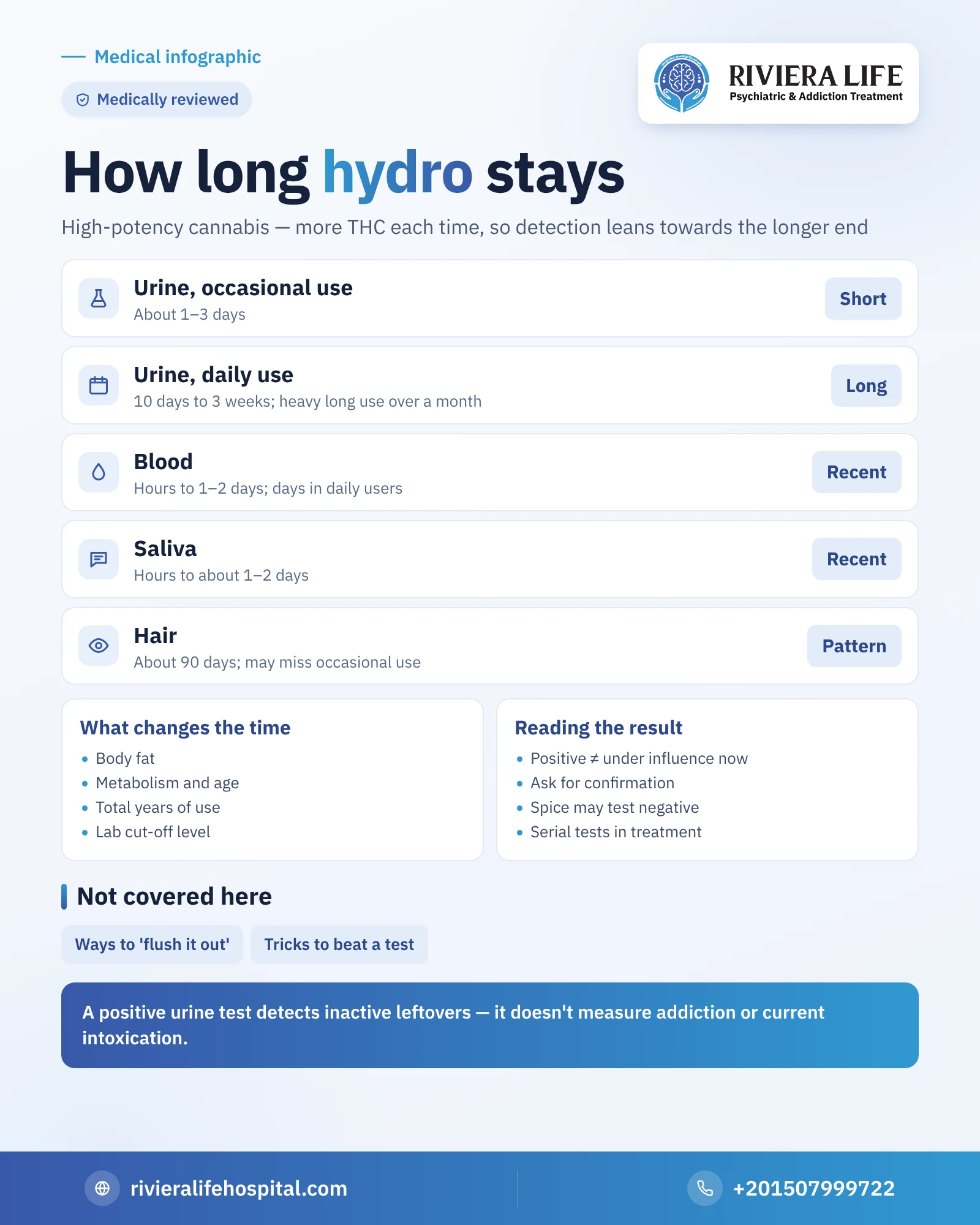
How long hydro stays in the body isn’t a single number, but a range determined by the type of test and the pattern of use. Roughly, it may show in urine for one to three days after occasional use, extend to two weeks or more with daily use, and may exceed a month in someone who has smoked it heavily for a long time.
Blood and saliva detect it for hours to a few days, and hair carries its trace for about three months. The reason hydro specifically leans towards the longer end of these ranges is the high concentration of the active substance in it, and the pattern of repeated use that usually accompanies it. In this article we explain this in detail, the factors that lengthen or shorten the period, and the limits of what a test can say.
What is hydro and why does its concentration matter?
“Hydro” is a name used in Egypt for cannabis flowers grown hydroponically in enclosed spaces, with controlled lighting and fertilization that raise the proportion of tetrahydrocannabinol (THC) in the plant. So it is high-potency marijuana, not a new substance. What matters for testing is that each time of use puts a larger amount of THC into the body compared with the weaker traditional types, and the larger the amount, the more is stored and needs time to leave. You will find the definition of hydro and how addiction to it develops in our article on hydro addiction.
How does hydro stay in the body?
After smoking, THC reaches the blood within minutes, then spreads quickly to the tissues, especially fatty tissue because it dissolves in fat. The liver turns it into products, the most important being a compound abbreviated THC-COOH, which is what most urine tests look for. With repeated use the fat stores fill, so they release the substance slowly into the blood for days and weeks after the last time. That is why the trace of cannabis stays much longer than that of stimulants or opioids, and why the period differs radically between someone who tried it once and someone who smokes every day.
How long hydro stays in urine
The urine test is the most widely used in laboratories, at work and in treatment programs. The following ranges are approximate, taken from general laboratory references for cannabis, and individual cases may fall outside them:
| Pattern of hydro use | Approximate detection window in urine |
|---|---|
| Once or rarely | About one to three days |
| Several times a week | About five to seven days |
| Daily | About ten days to three weeks |
| Daily and heavily for months or years | May exceed a month |
With hydro, reality tends towards the upper end of each range, because the amount taken in each time is larger.
How long hydro stays in the blood
THC rises quickly in the blood after smoking then falls within hours. With occasional use it can usually be detected for a few hours up to a day or two, but in a daily hydro smoker a low measurable level may remain for several days because of what leaks from the stores. Blood testing is mostly used in emergencies or accidents, because it comes closest to estimating recent use.
How long hydro stays in saliva
A saliva test detects what remains of the substance in the mouth after smoking, and its window is short: from hours to about a day or two, and may be a little longer with heavy use. Its advantage is that it is done in front of the person directly, and its drawback is that it doesn’t reflect the long-term pattern.
How long hydro stays in hair
THC products enter hair as it grows, and the usual sample close to the scalp reflects about ninety days. But hair testing is less sensitive to cannabis than to some other substances, may not detect rare use, and doesn’t reveal the last days before the sample was taken. That is why it is used to assess an extended pattern, not to answer the question “did he use yesterday?”.
In practice the doctor chooses the type of test according to the question being asked: urine to know about use in the last days or weeks, blood or saliva for very recent use, and hair for the pattern over months. No single test answers every question.
Why may hydro stay longer than ordinary hashish?
Not because the plant is chemically different, as the substance is the same. The difference is in the amount and the pattern. Higher potency means a bigger dose of THC in each cigarette, and with tolerance the user increases the amount further. Hydro users also often use it daily or several times a day, and this is the biggest factor in lengthening the period. Someone who smokes hydro once a month may be negative within days, and someone who smokes ordinary hashish every day may stay positive for weeks. For a full comparison of cannabis types and their tests, you can read how long marijuana stays in the body.
Other factors that change the period
- Body fat percentage: bodies with more fat store a larger amount and release it slowly.
- Metabolic speed, age and health: the liver’s ability to convert and eliminate differs from person to person.
- Total duration of use: years of use differ from weeks, even with the same daily amount.
- The laboratory cut-off: each test has a minimum concentration it considers positive, and the result may differ between two laboratories.
- Route of use: smoking, edibles and concentrates differ in the amount that reaches the body.
And you won’t find here any talk of ways to “speed up elimination” or cheat a test; they either have no evidence, are detected in the laboratory, or harm the body.
When hydro is adulterated
Some of what is sold as hydro may be herbs sprayed with synthetic cannabinoids of the spice and strox class, to seem stronger. These substances usually don’t show in the usual hashish test, so the result may come back negative despite clear symptoms, or weakly positive in a way that doesn’t explain the severity of the condition. And if the symptoms are more violent than expected from cannabis, such as seizures or severe agitation, it may be synthetic cannabinoid poisoning. You will find an example of these products in our article on the joker drug.
A positive result doesn’t mean he is under the influence now
A urine test detects inactive products that can stay for weeks after the effect has completely gone. So a person may be completely sober with a positive test, and may genuinely have stopped days ago. And the reverse too: a test alone doesn’t measure the degree of addiction or determine the amount used. What determines that is the doctor, through the medical history, the symptoms and the sequence of tests.
False positives and confirmatory testing
A rapid test relies on an immune reaction that may rarely be affected by some medicines, which is why its result is treated as preliminary. And if the result has important consequences at work, in court or in family relationships, the right thing is to request a confirmatory test with precise laboratory techniques, and tell the laboratory about all the medicines the person takes. Pure cannabidiol (CBD) products don’t usually cause a positive result, but some uncontrolled products may contain THC.
The role of testing in the treatment journey
In treatment programs testing isn’t used for punishment, but to follow progress. With a heavy hydro user the result may remain positive for weeks after genuinely stopping, so the doctor follows the gradual fall in concentration with successive tests instead of relying on a single result. This protects the patient from an unfair accusation, and at the same time reveals any return to use. You will find the full steps of treatment in our article on marijuana addiction treatment.
If you are a father or mother holding a test result and don’t know how to read it, the Riviera Life team can explain it to you in a confidential, free consultation, and determine the next step.
More from our marijuana guide
- Marijuana: the complete guide
- Hydro addiction
- The harms of hydro
- How long marijuana stays in the body
Questions many people ask
About one to three days after occasional use, and it may extend to weeks with daily use, and sometimes more than a month with heavy long-term use.
The active substance is the same, but its higher concentration in hydro and its pattern of repeated use usually make the period lean towards the longer end.
Yes, for hours to a day or two after occasional use, and a low level may remain for several days in a daily user.
Not necessarily. A urine test detects inactive products that may stay for weeks after the effect has gone, and it is read in light of the history and symptoms.
The use may have been old or small, or the product may have been adulterated with synthetic cannabinoids that the usual hashish test doesn't detect.