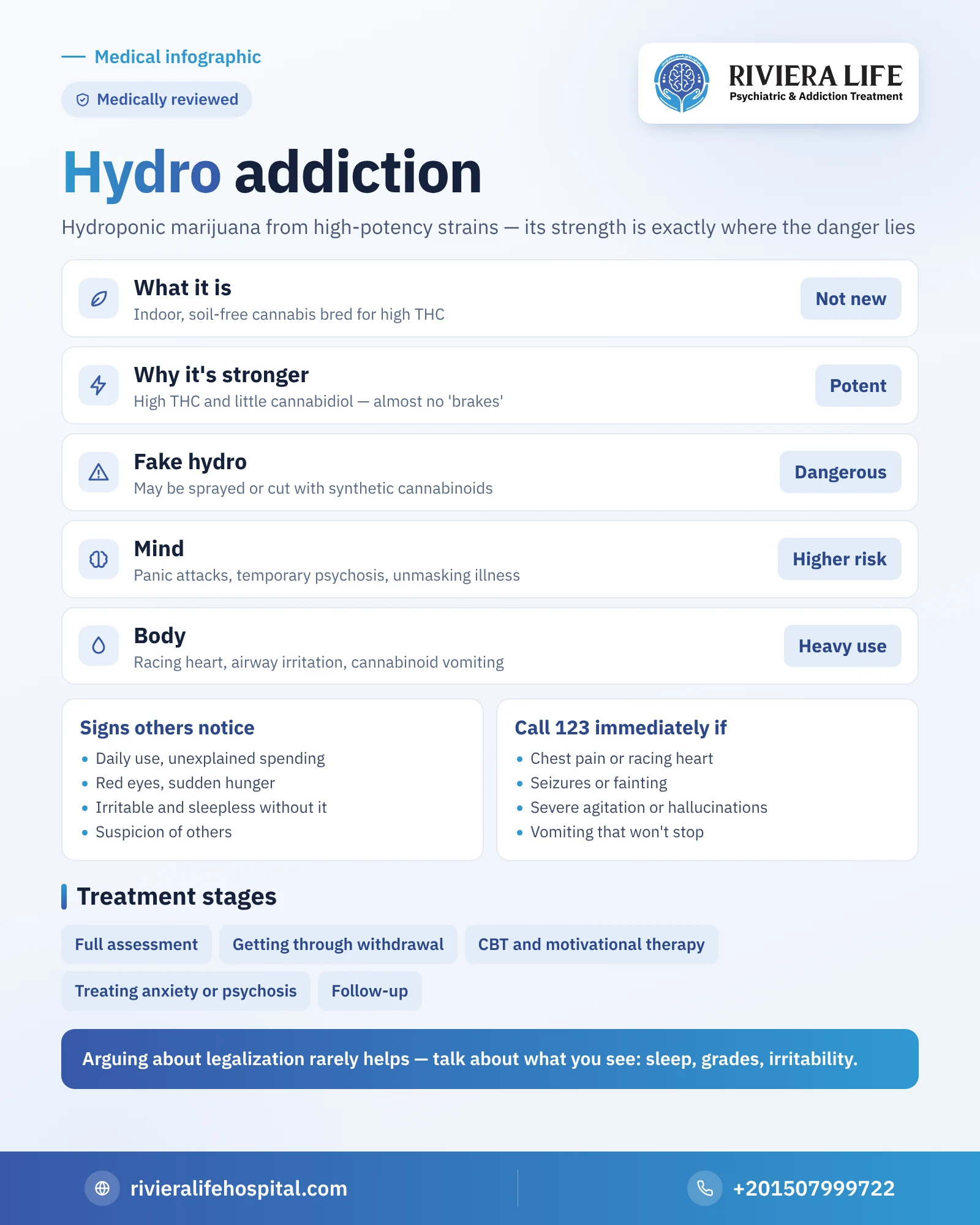
“Hydro” is a street name for a type of marijuana grown hydroponically indoors, without soil, under calculated lighting and feeding, from strains selected to give a high concentration of THC. That is why it is described as “cleaner” and “stronger” than ordinary bango, and sold at a higher price. But the strength of the substance is exactly the source of the danger: the higher the THC concentration, the greater the likelihood of addiction, panic attacks and psychosis. In this article we explain what sets hydro apart, how the signs of hydro addiction show, what its particular harms are, and how it is treated, referring to the core cannabis pages instead of repeating them.
What exactly is hydro?
Hydro is short for “hydroponic”, meaning water-based cultivation. The substance itself is the dried flowers of the cannabis plant — marijuana — and the difference is in how it is produced: roots in a nutrient solution, artificial lighting and controlled growth cycles, and the selection of female plants from high-potency strains. The result is dense buds glistening with resin, and on average a higher THC concentration than traditionally grown cannabis.
The general introduction to the plant, its components and its effect on the brain is on our marijuana page; the difference between it and crumbled leaves is on our bango page; and the pressed resin is on our hashish page.
Is hydro really stronger than hashish and bango?
Usually yes, in terms of THC concentration, although the strength varies from one batch to another and can’t be judged by appearance. More importantly, hydro usually contains only a small proportion of cannabidiol, the compound that may soften some of THC’s psychological effects. In other words, the user gets a concentrated dose of the substance that causes addiction and psychosis, with almost no “brakes”.
And there is an extra problem in the local market: what is sold as hydro isn’t always hydro. It may be ordinary cannabis sprayed with substances or mixed with synthetic cannabinoids resembling Spice, which are far more dangerous. The most important warning sign is an unusually intense effect after smoking, such as strong palpitations, agitation or seizures.
How does hydro use turn into addiction?
Concentrated doses raise tolerance quickly. A young man who started with a joint at the weekend finds himself months later needing more than once a day to feel the same thing, and then sleep, eating and coping with stress all become conditional on smoking. When he tries to stop, he faces irritability, insomnia and a pressing craving that quickly brings him back. A person is more vulnerable if they started in adolescence, have anxiety or depression, or are in a circle that uses regularly.
Signs of hydro addiction that people around you notice
- Smoking daily or several times a day, with growing spending that is hard to explain.
- Red eyes, sudden hunger, slow speech and laughing for no reason under the influence.
- Irritability, insomnia and loss of appetite if getting it is delayed.
- Falling behind in study or work, and losing interest in what they used to enjoy.
- Suspicion of others, or a feeling that people are watching them.
- Constantly justifying it as “a natural plant” and “lighter than cigarettes”.
The harms of hydro linked to its strength
On the mind
The high concentration increases the likelihood of panic attacks and temporary psychosis, and it may unmask a hidden psychotic illness in those who are predisposed. Daily use of high-concentration cannabis is linked to a clearer increase in the risk of psychosis than weaker types. If suspicion appears, read hashish addiction and suspicion.
On memory and motivation
Poor concentration and short-term memory, slower learning and loss of enthusiasm — effects that are more severe in those who started at an early age.
On the body
A racing heart after smoking, and irritation of the airways. With long-term heavy use, cannabinoid hyperemesis syndrome may appear: bouts of repeated vomiting and severe abdominal pain that ease temporarily with hot showers, and that only stop when cannabis stops.
When is it an emergency?
Call an ambulance immediately (123 in Egypt) if you see
After smoking hydro — especially if the source is unknown or it may be mixed with synthetic cannabinoids — call an ambulance if you see:
- Chest pain or severe palpitations that won’t settle
- Seizures or loss of consciousness
- Severe agitation, hallucinations or suspicion with dangerous behavior
- Repeated vomiting that won’t stop, with signs of dehydration
- Thoughts of self-harm or attempts at it
What happens when you stop hydro?
Many people go through withdrawal symptoms that usually start within one to three days, the most prominent being irritability, insomnia, disturbing dreams, poor appetite and pressing craving; they ease gradually over about two weeks, while sleep disturbance may last longer. The details of the stages are in marijuana withdrawal symptoms, which apply to hydro, with a tendency to be more severe in those used to high doses.
The stages of hydro addiction treatment
A comprehensive assessment
The amount and length of use, any other substances, and the presence of anxiety, depression or psychotic symptoms, with testing that helps show whether synthetic cannabinoids are involved.
Getting through withdrawal
Monitoring insomnia, irritability and vomiting if present, and using medicines for a short period to treat specific symptoms as the doctor judges. There is still no medicine approved specifically for cannabis addiction.
Psychotherapy
Cognitive behavioral therapy and motivational interviewing are the foundation, focusing on daily triggers and alternative ways of dealing with boredom, stress and using friends.
Treating accompanying disorders and follow-up
Treating anxiety, depression and psychosis if present, then regular follow-up and a relapse-prevention plan with the family’s involvement. The detailed picture of the treatment path is in marijuana addiction treatment.
Can hydro addiction be treated at home?
Some cases improve with a regular outpatient program if the person is motivated, isn’t using other substances and has no psychotic symptoms. An inpatient stay is better when there is suspicion or hallucinations, mixing with other substances, repeated vomiting, failed previous attempts, or an environment full of drug use.
How should a family deal with a son who uses hydro?
Many young people defend hydro passionately and point to countries that have legalized cannabis. Arguing about legalization usually doesn’t help. It works better for the family to talk about what they see with their own eyes: disturbed sleep, falling grades, and irritability when the drug runs out. Choose a calm time away from the effect, set clear limits on money and late nights, and suggest a single assessment visit instead of demanding an immediate stop. And if suspicion or strange ideas appear, the assessment can’t be postponed.
The right hospital for hydro addiction: how to choose
The right hospital for treating hydro addiction is one that deals with the dangers of the high concentration — psychosis and severe anxiety — and not just with the urge to smoke. Ask:
- Do they assess psychotic symptoms and anxiety linked to high-concentration cannabis?
- Can they detect synthetic cannabinoids if the product was adulterated?
- Do they deal medically with repeated vomiting and dehydration?
- Do they offer cognitive behavioral and motivational therapy suited to young people?
- Do they involve the family and set a follow-up plan after discharge?
And beware of promises of guaranteed cure rates or treatment completed in a few days.
Why Riviera Life for hydro addiction treatment?
These standards are what Riviera Life offers, in detail:
- Licensed by the Ministry of Health: a hospital licensed for psychiatry and addiction treatment.
- Consultants in psychiatry and addiction: they detect and treat the psychosis and anxiety linked to concentrated cannabis.
- Round-the-clock supervision: during withdrawal, panic attacks and repeated vomiting.
- Structured psychotherapy: a cognitive behavioral and motivational program targeting daily smoking habits.
- Fourteen years of experience: during which thousands of patients have recovered from hashish, marijuana and other substances.
- Complete confidentiality: protecting the young person’s academic and professional future.
- The family and aftercare: a program for parents, and follow-up after discharge.
Your first consultation about hydro is free, our line +201507999722 works all day, and we are in Sheikh Zayed, Giza.
Read also
- Marijuana: the complete guide
- How long marijuana stays in your system
- How to deal with someone addicted to hashish
- Cannabidiol (CBD) addiction treatment
- How long hydro stays in your system: urine, blood, saliva and hair, and why it lasts longer
- The harms of hydro: why high potency raises the risk of psychosis and addiction
Questions many people ask
It is marijuana grown hydroponically indoors from high-potency strains, so it usually contains a higher concentration of THC. It isn't a new substance — it is stronger cannabis.
Usually yes, because of its high THC and low cannabidiol, which increase the likelihood of addiction, panic attacks and psychosis. The danger grows if the product is cut with synthetic cannabinoids.
They usually start within one to three days and ease gradually over about two weeks, although sleep disturbance may last longer. Medical and psychological support makes this period easier and reduces relapse.
Yes. Many people recover with psychotherapy, treatment of accompanying anxiety or depression, and follow-up. Memory and concentration improve gradually after stopping in most people in recovery.
Psychiatry and addiction treatment together, to detect the psychosis and anxiety linked to concentrated cannabis, with round-the-clock supervision and a family program. Riviera Life in Sheikh Zayed offers these, and the first consultation is free.