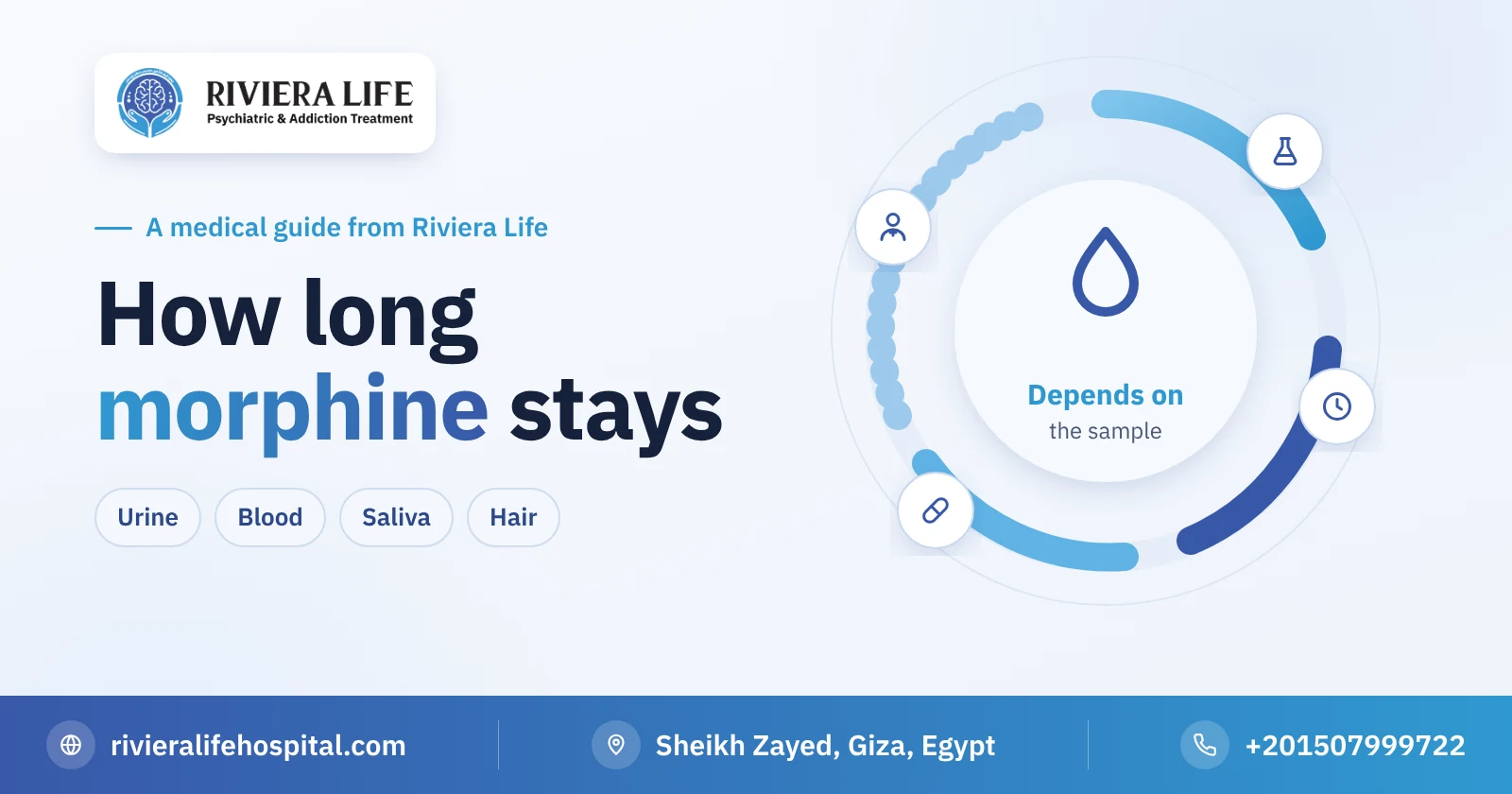
How long morphine stays in the body differs by sample; it usually stays in urine for about two to three days after the last dose, appears in blood for only hours, in saliva for a period that may reach a day or two, while hair keeps it for up to about three months.
This is the short answer to a question that reaches us in different forms: an employee taking a painkiller after surgery who is waiting for a work test, a father who wants to understand the result of a home strip, and a patient who fears their result will be misinterpreted. But these figures change with the form of the medicine, the duration of use and the state of the kidneys, and a positive result itself may have more than one source. We explain all of this in detail here.
Morphine’s journey inside the body
After morphine enters the blood it reaches the brain and starts working, then the liver converts most of it into two main compounds that bind to a substance called glucuronic acid. One of the two compounds is inactive in relieving pain, and the other is active and contributes to the effect. The kidneys then excrete these compounds in urine, along with a small amount of unchanged morphine.
The half-life of morphine in the blood is a few hours, meaning half the amount disappears from the blood in that time. But the compounds derived from it stay in urine longer, and they are what most tests actually detect. That is why morphine disappears from the blood quickly, while it keeps showing in urine for days.
This also explains why the time of effect doesn’t match the time of detection in a test. A person may have been completely out of morphine’s effect for two days, while its products are still in their urine. The reverse is also true: they may be clearly under the effect after a recent injection, while the urine needs some time for the products to concentrate in it.
How long morphine shows in each type of test
Urine test
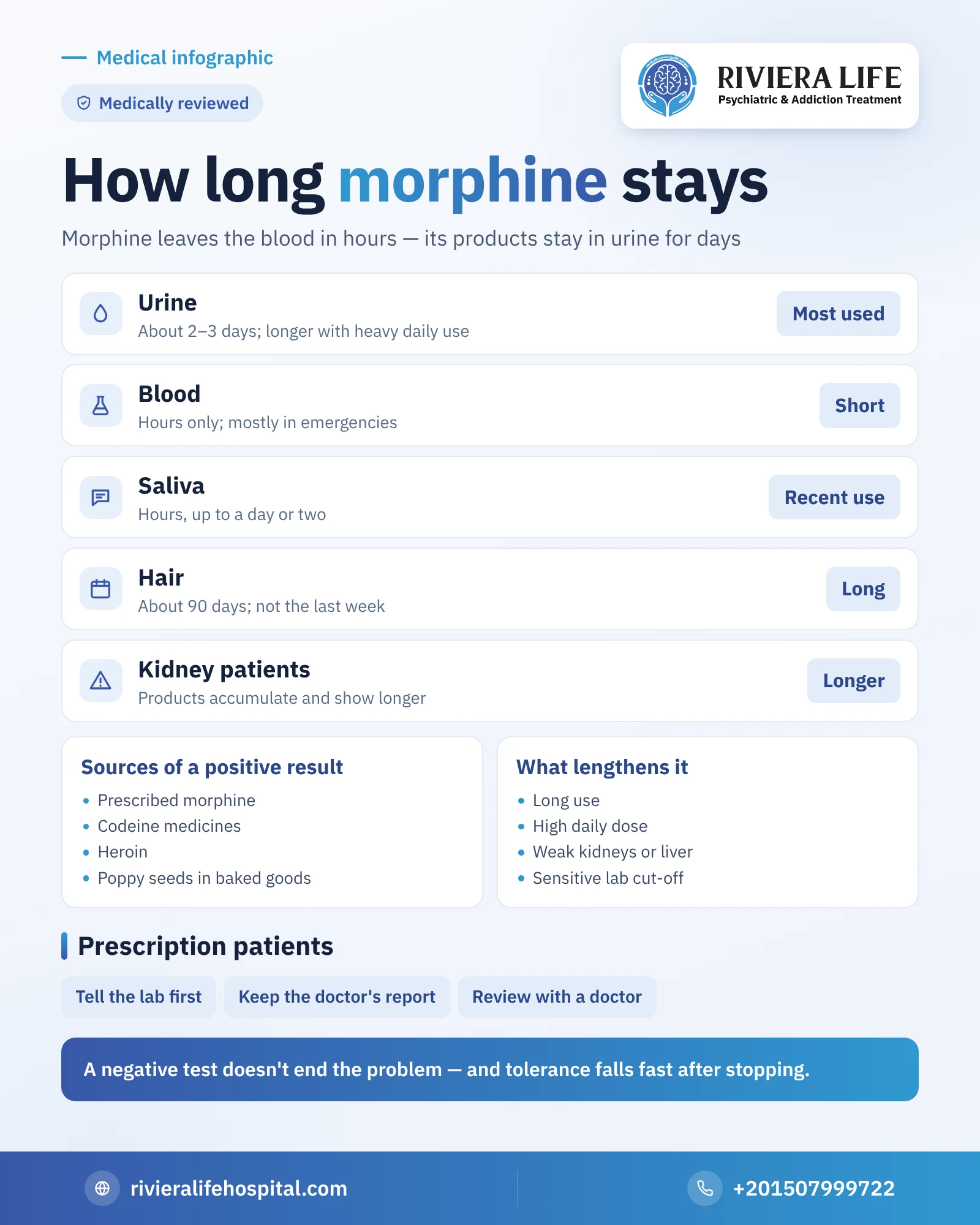
This is the most widespread in work, hospital and treatment center testing. Morphine and its products usually show in it for two to three days after the last dose, and the period may be longer in someone who has used large amounts daily for a long time.
Blood test
Its window is short, counted in hours. That is why it is mostly requested in emergencies to assess an unconscious patient or someone suspected of an overdose, or to monitor the level of the medicine in particular patients, not to detect use that happened days earlier.
Saliva test
It detects recent use, within hours and possibly up to a day or two. Its advantage is that the sample is taken in front of the person responsible for the test, so it is hard to tamper with.
Hair test
It keeps a trace of morphine longer than any other sample; the part close to the scalp reflects roughly ninety days. But it isn’t suitable for detecting use in the last week, because hair needs days to grow out of the skin.
Does the period differ between injections and tablets?
Yes, although the difference isn’t large in urine. An intravenous injection reaches the blood completely and quickly, then the journey of eliminating it starts immediately. Extended-release tablets, however, release the substance over many hours, so the countdown to its leaving the body starts later compared with an injection or a fast-acting tablet. The practical rule is that the count starts from the last moment morphine entered the blood, not from the moment the tablet was swallowed.
Factors that lengthen or shorten the period
- Duration of use: someone who has taken morphine for months differs from a patient who had one injection after an operation.
- Daily dose: larger amounts need longer to be eliminated.
- Kidney function: the main route for morphine’s products to leave, and any weakness slows their exit.
- Liver function: affects how fast morphine is converted into its products.
- Amount of fluids: affects the concentration of the substance in urine at the moment the sample is taken.
- Accuracy of the testing device: the detection cut-off differs from test to test, so the laboratory may detect morphine while a home strip doesn’t show it.
Kidney patients and older people
In a patient with kidney failure, morphine’s products accumulate in the blood, so they show in tests for longer, and drowsiness, confusion and side effects may increase with them even at normal doses. That is why doctors choose lower doses or other painkillers for these patients. The same applies to a lesser degree to older people, because kidney efficiency gradually declines with age.
Screening tests and confirmatory tests
Rapid strips and the first laboratory screen look for the group of opioids close in structure to morphine, and they are sensitive to morphine in particular because it is the substance they were designed around. But their result remains preliminary. A confirmatory test using chromatography coupled with mass spectrometry identifies the substance by name and measures its concentration, and can distinguish morphine from codeine and from the heroin-specific marker. You will find a comparison with the detection windows of other opioids in our article on how long opioids stay in the body.
Are home strips accurate?
A home strip is a screening tool, not a diagnostic tool. Its accuracy in detecting morphine is acceptable if it is used at the right time and read after the period stated in the instructions, but it may give a negative result if the amount in urine is below the detection cut-off, or a positive result because of a medicine containing codeine. A strip also tells you nothing about the amount, the timing or the presence of addiction. If you are going to use it within the family, consider its result the start of a question, not its end, confirm any positive result in a laboratory, and don’t let a strip replace a calm conversation and a medical assessment.
Where does morphine in a test come from?
Morphine showing in a sample doesn’t determine its source; it may come from:
- Medically prescribed morphine after surgery or for treating chronic pain.
- Medicines containing codeine, because the body converts part of it into morphine.
- Heroin, which turns into morphine inside the body within a short time. Details are in our article on how long heroin stays in the body.
- Poppy seeds in some baked goods and sweets, which may raise morphine in urine for hours without any narcotic effect.
If you take morphine on prescription
Tell the laboratory or the body requesting the test about the medicine before the sample is taken, and keep a copy of the prescription or the doctor’s report. A positive result in this case is expected, and doesn’t mean misuse. If the test is for an employer, you have the right to review the result with a doctor who can interpret it in light of your treatment.
Can morphine’s exit from the body be sped up?
There is no medically proven way to do this. The home recipes that circulate don’t change how fast the liver and kidneys work, and some may cause harm; laboratories also detect diluted or tampered samples and consider them invalid. Time alone removes morphine, and what happens to the brain afterwards matters more than its exit.
A negative test doesn’t mean the problem is over
The test may become negative within days, while intense craving and disturbed sleep and mood continue for weeks or months. Withdrawal symptoms start at roughly the same time morphine leaves the body; details are in our article on morphine withdrawal symptoms. Most dangerous is that the body’s tolerance falls quickly after stopping, so if the person returns to the amount they were used to, it may be enough to depress their breathing.
How are tests used during treatment?
In treatment programs, periodic tests are done not to punish, but to follow stability, adjust medicines and detect relapse early, and they give the patient and their family tangible evidence of progress. At Riviera Life, results are always interpreted in the context of the whole case, taking any prescribed medicine into account. You can read about the stages of treatment in our article on morphine addiction treatment.
More from our morphine guide
- Morphine: the complete guide
- Morphine addiction symptoms
- The harms of morphine
- Morphine withdrawal symptoms
Questions many people ask
Usually about two to three days after the last dose, and the period may be longer in someone who uses large amounts daily or has weak kidney function.
It may show if the test is done in the following few days. Tell the body responsible for the test about the treatment and keep the doctor's report, as the result in this case is expected and justified.
The rapid strip doesn't distinguish between them, because heroin turns into morphine. The confirmatory laboratory test looks for a heroin-specific marker that appears for only a few hours after use.
Yes, because the kidneys excrete morphine's products; if they are weak these products accumulate and show for longer, and side effects may increase with them, so the doctor adjusts the dose or chooses an alternative.
Usually yes, as a hair test reflects roughly three months before the sample is taken, but it doesn't detect use that happened in the last few days.