“How many days does heroin show in a test?” is a question about how long heroin stays in the body that reaches us often, sometimes from someone waiting for a work test or a premarital test, and sometimes from a mother who found a home test strip in her son’s room and doesn’t know how to read its result. The short answer: heroin usually shows in a urine test for one to three days after the last use, the period may be longer with heavy, repeated use, and it shows in a hair test for up to about three months.
But numbers alone aren’t enough to understand the result, because what the test actually detects is usually not heroin itself, but what it turns into inside the body. This article explains that in detail, when a positive result is inaccurate, and what the test can’t tell you.
What happens to heroin inside the body?
Heroin is a substance that changes very quickly. Within a few minutes of entering the blood it turns into an intermediate substance called “6-monoacetylmorphine” (6-MAM), then this substance in turn changes within a short time into morphine. Morphine is responsible for most of the effect, and it stays in the body much longer, until the liver processes it and most of it leaves with the urine.
This short chain explains two important things. The first is that heroin itself is rarely detected in tests because it disappears quickly. The second is that the presence of morphine alone in the test doesn’t necessarily mean the person used heroin; morphine may come from a prescribed medicine, from codeine or even from food, as we will see. The intermediate substance 6-MAM is the fingerprint specific to heroin, because it results from almost no other source, but it remains for only a few hours.
How long heroin shows in each type of test
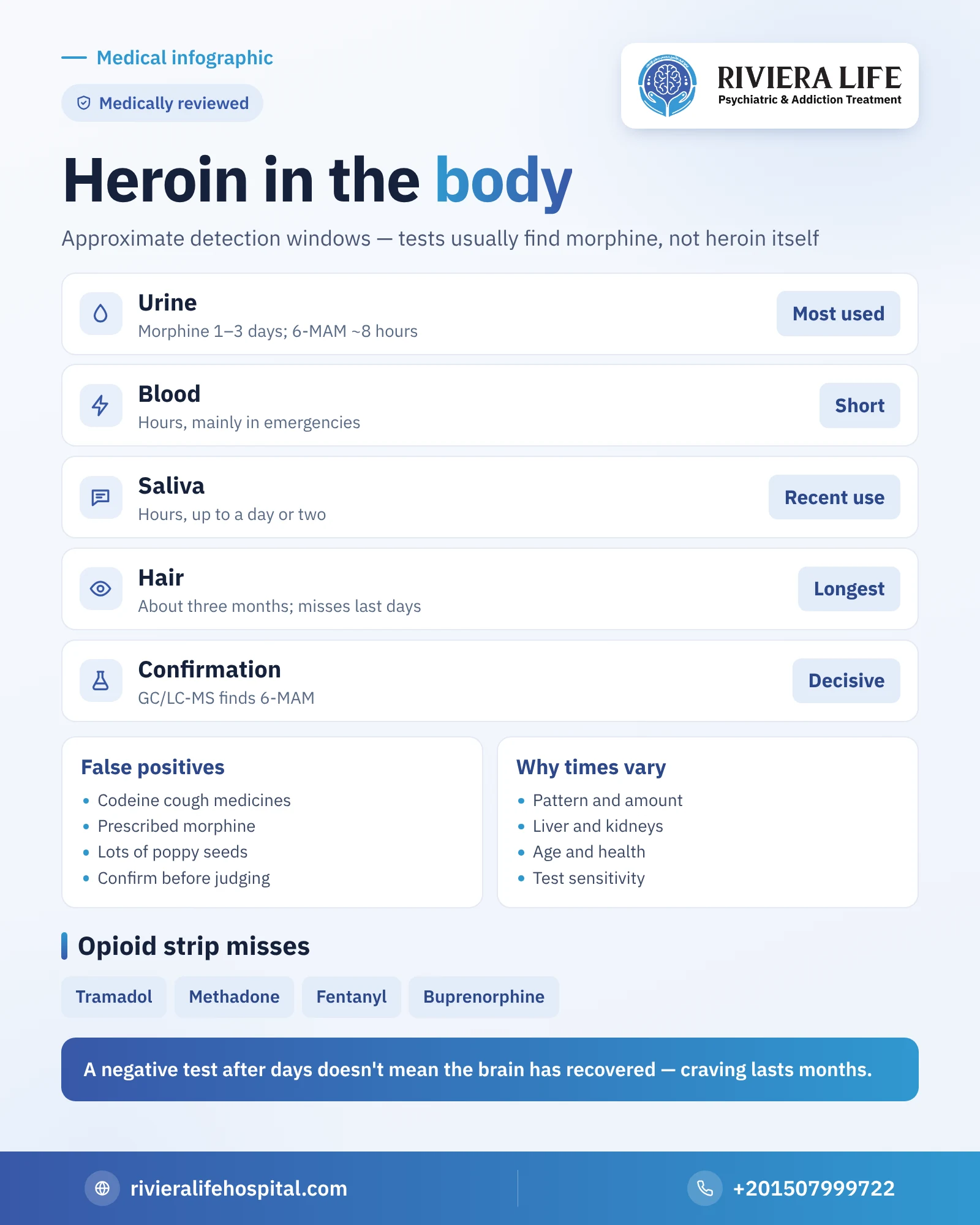
The period differs according to the sample tested, and these are the generally recognized approximate windows:
Urine test
The most used in Egypt and the world. The morphine produced from heroin usually shows in it for one to three days after the last dose, and may extend a little longer in someone who has used large amounts daily for a long time. The heroin-specific substance (6-MAM) usually only shows in urine during the first hours, within about eight hours.
Blood test
Its window is short, measured in hours, not days. It is mostly used in emergency departments and hospitals to assess the state of someone unconscious or suspected of an overdose, more than to detect previous use.
Saliva test
It detects recent use, within hours and possibly up to a day or two. It is distinguished by the ease of taking the sample in front of the person responsible for the test, but it is less widespread than the urine test.
Hair test
It has the longest window. Substances are deposited in hair as it grows, which is why the part close to the scalp (about four centimeters long) reflects roughly the last three months. But it doesn’t detect use that happened in the last few days, because hair needs time to grow above the surface of the skin.
Why does the period differ from person to person?
The previous numbers are averages, and may be shorter or longer depending on several factors:
- Pattern of use: someone who has used daily for months is completely different from someone who used once.
- Amount and purity of the substance: a larger amount needs longer to get rid of.
- Efficiency of the liver and kidneys: any weakness in their functions slows morphine’s exit from the body.
- Age and general health: metabolism slows with age and with chronic illnesses.
- Fluid intake and urine concentration: they affect the concentration of the substance in the sample at the moment it is taken.
- Sensitivity of the test itself: each device detects heroin above its own minimum level, so a lab result may confirm what a home strip doesn’t show.
Screening tests and confirmatory tests
Most rapid tests, whether home strips or the first test in the lab, rely on an immune reaction that looks for a group of substances similar in structure, not for one particular substance. That is why their result is called “preliminary”. If it comes back positive, the right step is a confirmatory test with more precise equipment such as chromatography coupled with mass spectrometry, which identifies the substance by name and measures its concentration, and can look specifically for 6-MAM to distinguish heroin from other sources of morphine.
And here is a point that often causes confusion: the ordinary “opioids” or “morphine” strip is designed to detect morphine and similar substances, and doesn’t reliably detect manufactured opioids such as tramadol, methadone, fentanyl and buprenorphine. Each of them has its own strip or test. So a negative opioid strip result doesn’t mean the person hasn’t used any opioid substance. You will find the detection times of these substances in the article on how long opioids stay in the body.
When is a positive result inaccurate?
Morphine may appear in urine without any heroin use in known cases:
- Taking medicines containing codeine, such as some cough medicines and painkillers, because codeine partly turns into morphine.
- Treatment with morphine or other medically prescribed opioid medicines.
- Eating a large amount of baked goods or sweets containing poppy seeds, which may raise morphine in urine for hours without having any narcotic effect.
That is why it is always advised to tell the lab about any medicines the person takes before the test, and not to judge the result of a preliminary strip before confirmation. The presence of 6-MAM in the confirmatory test is what settles that the source is heroin.
What can’t the test tell you?
The test answers one question: is the substance present in the sample above a certain level? But it doesn’t determine precisely when the use happened, its amount, whether the person is an addict or used once, or whether they were under the influence at the moment the sample was taken. Diagnosis needs a full medical and psychological assessment including history, symptoms and behavior, and the test is part of this picture, not the whole picture. To learn the signs that deserve attention alongside the test, see the article on heroin addiction symptoms.
Advice for the family before using a home test
A home strip is a useful tool if used calmly and within a plan, but it may turn into a source of clashes if used as a trap or a means of accusation. Before you turn to it, think about what you will do with the result, whatever it is. A positive result deserves confirmation in a lab, then a calm conversation and asking for specialist advice, and a negative result doesn’t necessarily mean everything is fine if there are other worrying signs. Most importantly, the goal isn’t to “catch” your son, but to get him to treatment. You will find practical ways to manage this conversation in the article on how to deal with a heroin addict.
Heroin leaving the body doesn’t mean the addiction is over
Many think the goal is to “clean the body” until the test becomes negative. But the absence of the substance from urine after days doesn’t mean the brain has recovered. The changes heroin caused in the reward and craving system continue for months, and they are what lead to relapse. Withdrawal symptoms also start within hours of the last dose and peak in the first days, roughly the same period in which morphine shows in the test, then longer symptoms such as insomnia, anxiety and urgent craving continue after it. The details of these stages are in the article on heroin withdrawal symptoms.
Among the most dangerous things the family must know is that the body’s tolerance of heroin falls quickly after stopping for days or weeks. If the person goes back to the amount they were used to before stopping, it may be enough to stop their breathing. That is why the period after leaving treatment, prison or any break is among the highest-risk periods for overdose.
Can the body be cleaned of heroin quickly?
The frank answer: there is no safe shortcut. The drinks, herbs and supplements promoted online with the promise of getting heroin out of the body aren’t backed by scientific evidence, and some of them strain the kidneys or disturb the blood’s salts. The substance breaks down and is excreted at a rate set by the body itself and with the passage of time after the last use.
More importantly, someone dependent on heroin doesn’t face a problem with the test as much as they face a body used to the substance. Stopping suddenly at home exposes them to a painful withdrawal that may push them to go back, and perhaps to a more dangerous dose after their tolerance has fallen.
- The myth: a drink or recipe that cleans the blood in days.
- The reality: nothing replaces the passage of time after stopping.
- The myth: stopping alone at home is the fastest solution.
- The reality: detox under medical supervision is safer and more successful.
The right step is a medical assessment then an organized detox followed by treatment that treats the dependence itself; you will find the stages in the article on heroin addiction treatment, and what the patient can expect in the first days in the article on heroin withdrawal symptoms.
How are tests used during treatment?
In treatment programs urine tests are used periodically, but they aren’t meant as punishment. They help the medical team follow stability, adjust medication treatment, and detect relapse early before it worsens, and they give the patient and family tangible evidence of progress that gradually rebuilds trust. These tests are done according to procedures that ensure the integrity of the sample and the accuracy of the result. You can learn about the full stages of treatment in the article on heroin addiction treatment.
Signs of overdose
Call an ambulance on 123 immediately if you see
Especially if the person has gone back to using after a period of abstinence.
- Loss of consciousness and no response to calling
- Very slow, irregular or stopped breathing
- Blue lips and nails
- Very narrow pupils
For the full picture of heroin, its forms and effect, go back to the heroin page, and for the harms it leaves on the body over time see the article on the harms of heroin.
Questions many people ask
The morphine produced from heroin usually shows in urine for one to three days after the last use, and the period may be slightly longer with heavy daily use. The heroin-specific substance (6-MAM) shows only in the first hours.
A hair test usually reflects roughly the last three months, but it doesn't detect very recent use in the last few days.
Yes, this may happen with cough medicines and painkillers containing codeine, morphine treatment, or eating a large amount of poppy seeds. That is why any positive screening result must be confirmed by a confirmatory lab test.
No, the ordinary opioid strip is designed to detect morphine and similar substances, and doesn't reliably detect tramadol, methadone or fentanyl; each has its own test.
No, the test may become negative after days, but the changes in the brain and the urgent craving continue for months, which is why recovery needs treatment and follow-up, not just waiting for the substance to leave.