Opioid withdrawal symptoms usually start hours after the last dose for short-acting substances such as heroin and morphine, and after one to two days or more for long-acting substances such as methadone. Symptoms peak on roughly the second or third day, and most calm within one to two weeks, while insomnia, anxiety and strong craving may continue for weeks or months. Withdrawal is painful but rarely threatens the life of a healthy person if medically managed; the real danger lies in dehydration, complications, and returning to use with a body that has lost its tolerance. Here we explain why withdrawal happens, its stages, how it differs between types of opioids, and when it needs urgent intervention.
Why do withdrawal symptoms happen?
Throughout the period of use, the brain tries to balance the calming effect of the opioid, so it raises the activity of stimulating systems, most importantly a center in the brainstem that releases noradrenaline. As long as the opioid is present, the balance holds. When it suddenly disappears, the stimulating system stays raised with nothing to restrain it, and something like a nervous storm appears: sweating, chills, a racing heart, tension and insomnia. At the same time, the bowel regains its movement violently after a long slowdown, bringing diarrhea and cramps. That is why withdrawal symptoms mostly look like the exact opposite of the opioid’s effects.
Opioid withdrawal symptoms
Physical symptoms
- Repeated yawning, a runny nose and tears.
- Sweating and chills with goosebumps.
- Dilated pupils.
- Pain in the muscles, bones and back, and restless legs.
- Nausea, vomiting, cramps and diarrhea.
- A fast pulse and a slight rise in blood pressure.
Psychological symptoms
- Anxiety, tension and irritability.
- Severe insomnia that makes sleep difficult even with exhaustion.
- Low mood and loss of enjoyment.
- A strong craving for the substance that occupies all thinking.
The timeline of opioid withdrawal
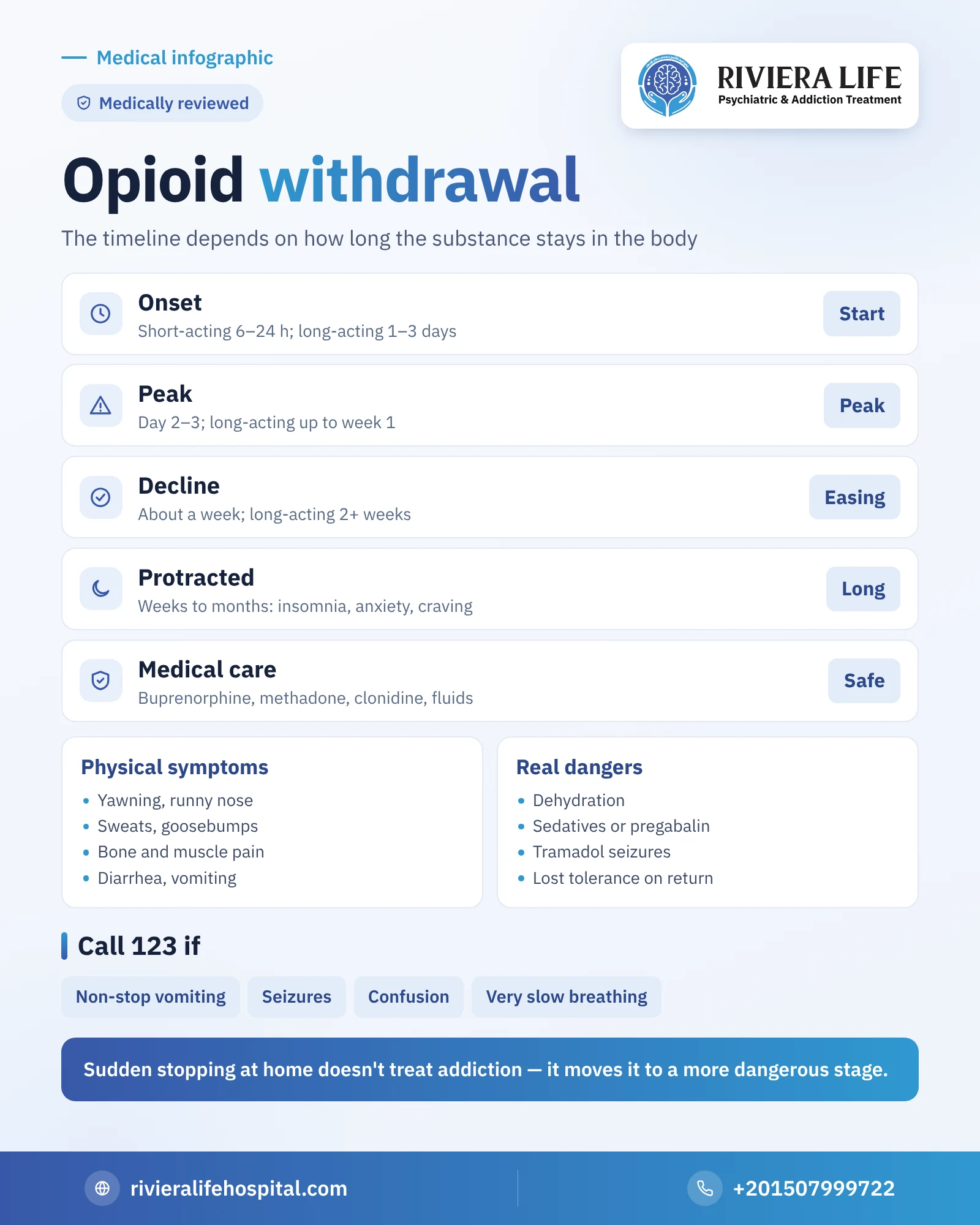
The timing depends mainly on how long the substance stays in the body. This table gives an approximate picture:
| Stage | Short-acting opioids | Long-acting opioids | What happens |
|---|---|---|---|
| Onset | Within roughly 6 to 24 hours | Within roughly one to three days | Yawning, runny nose, anxiety and craving |
| Peak | Day two to three | May be delayed to the first week | Pain, vomiting, diarrhea and severe insomnia |
| Decline | Within about a week | May extend two weeks or more | Physical symptoms gradually calm |
| Protracted stage | Weeks to months | Weeks to months | Insomnia, anxiety, mood swings and intermittent craving |
How does withdrawal differ between types of opioids?
Heroin produces the fastest and most intense withdrawal in the first days, because it leaves the body quickly; its details are in the article on heroin withdrawal symptoms. Morphine follows a similar timing, varying with extended or rapid formulations, and you will find it in the article on morphine withdrawal symptoms.
Methadone, on the other hand, starts late and its symptoms are milder at their peak but much longer, and may last weeks. Buprenorphine gives a relatively calmer and also longer withdrawal. Tramadol occupies a special position, as it combines the usual opioid symptoms with other symptoms linked to its effect on serotonin, such as panic attacks, numbness and severe tension, and sometimes confusion or hallucinations; you will find its explanation in the article on tramadol withdrawal symptoms.
Protracted symptoms after the first week
Many think it is over when the bone pain and diarrhea calm, then are surprised by weeks of broken sleep, distress, boredom and quick fatigue, with waves of craving that come for no clear reason or when passing a place or person linked to use. Doctors call this protracted withdrawal, and it is one of the most important causes of relapse in the first months. The patient knowing that these symptoms are expected and temporary, and having a plan to deal with them, makes a big difference to their ability to get through them.
Is opioid withdrawal dangerous?
In a healthy person whose withdrawal is medically managed, withdrawal itself is rarely fatal, unlike withdrawal from alcohol and sedatives. But there are situations that make it a real danger:
- Continuous vomiting and diarrhea may cause dehydration and electrolyte disturbance, especially in the elderly and heart and kidney patients.
- Accompanying use of sedatives, pregabalin or alcohol, as their withdrawal may cause seizures.
- Tramadol withdrawal may be accompanied by a seizure or confusion.
- Pregnancy, because unmanaged withdrawal may put the fetus at risk.
- Severe deterioration in mood and the appearance of thoughts of self-harm.
- Returning to use to escape the symptoms, at an old dose the body can no longer tolerate.
Call an ambulance on 123 immediately if you see
During withdrawal or after a sudden return to use.
- Vomiting or diarrhea that doesn’t stop, with severe dizziness and little urine
- Seizures or loss of consciousness
- Confusion, hallucinations or incoherent speech
- Very slow breathing after taking a dose to stop the symptoms
Why does sudden stopping at home usually fail?
Many families decide to lock their son in his room for a week until he “gets it over with”. In the first days the person suffers the most without any medicine to ease the symptoms, so they look for any way out, and often find a way to get the substance. And if they hold out and finish the week, they come out with a body that has lost its tolerance and a brain still dominated by craving, which is the most dangerous possible situation for an overdose. Sudden stopping without follow-up doesn’t treat addiction; it moves it to a more dangerous stage.
How is opioid withdrawal managed medically?
The doctor starts by assessing the substance used, its duration and what is mixed with it, then measures the severity of symptoms with well-known clinical scales that follow pulse, sweating, pupils, yawning, anxiety and others. Depending on the case, an opioid medicine may be used under supervision, such as buprenorphine or methadone, in doses that are gradually reduced or continued later as part of a treatment plan. Clonidine may be used to calm excessive nervous activity, with medicines for nausea, diarrhea, pain and sleep, and fluids to replace what the body loses. The goal isn’t just for the patient to suffer less, but to reach the next stage of treatment stable, which is explained in the article on opioid addiction treatment.
Stopping in someone taking opioids for chronic pain
Not everyone facing withdrawal is addicted. A patient with a slipped disc or arthritis who has been taking an opioid painkiller for months has a body that has become used to it, and if they stop it suddenly the same symptoms appear, along with the return of the original pain at an intensity that may seem greater than before.
These patients don’t usually need rapid withdrawal, but a slow gradual reduction lasting weeks or months, accompanied by alternative pain treatment that suits its cause. The rule here is that the reduction is done in agreement with the treating doctor, not by a sudden decision after reading about the risks of opioids. And if signs of losing control appear during the reduction, such as taking extra doses or looking for other sources, a specialist addiction assessment is needed.
Withdrawal during pregnancy
Stopping opioids suddenly during pregnancy isn’t usually advised. The safest option in most cases is moving to a stable medicine treatment under joint follow-up between the obstetrician and the addiction doctor, while preparing to follow up the newborn after birth because they may need special care.
How does the family support the patient during withdrawal?
Calm presence matters more than tense watching. Help them drink fluids and eat light food, and don’t take their irritability in the first days personally; it is part of the symptoms. Keep any sedative or painkilling medicines out of their reach, and don’t give them anything yourself to ease the pain. And after the acute stage ends, don’t consider the battle over; the following weeks need support and follow-up that are no less important.
At Riviera Life, withdrawal is managed under round-the-clock medical supervision, and medicines are adjusted day by day according to the severity of symptoms, until the patient moves on to rehabilitation in a stable condition.
Raw opium withdrawal symptoms
Opium withdrawal symptoms usually appear hours after the usual amount is late, and resemble what happens with other opioids: yawning, tears and a runny nose, then pain in the muscles and bones, chills and insomnia, and nausea, diarrhea and cramps. They peak on roughly the second or third day.
The particularity here lies in who goes through them. An opium user is usually older and has used it for years, and may have heart disease, high blood pressure or diabetes. Vomiting and diarrhea cause dehydration and electrolyte disturbance in them faster than in a young person, which is why stopping suddenly at home isn’t advised.
Among the signs that call for a quick consultation: continuous vomiting that doesn’t allow drinking fluids, severe dizziness, unusual palpitations, or clouded consciousness. These indicators are more dangerous in the elderly, and shouldn’t be left to pass on their own.
The most suitable approach is usually a carefully planned gradual withdrawal under medical supervision with treatment of symptoms and follow-up of chronic illnesses. The article on opium addiction treatment explains this plan, and the article on opium introduces the substance and why users become attached to it.
Fentanyl withdrawal symptoms
Fentanyl withdrawal symptoms are the same well-known opioid symptoms, but they usually come more intensely, and the craving in them is stronger. Fentanyl is a substance that dissolves in fat and is stored in tissues, so withdrawal may be delayed or last longer in someone who used it for a long time compared with heroin.
Two points make the picture more complicated. The first is that fentanyl on the illicit market varies in concentration, so the patient doesn’t know the true size of their dependence. The second is that starting some supporting medicines such as buprenorphine before the right time may cause sudden acute withdrawal, so the doctor determines its timing personally.
That is why it is preferable for withdrawal to be managed in a medical facility able to monitor breathing and vital signs, and for the relapse prevention plan to start before the patient leaves, not after.
After days of stopping, the body loses part of its tolerance, so returning to the previous amount becomes a common cause of overdose. Learn about the substance in the article on fentanyl and its risks, about the withdrawal plan in fentanyl addiction treatment, and about the rescue medicine in the article on naloxone.
More from the opioids guide
- Opioids: the complete guide
- Opioid addiction symptoms
- The harms of opioids
- How long opioids stay in the body
- Clonidine: its role in opioid withdrawal and ADHD, and its risks
- Kratom addiction: is it safe? Dependence, withdrawal and contaminants
Questions many people ask
Within roughly hours of the last dose for short-acting substances such as heroin and morphine, and after one to three days for long-acting substances such as methadone.
The acute physical symptoms usually calm within one to two weeks, while insomnia, anxiety and strong craving may continue for weeks or months in what is known as protracted withdrawal.
It is rarely fatal in a healthy person whose withdrawal is medically managed, but severe dehydration, mixing with sedatives, pregnancy, tramadol seizures, and returning to use with a body that has lost its tolerance are real dangerous situations.
Stopping suddenly at home without supervision isn't advised, because it usually fails and raises the risk of overdose on going back. The doctor decides whether the case needs admission or a gradual reduction with follow-up.
The doctor may use buprenorphine or methadone in graded doses, or clonidine with medicines for nausea, diarrhea, pain and sleep, depending on the case and under medical supervision.