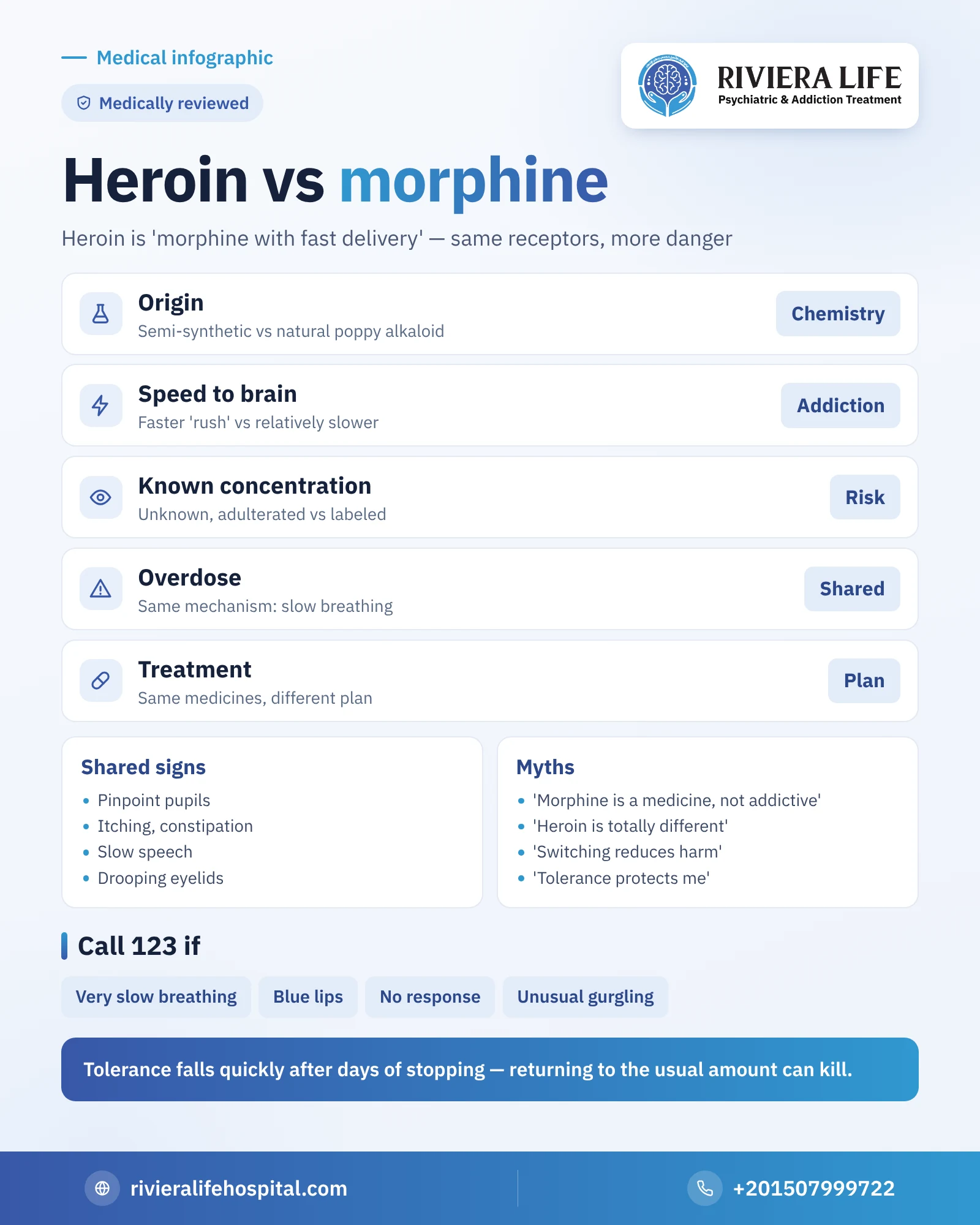
The difference between heroin and morphine is that the two are from one family, as heroin is made chemically from morphine, and turns back into morphine inside the body. But heroin reaches the brain faster and with greater force, and is sold on the black market with unknown concentration and often adulterated, while morphine is a regulated medicine with legitimate medical use under strict control. Both cause physical dependence and deadly overdose by the same mechanism: slowed breathing. This article explains where they meet and where they part, so the family understands what it is facing.
The difference between heroin and morphine in a table
| Comparison | Heroin | Morphine |
|---|---|---|
| Origin | A semi-synthetic derivative of morphine | A natural alkaloid from poppy latex |
| Medical status | Not used as an ordinary treatment in Egypt | A painkiller for severe pain under medical supervision |
| Speed of reaching the brain | Faster, so it gives a strong “rush” | Relatively slower |
| Strength by weight | Several times stronger approximately | The reference against which opioids are measured |
| Knowing the concentration | Unknown and variable from pack to pack | Specified and written on the medicine |
| Ways of obtaining it | Illicit trade | A controlled medical prescription |
| Overdose risk | Very high because of adulteration and varying purity | High with misuse or combining with sedatives |
The family relationship: how does one turn into the other?
Morphine is a substance that forms naturally in the latex of the poppy fruit, and it is one of the oldest and most important painkillers in medicine. Heroin (diacetylmorphine) results from a chemical modification of the morphine molecule, a modification that makes it more fat-soluble. We won’t explain any manufacturing details here; what matters is understanding the result: a molecule that crosses the blood–brain barrier very quickly.
As soon as it enters the brain, enzymes remove part of its structure, so it ends up as morphine binding to opioid receptors. In this sense it can be said that heroin is “morphine with fast delivery”, and this is the secret of the difference in both feeling and addiction. A wider introduction to each substance is on the heroin and morphine pages.
Why does heroin seem stronger? A question of speed
Addiction isn’t about the strength of the substance alone, but about the speed of its arrival at the reward centers. A substance that arrives in seconds leaves a stronger psychological effect than one that arrives in an hour, even if the final effect is similar. Heroin excels here, so the brain quickly links the act of use with the high, and urgent craving forms at a higher rate.
This doesn’t mean morphine is “safe”. Morphine taken by mouth on prescription may cause physical dependence within weeks of regular use, and changing the method or using it without a doctor brings it closer to heroin in danger. The article on the causes of morphine addiction shows how dependence starts after the prescription.
Medical use versus the black market
Morphine is given in hospitals for pain after major operations, cancer pain and some acute heart conditions, at doses the doctor calculates according to weight and condition and under breathing monitoring. In some countries the heroin derivative itself is used medically inside hospitals in narrow circumstances, but it isn’t a medicine available in Egyptian pharmacies.
Heroin circulating outside this framework, however, is a product whose composition no one knows. It may be purer than the body can bear, and it may be mixed with cheap substances or with much stronger opioids. This randomness is what makes overdose closer with heroin even for someone who “knows their body”. The drug overdose page explains the general signs.
The feeling and visible signs
The basic feeling is the same: numbing of pain, warmth, relaxation and drowsiness. The physical signs are also similar: narrow pupils, itching, constipation, slowness in movement and speech, and drooping eyelids. That is why home observation isn’t enough to tell the two substances apart, and the matter needs medical assessment and testing.
In behavior, however, the context differs more than the symptoms. Someone taking morphine after an injury or surgery usually behaves according to a known schedule, then danger signals appear when they ask for more than prescribed, move between doctors or hide the box. Someone using heroin hides it from the start, and the course of their day changes around getting it. The details of these signs are in heroin addiction symptoms and morphine addiction symptoms.
Overdose: a shared danger and a different cause
In both cases excess usually kills by slowing breathing until it stops. The difference is in the reasons for reaching this point. With heroin the most common reason is not knowing the concentration or adulteration, or returning after a break when the body has lost its tolerance. With pharmaceutical morphine, the risks appear when increasing the amount on one’s own, combining with sedatives or alcohol, or with weak kidneys that slow the elimination of the medicine.
Call an ambulance on 123 immediately if you see
These are signs of an overdose of any opioid substance, medical or not. Stay with the person and don't let them sleep.
- Very slow or irregular breathing or stopped breathing
- Lips or nails turning blue
- No response to calling or to gentle shaking
- Pinpoint pupils with severe lethargy
- Unusual gurgling or snoring
There is a specific emergency antidote for this condition, naloxone, given by paramedics or trained staff, and the person may need prolonged monitoring after it. Read naloxone to understand its role and limits.
Accumulated harms to the body and life
The physiological harms are close: chronic constipation, weak sexual desire and hormonal disturbance, disturbed sleep, breathing depression and declining immunity. But the life surrounding heroin adds other layers: infections transmitted by shared equipment if injected, abscesses, legal involvement and increasing spending. The details of the harms are in the articles on the harms of heroin and the harms of morphine.
Withdrawal: similar in picture, different in timing
The general picture is the same: yawning, tears and a runny nose, then bone and muscle pains, diarrhea, vomiting, insomnia and chills. Withdrawal starts within hours of the last dose in both cases, and may be slightly delayed and prolonged with long-acting morphine preparations, while with heroin it comes faster and more clearly. It usually isn’t life-threatening if dehydration is monitored, but psychological pain and urgent craving push many to go back. See heroin withdrawal symptoms and morphine withdrawal symptoms.
Treatment: the same medicines and a different plan
Approved medicines from a single class are used for opioid addiction, from which the doctor determines what suits the case, and they are always combined with psychological and behavioral therapy. The difference is in what surrounds the medicine. A heroin patient usually needs an assessment for infectious diseases and social support to rearrange their life. A pharmaceutical morphine patient needs a plan with the treating doctor for the original pain, because leaving the pain without alternative treatment exposes them to relapse. Heroin addiction treatment and morphine addiction treatment explain the stages in detail.
Common wrong ideas
- “Morphine is a medicine so it doesn’t addict”: a legitimate medicine also causes dependence if used without supervision or for a long time.
- “Heroin is a completely different substance”: it is modified morphine that arrives faster, and the receptors affected are the same.
- “I can switch from heroin to morphine to reduce harm”: this is replacing one substance with another that maintains dependence, and real therapeutic alternatives are determined by the doctor.
- “Tolerance protects me”: tolerance falls quickly after days of stopping, so returning at the usual amount becomes deadly.
When do you ask for help?
Ask for help if your relative has taken an opioid painkiller more than the prescription, looked for it outside the pharmacy, or signs of drowsiness and narrow pupils have appeared without reason, or their attempts to stop have repeatedly failed. At Riviera Life you will find a team of consultants in psychiatry and addiction treatment, round-the-clock medical supervision, complete confidentiality, and a free first consultation on +201507999722. The hospital is licensed by the Ministry of Health and located in Sheikh Zayed, Giza.
More from the heroin guide
- Heroin: the complete guide
- The difference between tramadol and morphine
- Types of opioid painkillers
- Opioid addiction treatment
Questions many people ask
Yes by weight, as it gives an effect several times stronger because it crosses to the brain faster, but inside the body it turns into morphine.
It may cause physical and psychological dependence if used for a long period or without the doctor's supervision. That is why it isn't increased or stopped except under the treating doctor's supervision.
Because its concentration is unknown and it may be mixed with other substances or stronger opioids, so the effect of the amount can't be predicted.
Yes, it is an antagonist to opioids in general and temporarily reverses slow breathing, but the ambulance remains necessary because its effect is shorter than some opioids.
The approved medicines are from the same class, but the plan differs: heroin usually needs an assessment for infections and social support, and pharmaceutical morphine needs an alternative plan to treat the original pain.